How to track your real wake-up time, and why it matters
The time you set and the time you got up are different numbers. How to read a wake-up chart, and what sleep regularity research says about the gap.
Visana Studios
6 min read
The time you set on your alarm and the time you actually got up are two different numbers. Only one of them records what happened.
The gap is the number to watch
Call the distance between the moment your alarm first rings and the moment you were really up the wake-time gap. Say the alarm rings at 07:00, you lie there for twenty minutes, and you finish getting up at 07:21. That morning's gap is 21 minutes. One figure like that tells you very little. A week of them starts to show how you really leave the bed.
A clock on the nightstand shows two things: the time you set and the time right now. Nothing in between gets recorded, so a bad week can pass for a normal one.
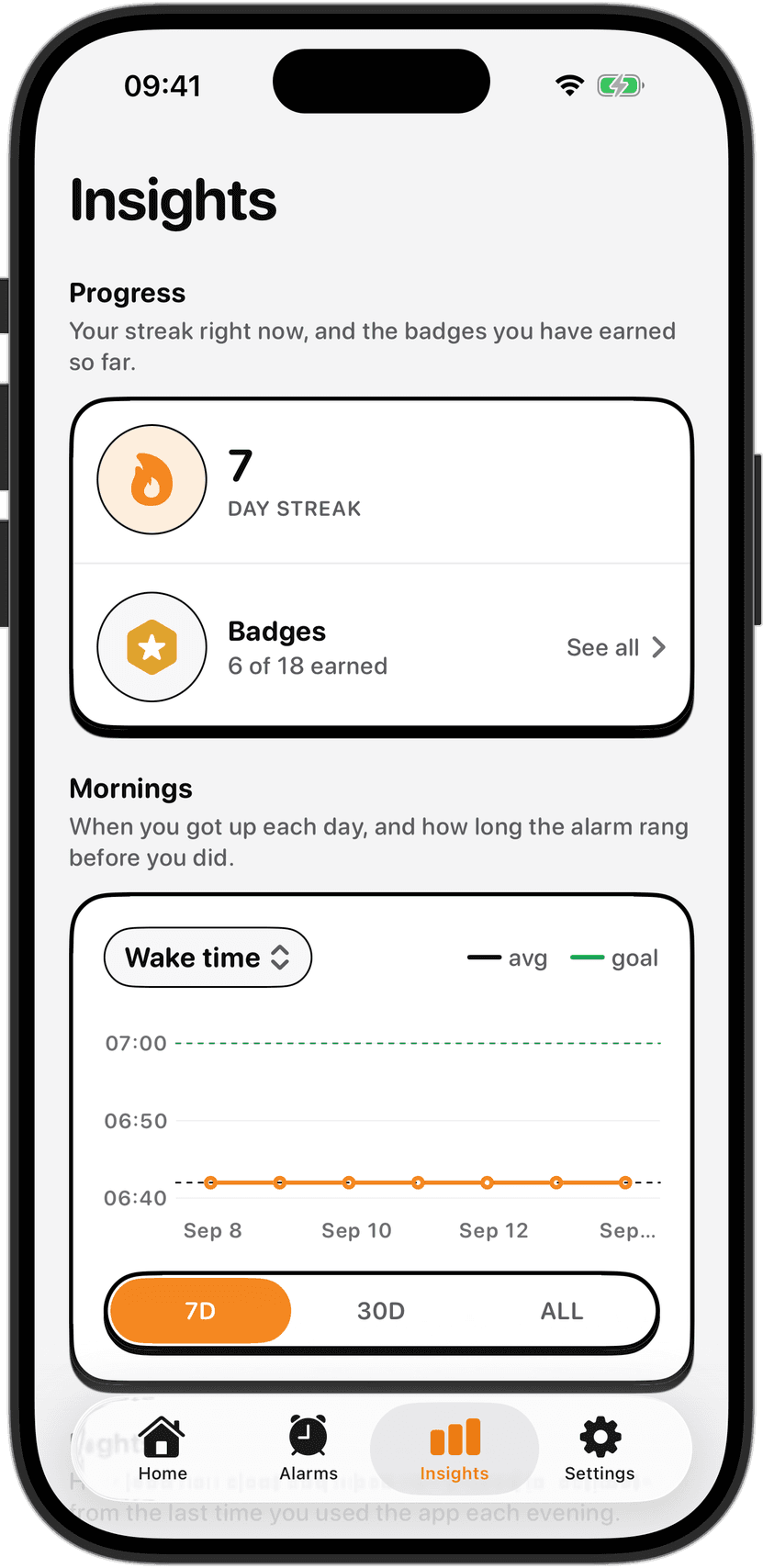
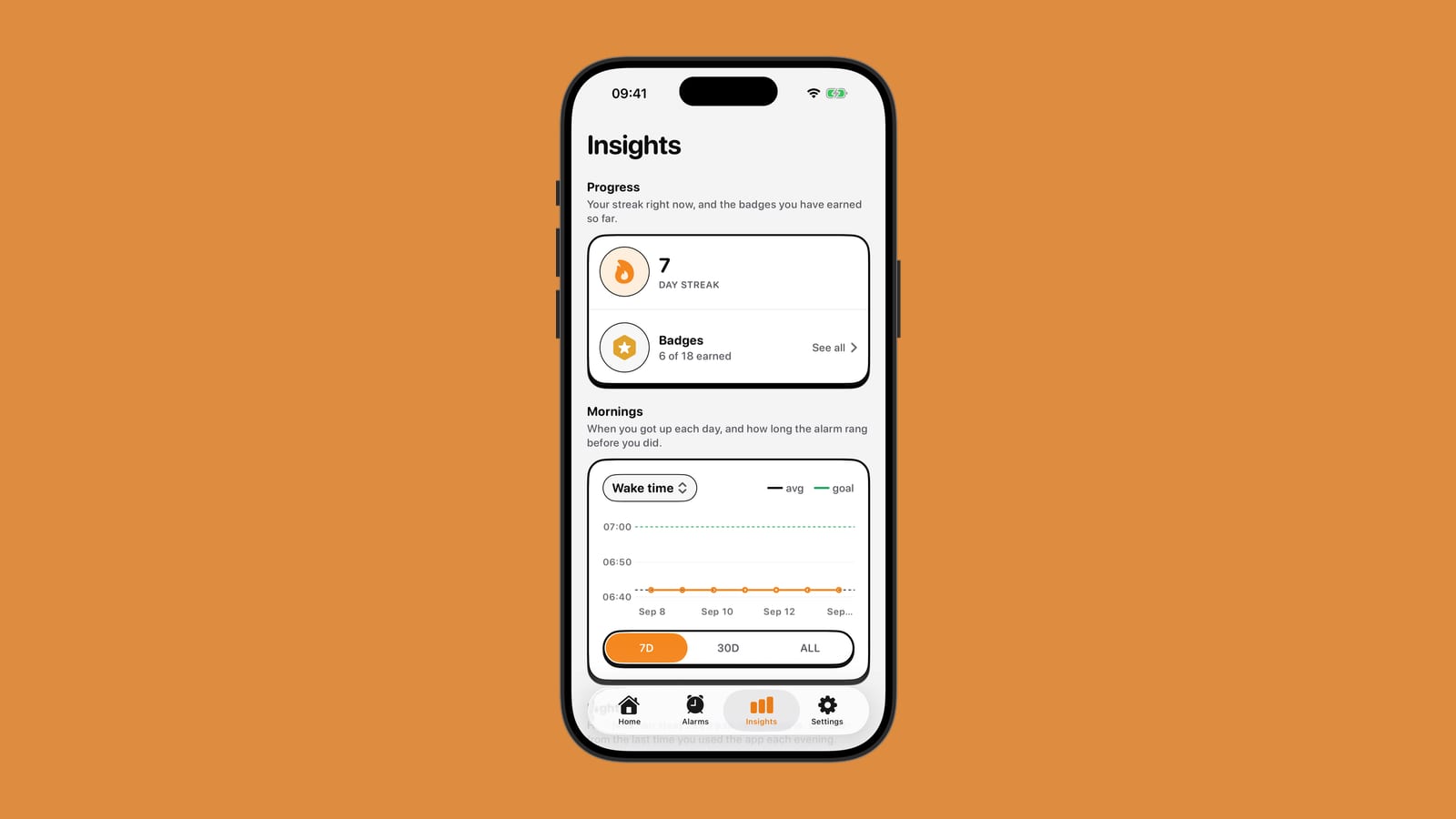
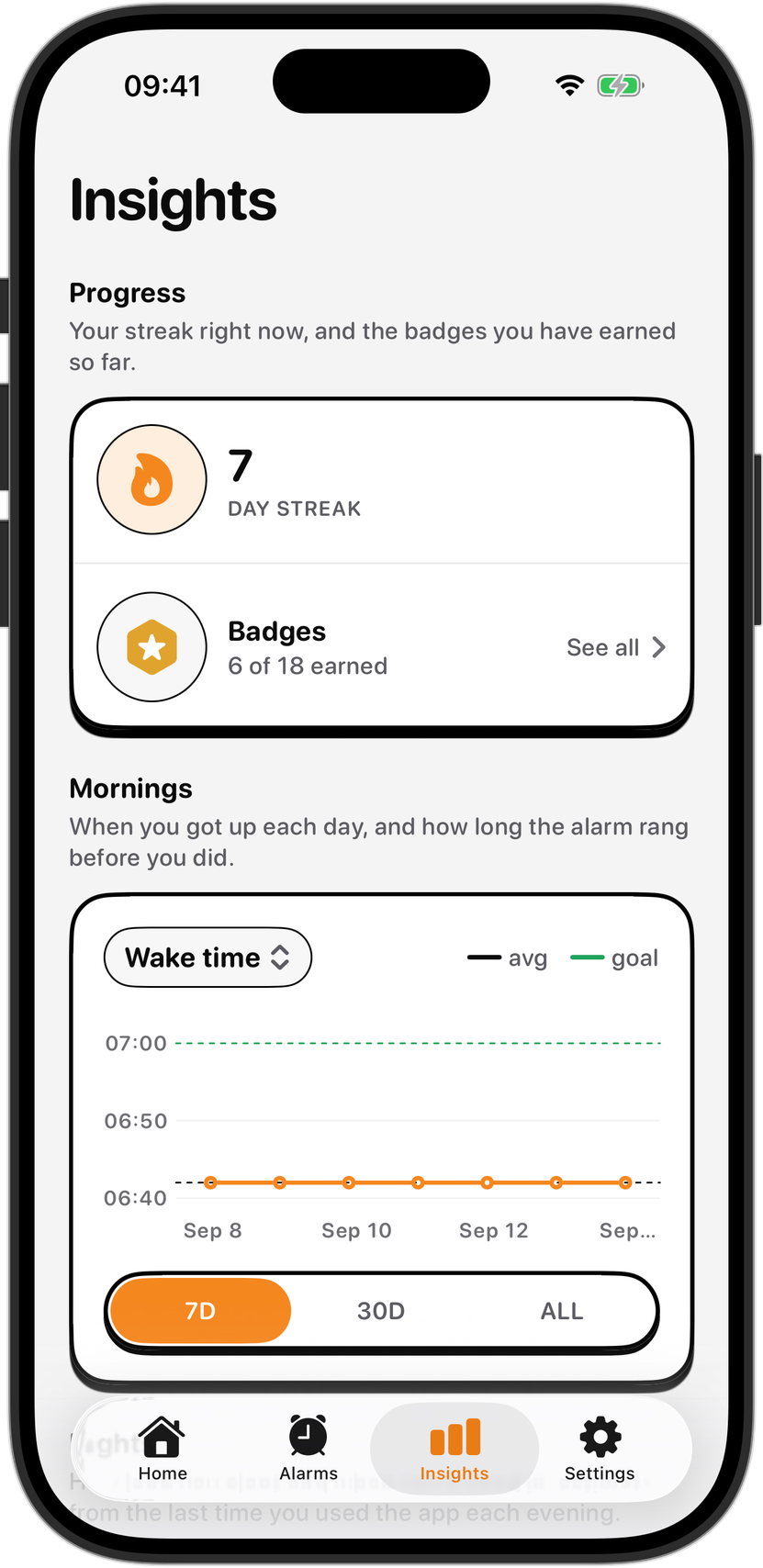
NoNap's Insights tab has a Mornings card built around this gap. Its description reads "When you got up each day, and how long the alarm rang before you did." The chart can be switched between 7 days, 30 days and all of your history. A green line marks your goal, a black line marks your average, and each orange point is one morning.
Why regularity matters more than one good morning
A single early start proves very little. What the research keeps measuring is regularity, meaning how similar your sleep and wake pattern is from one day to the next.
In 2024 the journal Sleep published a large study by Windred and colleagues. It used accelerometer data from about 61,000 adults in the UK Biobank, recorded for one week per person, and followed the group for a mean of 6.3 years. People with the most regular patterns had a lower risk of death from any cause than people with the least regular ones. In the minimally adjusted model the hazard ratio was 0.52, with a range of 0.45 to 0.60. After adjustment for more factors it was 0.70, with a range of 0.59 to 0.83. The authors called their findings correlational, and they noted that a single week of data is only a snapshot.
A smaller study from 2017 looked at the pattern from another angle. Phillips and colleagues followed 61 undergraduates for 30 days using sleep diaries. Students with more regular patterns tended to have better academic performance, with a correlation of r = 0.37. The irregular sleepers also had a later body clock, measured through the time their melatonin began to rise. That timing averaged 00:08 for the irregular group and 21:32 for the regular group, and each group varied by almost two hours. The authors' modelling suggested that much of the timing gap came from differences in light exposure. The study is small and correlational, so it cannot show that irregularity causes lower grades.
The clearest guidance comes from a 2023 consensus statement in Sleep Health, written by a panel convened by the National Sleep Foundation. It concluded that "consistent timing of bedtimes and wake times are associated with improved outcomes," and linked that consistency to alertness, cardiovascular and metabolic health, inflammation and mental health. The word to notice is "associated." The panel described links, not guaranteed results.
The same statement treats catch-up sleep more modestly than a lot of advice does. According to the Foundation's summary, an extra one to two hours on non-work days can help most people recover from sleep debt. That is a recovery tool, not a way to undo a month of mornings that swing by an hour. The catch-up sleep post goes further into that trade-off.
Reading the chart without fooling yourself
Start with a goal you can actually reach. A goal you miss every day trains you to ignore the chart. If your average sits 40 minutes behind the goal, the chart is telling you the goal is ahead of your life, not that you are lazy. The post on realistic wake times explains how to pick one.
Look at the spread of the points as well as the average. Tightly grouped points around a line show a steady pattern, even if that pattern is later than you would like. Scattered points mean your mornings are swinging from day to day, which is the kind of variability the regularity studies above link to worse outcomes. Those two situations need different fixes. A steady but late schedule can often be moved gradually. A scattered one usually needs a fixed time to get up before you adjust anything else.
Be careful with a single bad point. A 40-minute gap on a morning after a poor night is information about that night, not proof that the whole plan has failed. What matters is whether the bad mornings keep clustering, and the chart makes that visible over 30 days in a way memory does not.
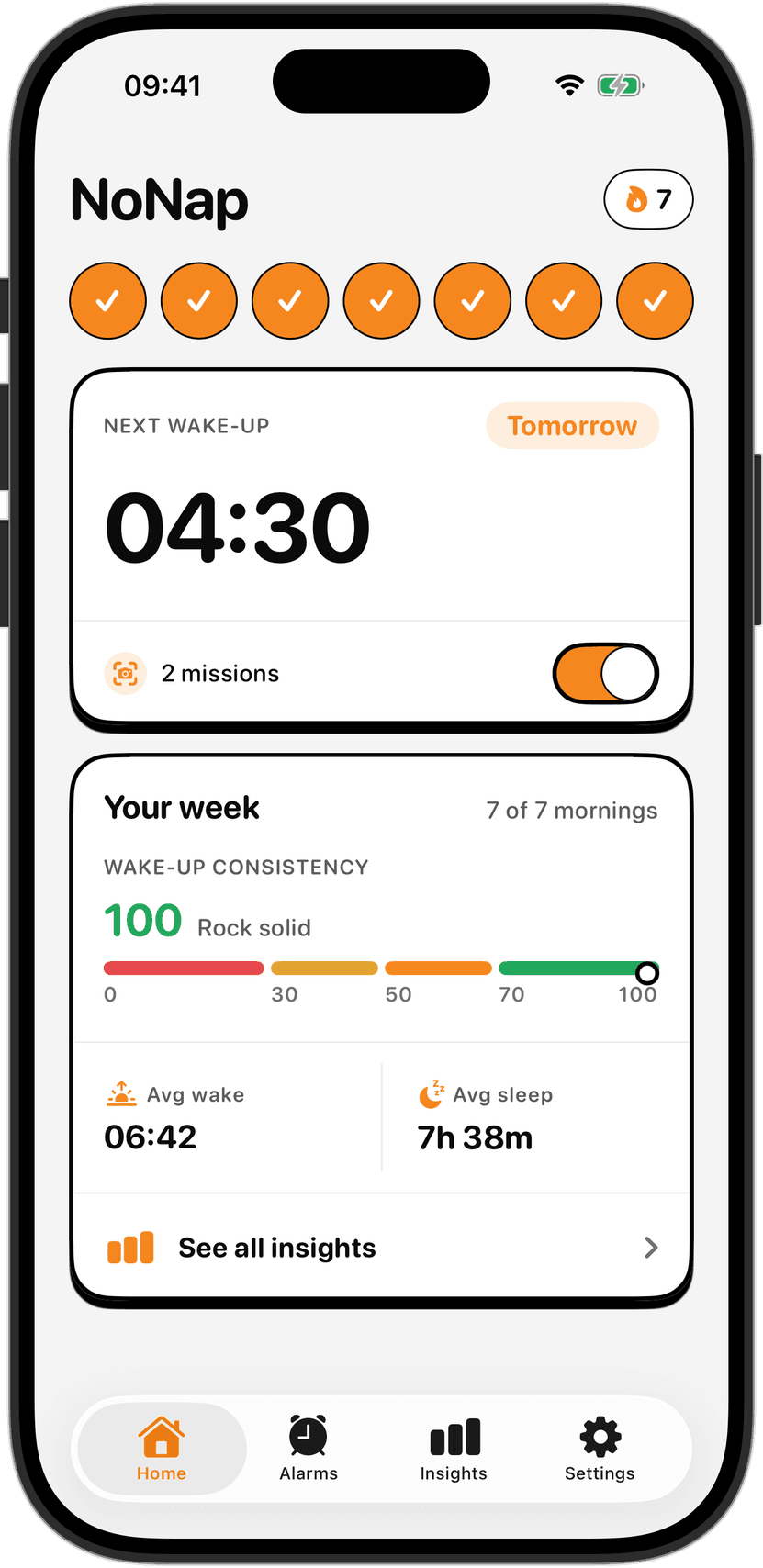
Read the streak next to the chart. The Insights tab also shows a day streak and badges. The streak tells you that you finished your wake task on consecutive mornings, so you got up. The chart tells you how far past the alarm you got up. Together they answer two separate questions: are you consistent, and how late are you running?
What the chart does not show
The Mornings card is about getting up. It does not explain why you woke late, how well you slept, or what happened the night before. If those things matter to you, they need their own record, and a tracker has its own limits. The sleep tracker accuracy post covers those.
Your history stays on your phone. NoNap keeps wake-up history on the device, and that is a privacy benefit with a clear cost. If the phone is lost, reset or broken, the streaks and history on it go with it, and nothing is stored anywhere else to get them back.
If you keep waking unrefreshed even with a steady schedule, or you notice loud snoring, pauses in breathing or daytime sleepiness, see a doctor. A chart of wake times can show a pattern, but it cannot tell a schedule problem apart from a medical one. The sleep apnea warning signs post lists what to look out for.
Sources
Windred DP, Burns AC, Lane JM, Saxena R, Rutter MK, Cain SW, Phillips AJK. Sleep regularity is a stronger predictor of mortality risk than sleep duration: A prospective cohort study. Sleep. 2024;47(1):zsad253. https://doi.org/10.1093/sleep/zsad253. Source for the UK Biobank cohort of about 61,000 adults, one week of accelerometer recording, mean follow-up of 6.30 years, and the hazard ratios of 0.52 (0.45 to 0.60) minimally adjusted and 0.70 (0.59 to 0.83) fully adjusted, along with the authors' note on correlational findings and single-week snapshots.
Phillips AJK, Clerx WM, O'Brien CS, Sano A, Barger LK, Picard RW, Lockley SW, Klerman EB, Czeisler CA. Irregular sleep/wake patterns are associated with poorer academic performance and delayed circadian and sleep/wake timing. Scientific Reports. 2017;7:3216. https://doi.org/10.1038/s41598-017-03171-4. Source for the 61 undergraduates studied over 30 days with sleep diaries, the correlation of r = 0.37 between regularity and academic performance, the dim-light melatonin onset times of 00:08 and 21:32, and the modelling that linked the timing gap to light exposure.
Sletten TL, Weaver MD, Foster RG, Gozal D, Klerman EB, Rajaratnam SMW, Roenneberg T, Takahashi JS, Turek FW, Vitiello MV, Young MW, Czeisler CA. The importance of sleep regularity: a consensus statement of the National Sleep Foundation sleep timing and variability panel. Sleep Health. 2023;9(6):801-820. https://doi.org/10.1016/j.sleh.2023.07.016. Source for the statement that consistent timing of bedtimes and wake times is associated with improved outcomes.
National Sleep Foundation. Sleep schedules and sleep timing guideline, press release, 6 September 2023. https://www.thensf.org/sleep-schedules-sleep-timing-guideline/. Source for the summary of catch-up sleep of one to two extra hours on non-work days and for the list of outcome areas.