Why Do I Get Sleepy After Lunch? What Studies Show
The afternoon slump has a body clock component that a heavy lunch can make worse. Here is what the sleep research found in trials and models, and what helps.
Visana Studios
5 min read
The afternoon slump feels like a lunch problem, and sometimes it is. But the research points to something that happens with or without a meal. Timothy Monk, reviewing the evidence in 2005, described a dip in performance in the middle of the afternoon that can appear even when a person has not eaten lunch and has no idea what time it is.
Two drives that add up to sleepiness
How sleepy you feel at any moment depends on two separate things. The first is sleep pressure, the build-up that grows the longer you stay awake and gets cleared during sleep. The second is the circadian clock, the internal timer that raises and lowers your readiness to sleep across the day, whatever happened the night before.
Dijk and Czeisler (1995) set out to pull these two apart. They kept eight men in an environment free of time cues, on a 28-hour schedule, so that their sleep fell at every phase of the body clock. Their analysis found that the circadian and sleep-dependent parts of sleep propensity interact in a non-additive way. In other words, the two do not simply stack.
A 2009 model by Frederik Bes, Marc Jobert and Hartmut Schulz takes a more explicit route. It multiplies a homeostatic drive, which tracks sleep pressure, by a circadian drive, and the product reproduces the known daily pattern of sleepiness. The curve has a peak during the night, a low around 8 a.m., a second low around 8 p.m., and a secondary peak close to 2 p.m. The authors attribute that afternoon bump to the circadian side, because their model contains no meals at all.
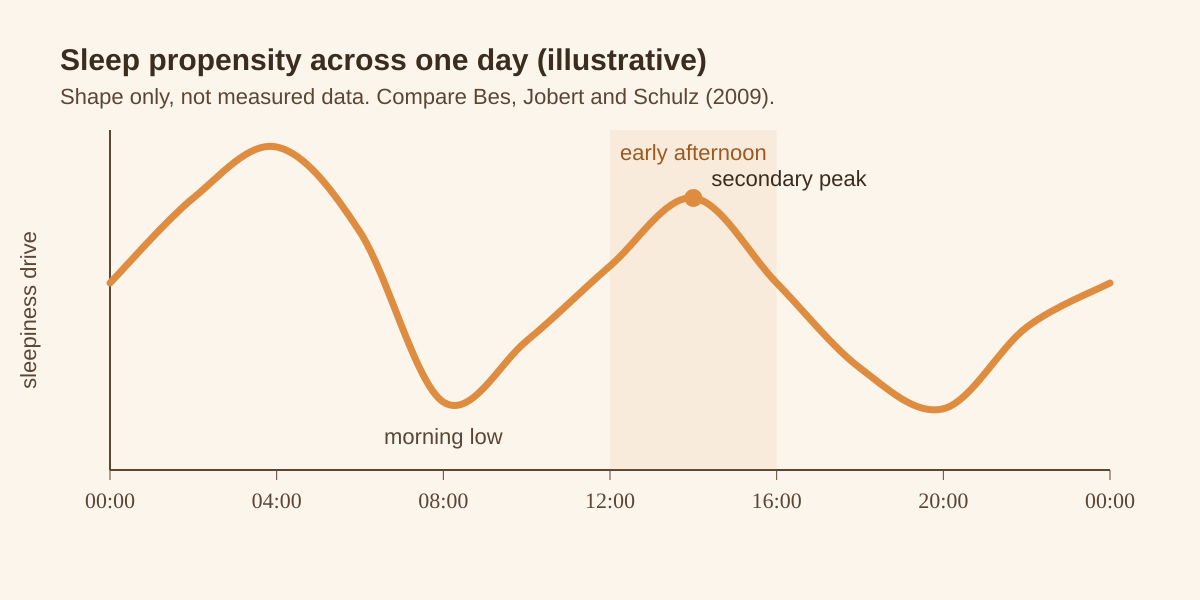
Two caveats matter here. The model's values are relative rather than absolute, and the paper does not say how much of the afternoon bump comes from each drive. The diagram shows the shape the authors describe, not a measurement from anyone's body.
Where a heavy lunch fits in
Monk's review says the dip is real, linked to the size of a 12-hour component in the circadian system, and "certainly exacerbated by a high-carbohydrate lunch." Lunch, in other words, does not create the dip. It can deepen one that was already coming.
The clearest test of that came from Reyner and colleagues (2012). Twelve young men had their previous night's sleep restricted to five hours. In a counterbalanced, double-blind design, each one ate either a light lunch of 305 calories or a heavy lunch of 922 calories, then completed a two-hour monotonous afternoon drive in a driving simulator. The heavy lunch had three times the fat and twice the carbohydrate of the light one.
After the heavy lunch, the drivers drifted out of their lane more often, their brain activity showed more of the EEG pattern linked to sleepiness, and they reported a trend toward feeling sleepier. Both lunches showed sleepiness getting worse over the drive. The two conditions did not differ for the first 30 minutes, and the gap opened up after that. The authors concluded that the dip is largely unrelated to lunch, and that a disturbed night makes it worse.
That study is small, and it used young men only. Because the heavy lunch differed from the light one in fat and carbohydrate as well as in size, it cannot tell you which of those mattered most. What it does show is that, on a short night, the bigger lunch was enough to increase lane drifting in the simulator. That is a fair reason to be careful behind a wheel after a heavy meal and little sleep.
Why some afternoons hit harder
The dip is not the same for everyone. Monk says it may be more likely in people at the extreme morning end of the chronotype range, the early risers who go to bed and wake early. Bes and colleagues reached the same expectation from their model, since in morning types the sleep period sits earlier, which changes the balance of the two drives. The model's authors say one study partly supports that prediction, which is weaker than a firm result.
Sleep loss is the other big variable. In the Reyner study, the five-hour night was the setup that made the afternoon measurably worse. Most people do not cut their sleep to five hours on purpose, so the practical question is how much a short night costs on an ordinary weekday, and that is something a single study cannot answer.
What tends to help
If the slump is mostly circadian, a smaller lunch is the lower-risk move, because the study that tested lunch size found the heavy meal made sleepiness worse and not better. A lighter midday meal is a sensible default, though it is not a proven cure, and the evidence on exact composition is thin.
Morning light is the other lever people usually pull on the body clock. The morning light and body clock post walks through what the research says about exposure and timing.
Naps are the usual response to an afternoon slump. Whether one helps depends on its length and timing, and the how long to nap post covers the research on both. If you are sleepy every afternoon even after a full night, or you fall asleep in situations where you should not, talk to a doctor. Persistent daytime sleepiness can have causes that no lunch change will fix, and the excessive daytime sleepiness post explains the warning signs to look for.
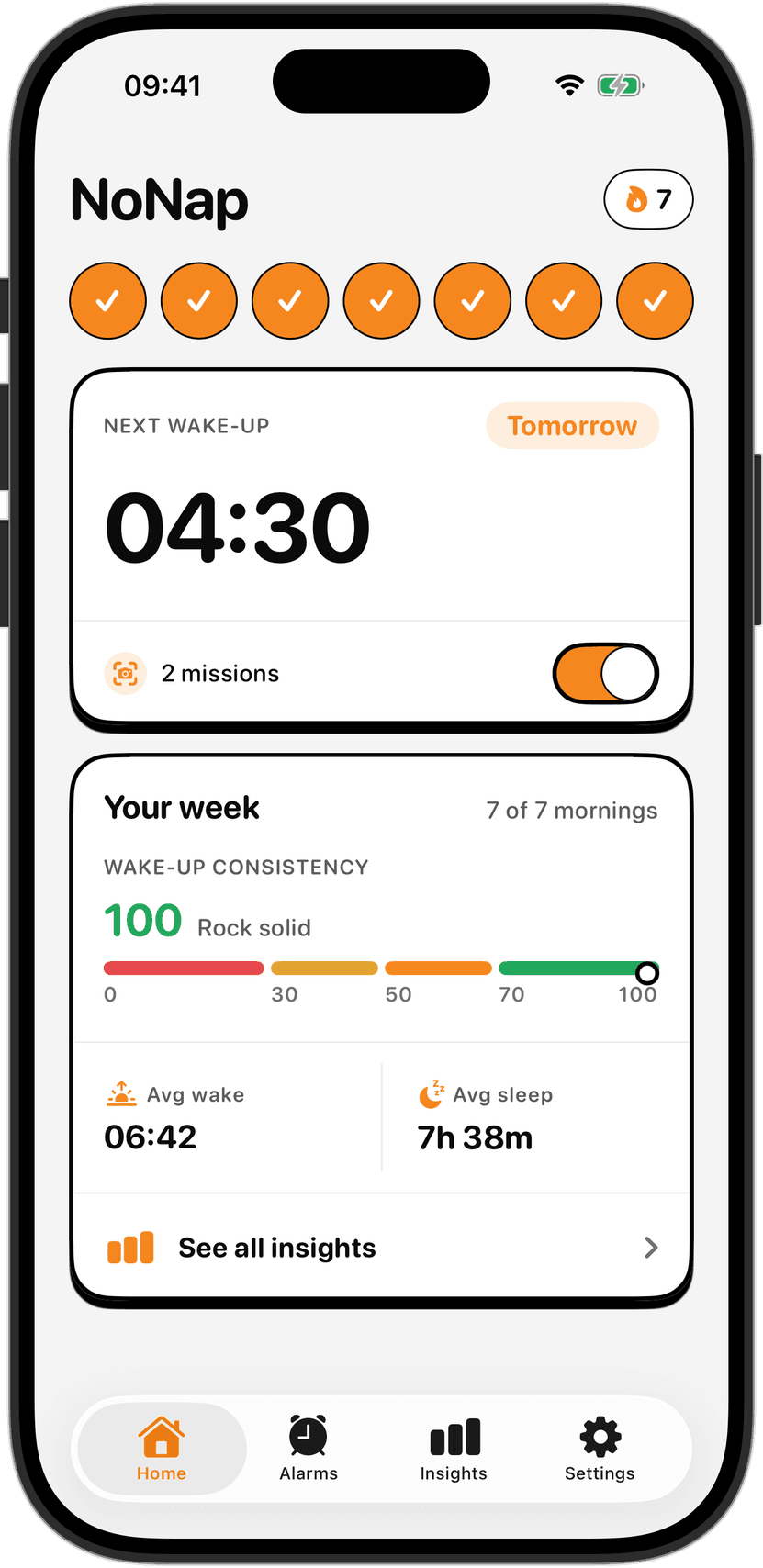
NoNap is an alarm for the morning. It does not track sleep or energy, so it cannot tell you whether your afternoon slump came from lunch or from a short night. What it does is hold the wake time you set, with one alarm and a wake task you have to finish before it stops. The full list of features is on the home page.
Sources
Monk, T. H. (2005). The post-lunch dip in performance. Clinics in Sports Medicine. doi:10.1016/j.csm.2004.12.002
Reyner, L. A., Wells, S. J., Mortlock, V., and Horne, J. A. (2012). 'Post-lunch' sleepiness during prolonged, monotonous driving: effects of meal size. Physiology & Behavior. doi:10.1016/j.physbeh.2011.11.025. PubMed 22155490.
Bes, F., Jobert, M., and Schulz, H. (2009). Modeling napping, post-lunch dip, and other variations in human sleep propensity. Sleep, 32(3), 392 to 398. doi:10.1093/sleep/32.3.392
Dijk, D.-J., and Czeisler, C. A. (1995). Contribution of the circadian pacemaker and the sleep homeostat to sleep propensity, sleep structure, electroencephalographic slow waves, and sleep spindle activity in humans. Journal of Neuroscience, 15(5), 3526 to 3538. doi:10.1523/jneurosci.15-05-03526.1995
Image credits
The cover uses two of NoNap's own app screenshots, 15-home-next-wake-up and 17-insights-dashboard. The diagram was made for this post and is labelled as illustrative.