Does traffic noise wake you up? The WHO night limits
Night traffic noise is linked to more awakenings and sleep disturbance. Here is what the WHO's 40 to 45 decibel night limits mean and how solid the evidence is.
Visana Studios
4 min read
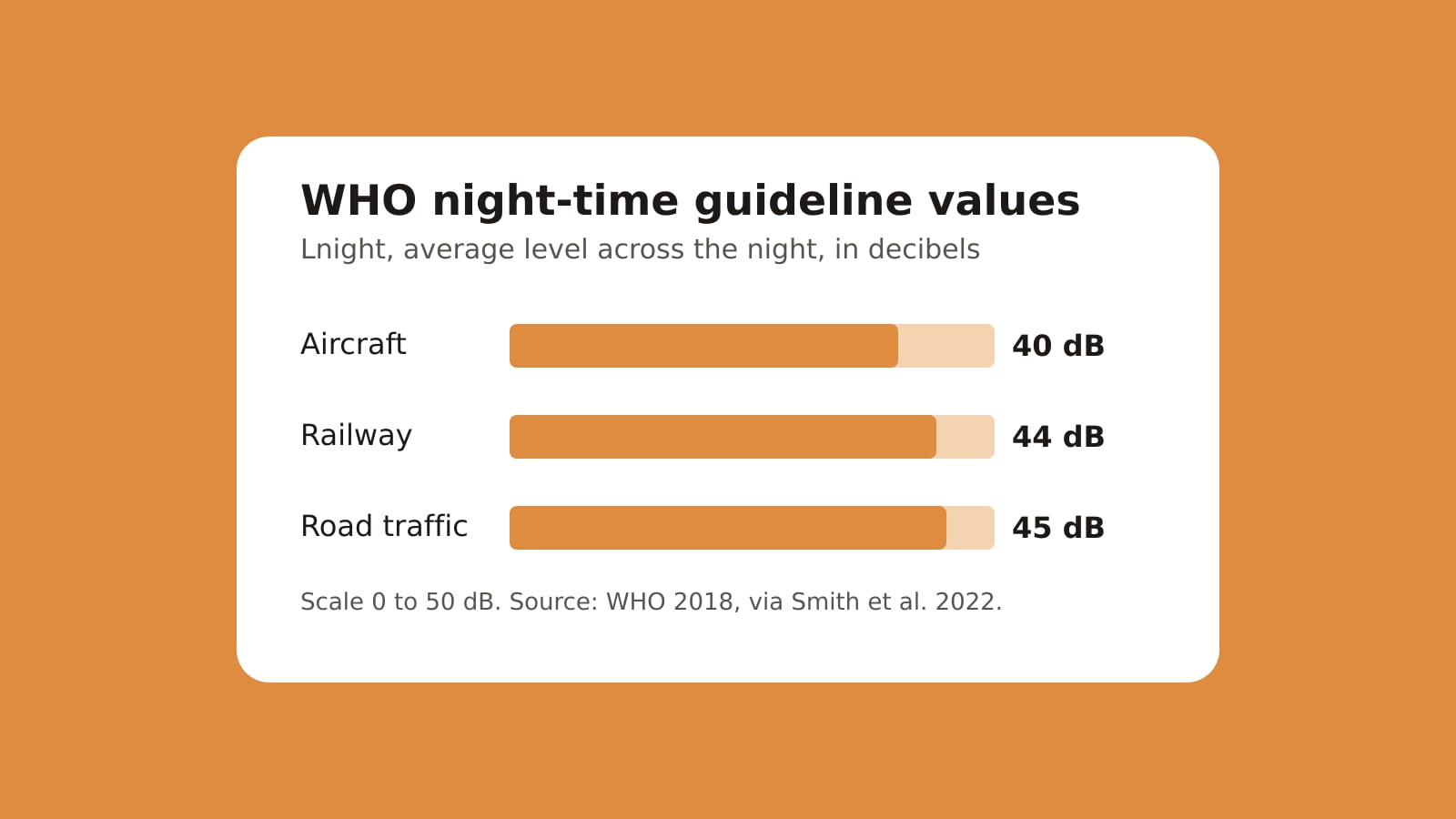
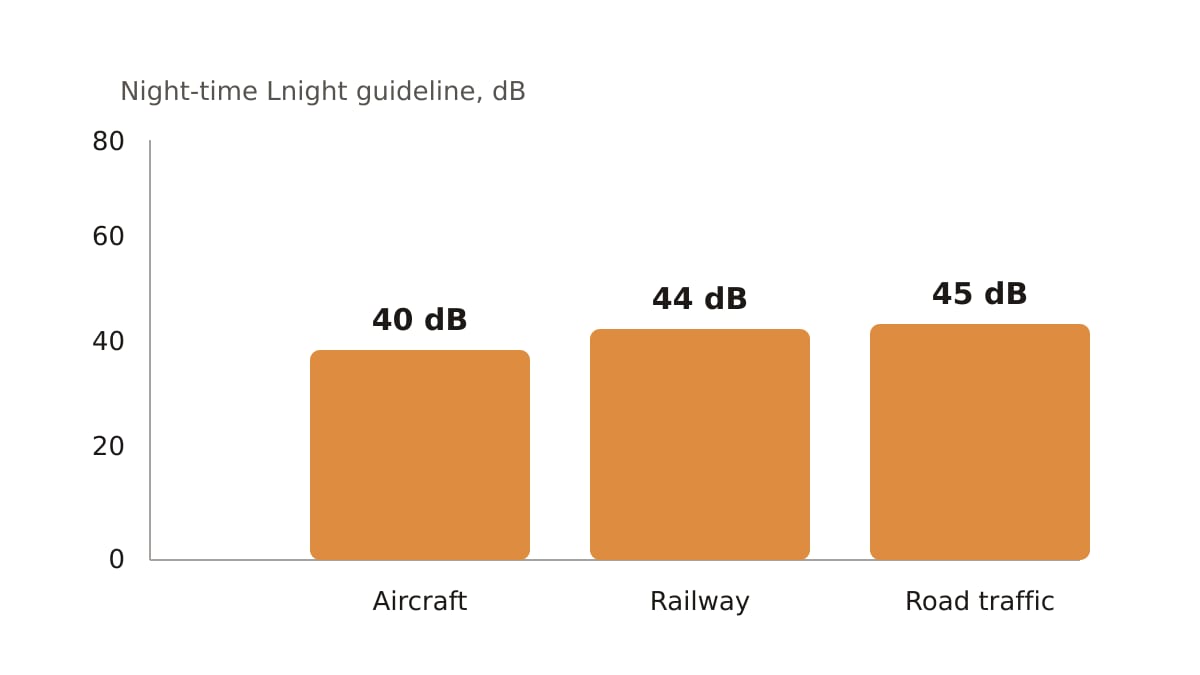
The World Health Organization sets its night-time noise guidelines as an average level across the whole night, written Lnight. For road traffic the value is 45 decibels, for railways 44 and for aircraft 40 (Smith, Cordoza and Basner, 2022). These are reference points for planning and policy. They are not a line below which sleep is unaffected.
The values come from the WHO's 2018 Environmental Noise Guidelines for the European Region, which drew on seven systematic reviews of studies published between 2000 and 2014 (van Kamp et al., 2020). Newer studies have appeared since. A 2022 update adds 11 studies with 109,070 survey responses to the 25 original studies, which covered 64,090 responses. Its authors found that results around 40 decibels still matched the earlier review, so they saw no need to revisit the night limits. High-level aircraft noise is the exception. The newer estimates there ran higher, and the authors say such noise appears to carry more risk than earlier estimates suggested.
What the odds ratios measure
Smith and colleagues report odds ratios for each 10 decibel rise in night-time noise, across levels of 40 to 65 decibels. An odds ratio of 1 means no change. When the survey questions mentioned noise, the odds of an awakening from road traffic were 1.75 times higher for each 10 decibel rise (95% confidence interval 1.24 to 2.47). The aircraft figure was 2.34 (1.87 to 2.93), and the railway figure was 2.54 (1.49 to 4.33).
These numbers are easy to misread. A factor of 1.75 does not mean three in four nights end in an awakening. It describes how the odds shift, and the real chance of waking depends on where you start. A bedroom that is already quiet has a low baseline, so the same factor moves the absolute risk much less than it would on a busy road.
The gap between the two sets of numbers matters more than any single one. When the questions did not mention noise, the road traffic awakening figure dropped to 1.10 (1.01 to 1.20). The aircraft and railway figures fell to 1.11 (0.81 to 1.53) and 1.09 (0.78 to 1.53), with intervals that include 1. A question about traffic may draw attention to traffic, and people who notice a noise may also report waking because of it. That is plausible, though the review's figures cannot prove it.
Where the evidence is weaker
Smith and colleagues graded the quality of their evidence. For questions that mentioned noise, they rated it moderate. When noise was not mentioned, the grades fell to low for aircraft and road traffic, and very low for rail. The studies also disagree a lot. Heterogeneity, a measure of how much results vary between studies, was at least 75% in every noise-mentioned analysis. Ten of the 15 road traffic studies were rated as having a high risk of bias in how exposure was assessed, so the noise a person actually heard was not always measured accurately.
The earlier WHO review reached a similar picture. Van Kamp and colleagues report that the WHO rated road traffic noise linked to cortical awakenings, which are detected on brain recordings, and to self-reported sleep disturbance as moderate quality. Every other pairing of noise source and sleep outcome was rated very low. Road traffic is therefore the best-supported link, while the aircraft and rail evidence is thinner.
An average is also a blunt tool. One loud lorry or motorbike can wake someone at a level that barely moves the night's average, which is one reason a single number cannot describe every bedroom. Even so, the stakes are not small. A 2011 WHO estimate, cited by Smith and colleagues, put the loss from noise-induced sleep disturbance at 903,000 disability-adjusted life years a year in Western Europe.
What helps in a noisy bedroom
These studies measure how noise relates to sleep. They do not test individual fixes, so the steps below are sensible options rather than proven treatments. The simplest is to sleep in a room on the quiet side of the building. Keeping a window that faces a main road closed helps, and a window seal or secondary glazing may cut down what gets in. Earplugs are cheap to try, but test them on a night when you do not need to be up early, since comfort varies a lot.
Some people find a fan or a steady sound masks passing traffic. The evidence for that is covered in our white noise post.
NoNap cannot quieten the street. What it does is ring through silent mode and Focus settings, because it uses the system alarm, so the mute switch has no effect on it, and Sleep Focus and Do Not Disturb do not mute it. The silent mode post covers how that works.
Sources
Smith, M. G., Cordoza, M., and Basner, M. (2022). Environmental noise and effects on sleep: an update to the WHO systematic review and meta-analysis. Environmental Health Perspectives, 130(7), 076001. https://doi.org/10.1289/EHP10197
van Kamp, I., Simon, S., Notley, H., Baliatsas, C., and van Kempen, E. (2020). Evidence relating to environmental noise exposure and annoyance, sleep disturbance, cardio-vascular and metabolic health outcomes in the context of IGCB(N): a scoping review of new evidence. International Journal of Environmental Research and Public Health, 17(9), 3016. https://doi.org/10.3390/ijerph17093016
World Health Organization Regional Office for Europe (2018). Environmental noise guidelines for the European Region. ISBN 978-92-8-905356-3. https://www.who.int/publications/i/item/9789289053563