Night owl or early bird: what your chronotype actually is
What chronotype means, how researchers measure it with a questionnaire and genetics, and why a late riser isn't lazy, just wired later.
Visana Studios
8 min read
Left alone on a beach with no clock, no phone and no job to get to, one person will be up at first light and restless by 7am. Another will still be asleep, and won't feel entirely human until well past 10. Give them a week of that freedom and the pattern holds. Researchers have spent more than two decades trying to put a number on the gap between those two people, and the number turns out to be strikingly consistent for any one person, even though the two of them will never agree on what time a day should start.
What chronotype actually measures
Chronotype is the timing preference built into your internal clock: when your body wants to sleep and wake if nothing external is forcing a different schedule. It isn't the same as being a morning person by disposition, or a night person by habit picked up in college. Everyone runs on a roughly 24 hour circadian rhythm, generated by a cluster of neurons behind the eyes, but the exact phase of that rhythm, whether your body reads 7am as morning or the middle of the night, differs from one person to the next. Sleep scientists tend to describe it as a spectrum rather than two tribes. Most people cluster near the middle. Smaller groups stretch out toward the extremes, early or late.
The questionnaire that turns a preference into a number
For most of the twentieth century, chronotype was measured with self-report scales asking people to rate their own alertness at different hours. In the early 2000s, Till Roenneberg and Martha Merrow at LMU Munich took a more direct route. Their Munich ChronoType Questionnaire, published with Anna Wirz-Justice in 2003 in the Journal of Biological Rhythms based on a pilot study of 500 people, asks what time someone actually fell asleep and woke up on free days, the days with no alarm and no job pulling them out of bed. From those two numbers it calculates the midpoint of sleep on free days, a figure researchers call MSF. Because most people carry sleep debt through the workweek and pay it back by sleeping in on weekends, that raw midpoint runs later than a person's true baseline, so the questionnaire corrects for the extra sleep, producing MSFsc. Someone whose corrected midpoint lands near 2am or 3am counts as a late chronotype. Someone near midnight sits in the middle, and someone before 11pm leans early. In large MCTQ datasets, the gap between the earliest and latest people commonly runs past 6 hours, wider than the difference between neighboring time zones. That same mismatch between the work week and free days is what researchers now call social jetlag, and it hits late chronotypes hardest of all.
What twin and gene studies found
Sleep timing running in families is an old observation. Twin studies gave it a number. So did later genetics. In 2007, Markku Koskenvuo and colleagues published an analysis of 8,753 adult twin pairs from the Finnish Twin Cohort in the Journal of Sleep Research and estimated that genetics accounts for 49.7 percent of the variation in diurnal type between people, with the rest split among environment and factors twins don't share even when raised together. That's a large share for a trait many people still treat as a habit to break through effort.
The genome backs this up in more granular detail. In 2019, Samuel Jones and a large international team published a genome-wide association study in Nature Communications built on 697,828 people, combining UK Biobank with genetic data from the company 23andMe. They identified 351 separate regions of the genome linked to whether someone reports being a morning or an evening person, most never flagged before. The effect size at the individual level is modest: among a subset whose sleep was tracked with wrist actigraphy rather than self-report, the 5 percent of people carrying the most morningness-linked gene variants had their sleep timing running only about 25 minutes earlier on average than the 5 percent carrying the fewest. Using a technique called Mendelian randomization, which treats genetic variants as a kind of natural experiment, the same team found evidence that a later chronotype has a causal link to greater risk of schizophrenia and to worse general wellbeing. A weaker link to depression showed up too, but didn't clear the study's own statistical bar. None of this predicts anything about one specific night owl's mental health. Signals built from hundreds of thousands of genomes describe population tendencies, not individual futures. What they do settle is the underlying question. A late chronotype has real, measurable roots in DNA. It is not a scheduling choice made badly.
Why your body clock moves as you get older
Chronotype is not fixed for life. Small children skew early, as any parent awake at 6:15 on a Saturday already knows firsthand. Puberty pushes the clock dramatically later, a shift covered in more depth in our piece on resetting a teenager's sleep schedule, and that lateness peaks around age 20. Roenneberg and colleagues, analyzing an internet survey of roughly 25,000 people mostly from German-speaking countries in a short 2004 paper in Current Biology, found chronotype drifting steadily later through the teenage years and topping out around 19 to 21, with women reaching their latest point slightly earlier than men before both swing back toward morningness for the rest of adulthood. A much larger US study, published by Dorothee Fischer and colleagues in PLOS ONE in 2017 using diary data from 53,689 people, found nearly the same curve: chronotype peaking in lateness around 18 for women and 19 for men, then drifting earlier decade after decade. That study also found a sex difference that flips partway through life. Women run earlier than men through their 20s and 30s, and the pattern reverses close to age 40, after which men trend earlier for the rest of adulthood. By the 60s and 70s, chronotype has usually swung back well toward the early end of the spectrum, part of why older adults so often wake before dawn without trying or wanting to.
When lateness crosses into a diagnosis
A late chronotype on its own isn't a medical problem. Most night owls never need treatment for one. The American Academy of Sleep Medicine draws the line at delayed sleep-wake phase disorder: a sleep pattern shifted two or more hours past what's typical, present for at least a week straight, that causes real trouble falling asleep at a workable bedtime or waking for school and work. The AASM estimates it affects 7 to 16 percent of teenagers and young adults, and about 40 percent of people with the disorder have a family member with the same pattern, matching the genetic research above. Left alone on a schedule of their own choosing, they sleep a normal length and quality. The problem is purely timing. If your bedtime refuses to move even when a lot depends on it, and mornings are wrecking your work, school or relationships month after month, that's worth raising with a doctor rather than pushing through it alone. A sleep diary kept for a couple of weeks beforehand, noting bedtime, time to fall asleep and wake time, makes that appointment far more useful.
Working with the clock you actually have
None of this argues for giving up on an earlier schedule if your life genuinely needs one. It argues for expecting real effort if your chronotype runs late, the same effort anyone would expect from working against their own biology rather than with it. Morning light exposure, a wake time that barely moves between weekdays and weekends, the same fix that works for teenagers fighting a delayed clock of their own, and patience measured in weeks rather than days are what actually shift a chronotype. A gradual approach, moving bedtime by 15 minutes every few days, has a real shot at working. Treating the whole thing as a discipline problem to be solved with one brutal Monday morning does not.
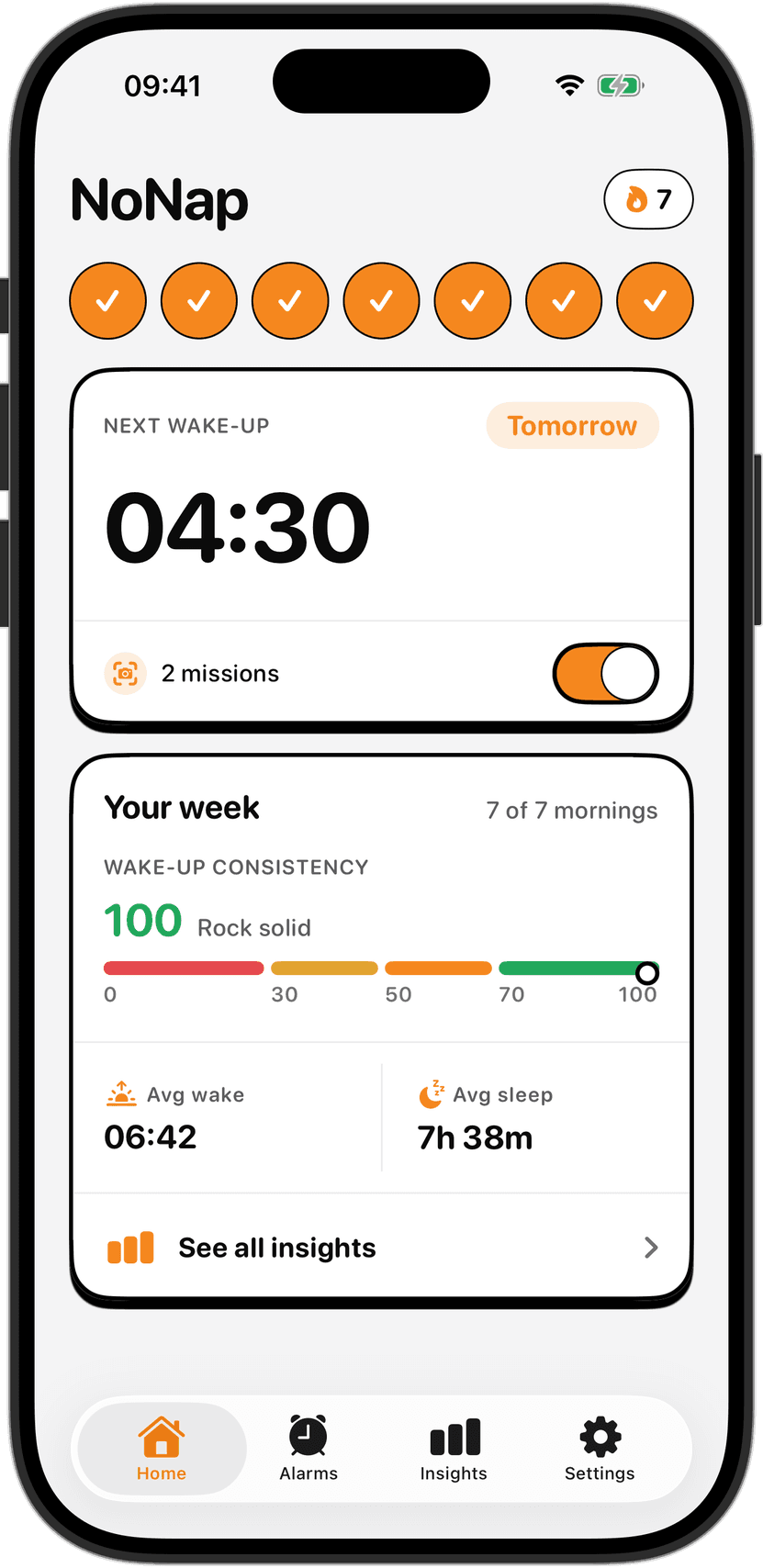
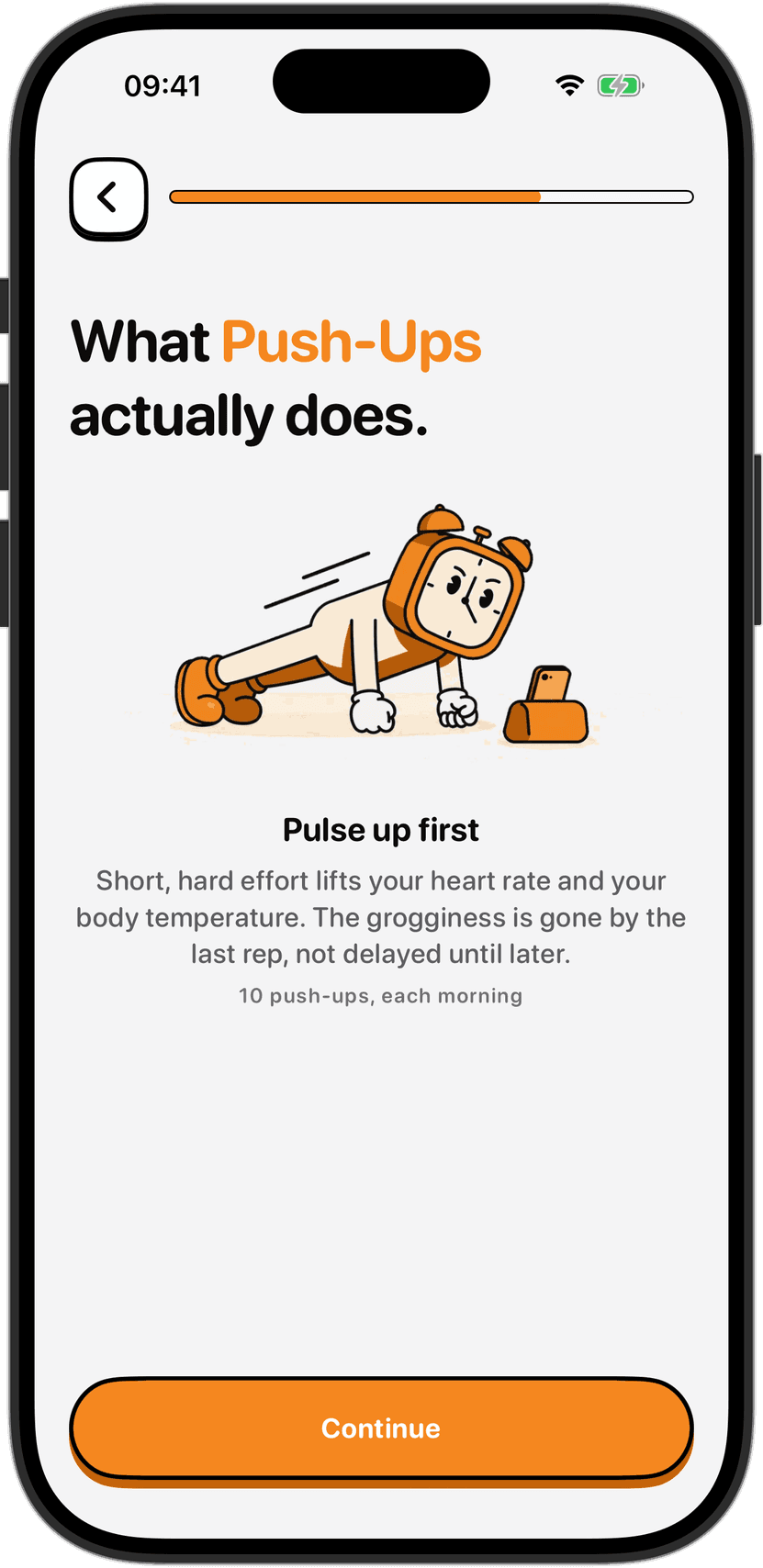
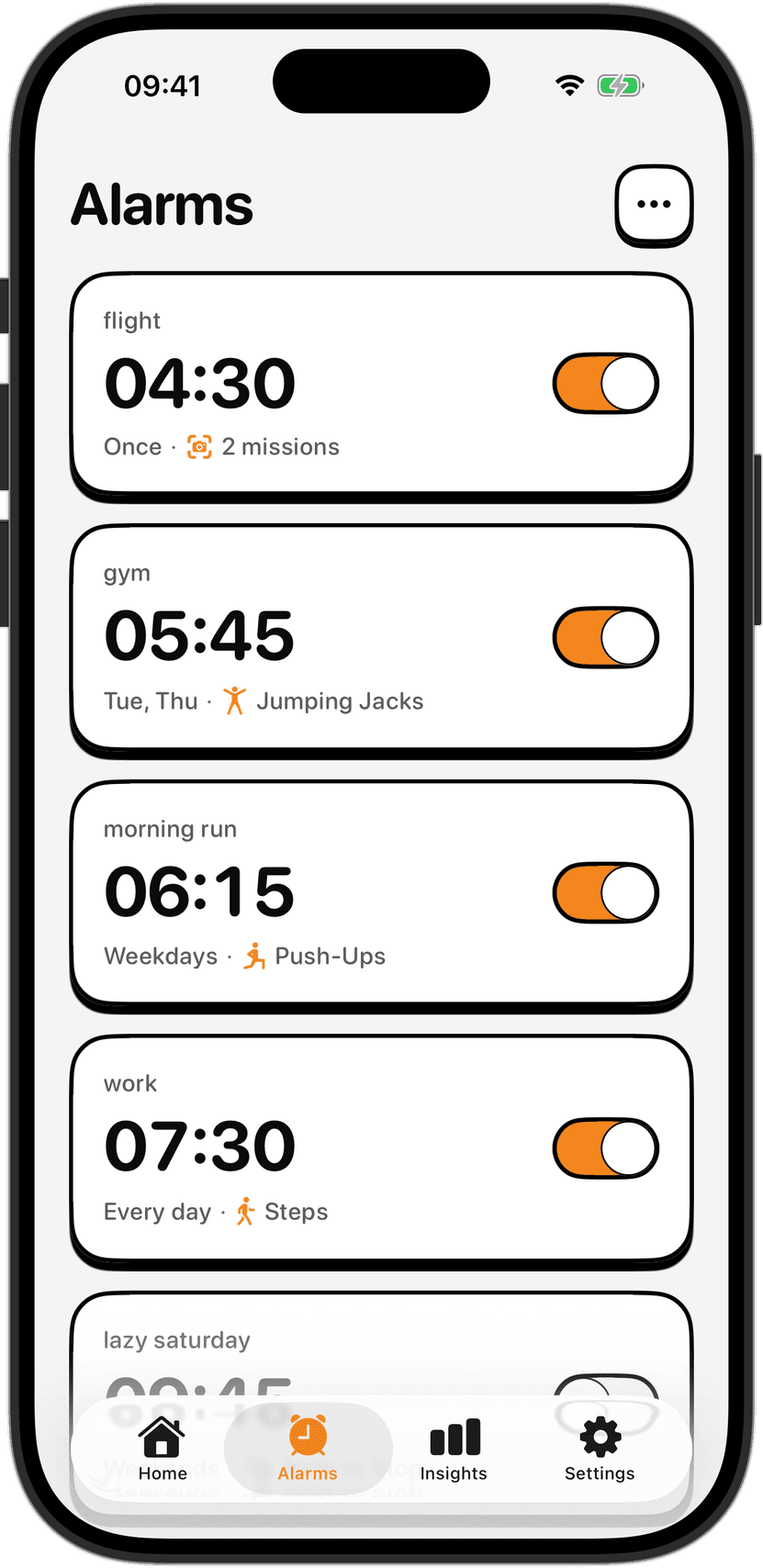
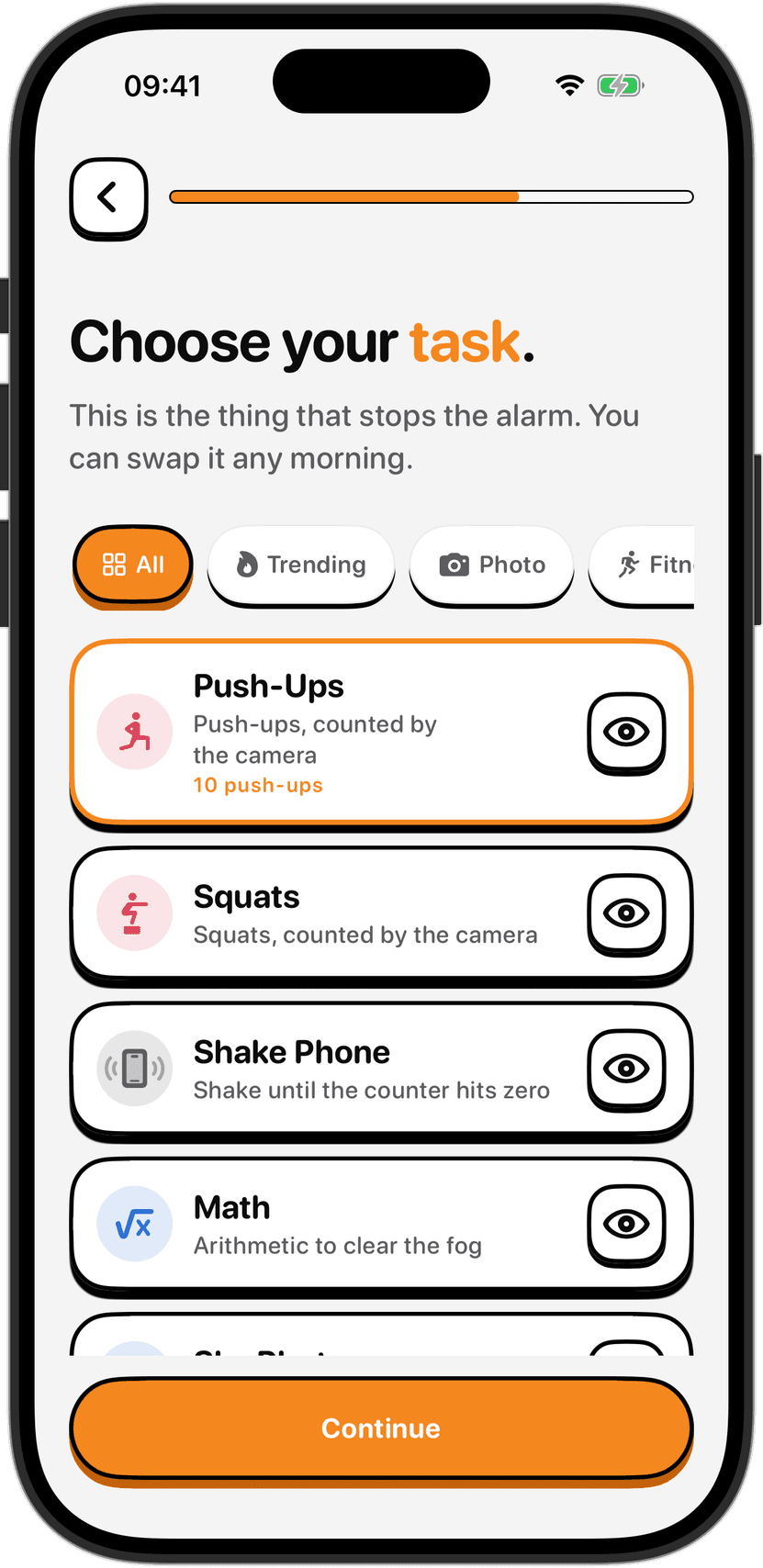
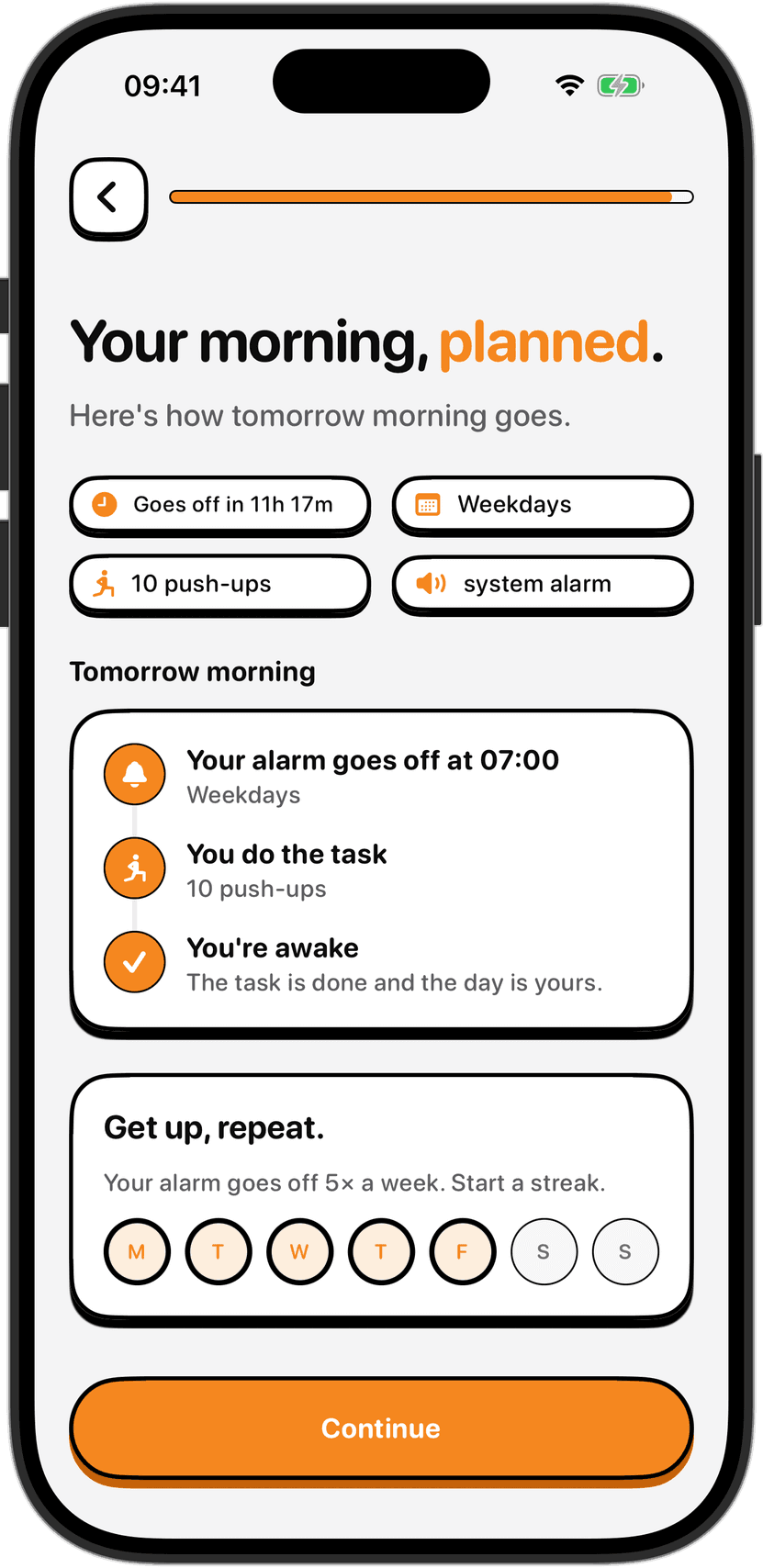
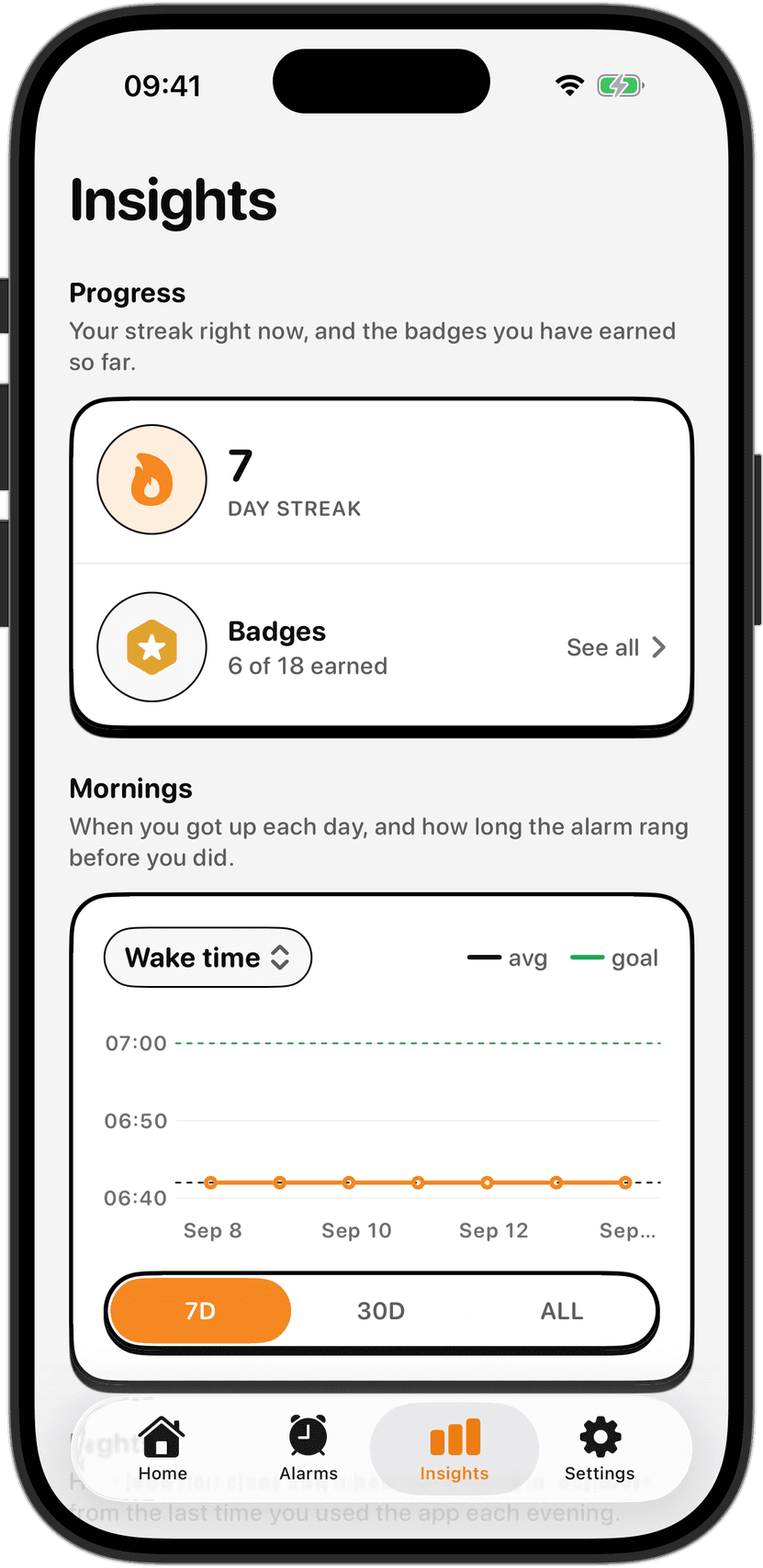
For anyone whose sticking point isn't shifting the clock but actually getting upright once the alarm rings, that's a separate problem from chronotype, and it's the one NoNap is built around. It's a single iPhone alarm with no snooze button, built on Apple's system alarm, so the Ring and Silent switch and Sleep Focus can't mute it and it can't be swiped away from the lock screen. Stopping it means finishing a short task, among them a math problem, a photo, or a few reps counted by the camera (stick to reps you can do safely half-asleep), which at least gets a late chronotype fully upright before it decides whether to fall back into bed. Setup takes about twenty seconds the night before.
Sources
Roenneberg, T., Wirz-Justice, A., and Merrow, M. (2003). Life between clocks: daily temporal patterns of human chronotypes. Journal of Biological Rhythms, 18(1), 80-90. doi.org/10.1177/0748730402239679
Koskenvuo, M., Hublin, C., Partinen, M., Heikkila, K., and Kaprio, J. (2007). Heritability of diurnal type: a nationwide study of 8,753 adult twin pairs. Journal of Sleep Research, 16(2), 156-162. doi.org/10.1111/j.1365-2869.2007.00580.x
Jones, S. E., Lane, J. M., Wood, A. R., et al. (2019). Genome-wide association analyses of chronotype in 697,828 individuals provides insights into circadian rhythms. Nature Communications, 10, 343. doi.org/10.1038/s41467-018-08259-7
Roenneberg, T., Kuehnle, T., Pramstaller, P. P., Ricken, J., Havel, M., Guth, A., and Merrow, M. (2004). A marker for the end of adolescence. Current Biology, 14(24), R1038-R1039. doi.org/10.1016/j.cub.2004.11.039
Fischer, D., Lombardi, D. A., Marucci-Wellman, H., and Roenneberg, T. (2017). Chronotypes in the US: influence of age and sex. PLOS ONE, 12(6), e0178782. doi.org/10.1371/journal.pone.0178782
American Academy of Sleep Medicine. Delayed Sleep-Wake Phase. Sleep Education, accessed August 2026. sleepeducation.org/sleep-disorders/delayed-sleep-wake-phase/
Image credits
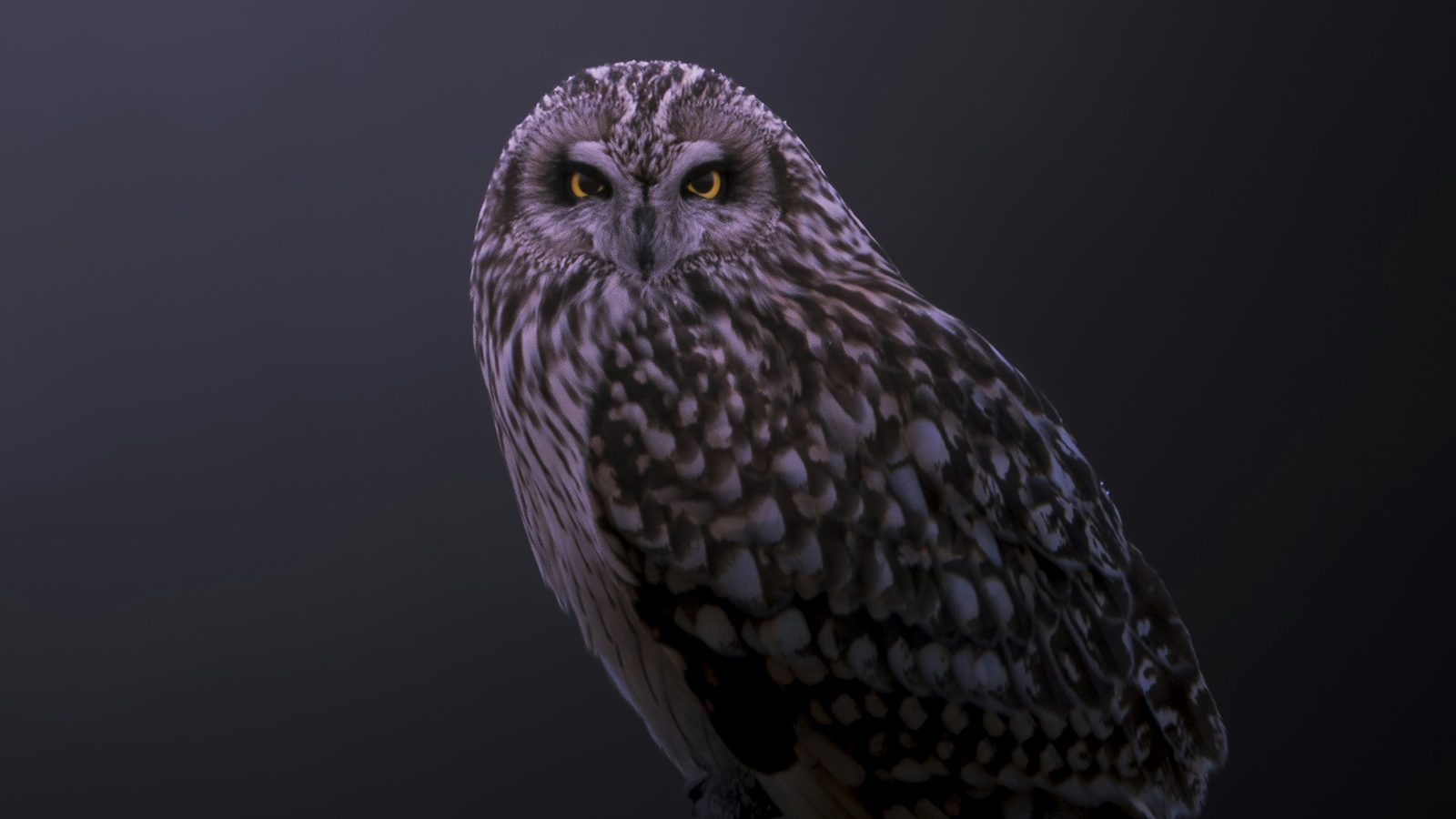
Cover photo of a short eared owl by Christoph Nolte on Unsplash (unsplash.com/photos/an-owl-sitting-on-a-branch-in-the-dark-as1_CYaRREc), used under the Unsplash License, which permits commercial use without attribution.