How astronauts wake up in space
NASA's tradition of wake-up music, why astronauts sleep poorly on the ISS, and how lighting systems are being upgraded to support circadian rhythms.
Visana Studios
5 min read
Every morning on the International Space Station, Mission Control plays wake-up music to the crew. The tradition spans decades of human spaceflight. It might be a song a crew member requested, or something picked by their family, or a track that becomes inside-joke shorthand for another day in orbit. The music drifts through modules where several human beings have been trying to sleep in a weightless box hurtling around the planet every 90 minutes.
Those astronauts are probably tired. Considerably more tired than they were on Earth.
The sleep problem at 250 miles altitude
The International Space Station orbits in darkness and daylight in equal measure, sixteen sunrises and sunsets per day. That means the sun rises over the horizon every 90 minutes, a rhythm that bears no resemblance to the 24-hour clock your body ran on for your whole life before launch.
In 2014, a team led by Laura Barger at Harvard Medical School studied the sleep patterns of 64 space shuttle astronauts and 21 ISS astronauts across more than 8,000 nights before, during, and after spaceflight. They measured sleep with wrist actigraphy, the same motion-tracking watches used in sleep research on Earth, plus daily logs kept by the astronauts themselves.
On the ISS, astronauts averaged 6.09 hours of sleep per night, with high night-to-night variation. More tellingly, on 43.8 percent of nights in orbit, astronauts slept less than 6 hours. The problem was not just quantity: sleep quality degraded as well. Astronauts reported alterations in sleep architecture, including reduced deep sleep and REM sleep stages, the stages where the brain consolidates memory and handles emotional regulation.
The Barger study also tracked what astronauts did about it. Seventy-five percent of ISS crew members reported using sleep medications during their missions. That was not just the occasional rough night. On roughly half of all nights in space, shuttle crew members were taking pills to sleep.
Why the space station makes sleep so difficult
The most obvious culprit is the light-dark cycle itself. The ISS cabin is lit to roughly 500 lux during waking hours, a reasonable level for work. But it is substantially lower than the 2,500 lux of daylight on Earth, and it does nothing to address the fundamental problem: there is no light-dark cycle at all. The station's ambient lighting is constant regardless of the local time humans are trying to use there, and it is weaker than what a human body evolved expecting.
Circadian rhythm disruption follows. Without the regular dawn and dusk their clocks learned to anticipate, astronauts experience dampened circadian rhythm amplitude for both body temperature and alertness. The body clock does not vanish in space, but it loses the signal that normally tightens its 24-hour cycle. The phase of the rhythm drifts, sometimes aligning with Houston time, sometimes slipping sideways into something between two time zones at once.
A 2025 review by researchers at Université Laval and other institutions, published in Frontiers in Physiology, notes that NASA has responded to this with pre-mission countermeasures. Before launch, astronauts are exposed to a strategically optimized schedule of bright light to enhance, and dark goggles to minimize, photic input to the circadian system. The goal is to shift their circadian rhythms toward the schedule they will keep in space, so the adjustment in orbit is smaller.
The lighting upgrade
The ISS itself is getting a circadian upgrade. Space agencies are installing lighting that uses short-wavelength blue-green light, in the range of 460 to 512 nanometers. This wavelength range is more effective than broad-spectrum illumination at modulating the circadian phase, because it targets the photoreceptors in the retina that the circadian system relies on most directly. The new systems allow astronauts to get the circadian stimulus they need without disrupting the visual tasks they are doing.
It is not a complete fix. No lighting system can restore the Earth's light-dark cycle in an orbit that cycles every 90 minutes. But it can provide more of the signal that keeps circadian rhythms on track, and it gives the body clock something closer to the anchor it is built to need.
The problem extends beyond sleep quality. Sleep deficiency cumulates. The Barger study tracked critical days: the 24-hour periods before extravehicular activities, spacewalks where a single lapse in attention can become fatal. On 51.3 percent of the nights before those missions, astronauts slept less than 6 hours.
The broader lesson sits underneath all of this. Sleep looks like a luxury in the moment, another thing to squeeze in around a full day. But your circadian rhythm is not listening to your schedule. It runs on light and dark, on the sun's timing, on signals your body has been reading for hundreds of thousands of years. Move it into a box in space, and all the willpower in the world cannot fix what happens to sleep when those signals drop away.
Most alarm clocks do not face that problem. If you set a consistent wake time, your body clock learns that timing and starts preparing for the alarm several minutes before it goes off, a process sleep researchers call sleep inertia reduction. On Earth, the light coming through your window in the morning strengthens that signal. On the ISS, there is no window that works that way. The wake-up music plays, and the alarm still goes off at 6:30 a.m. Houston time, but the circadian system is somewhere else entirely.
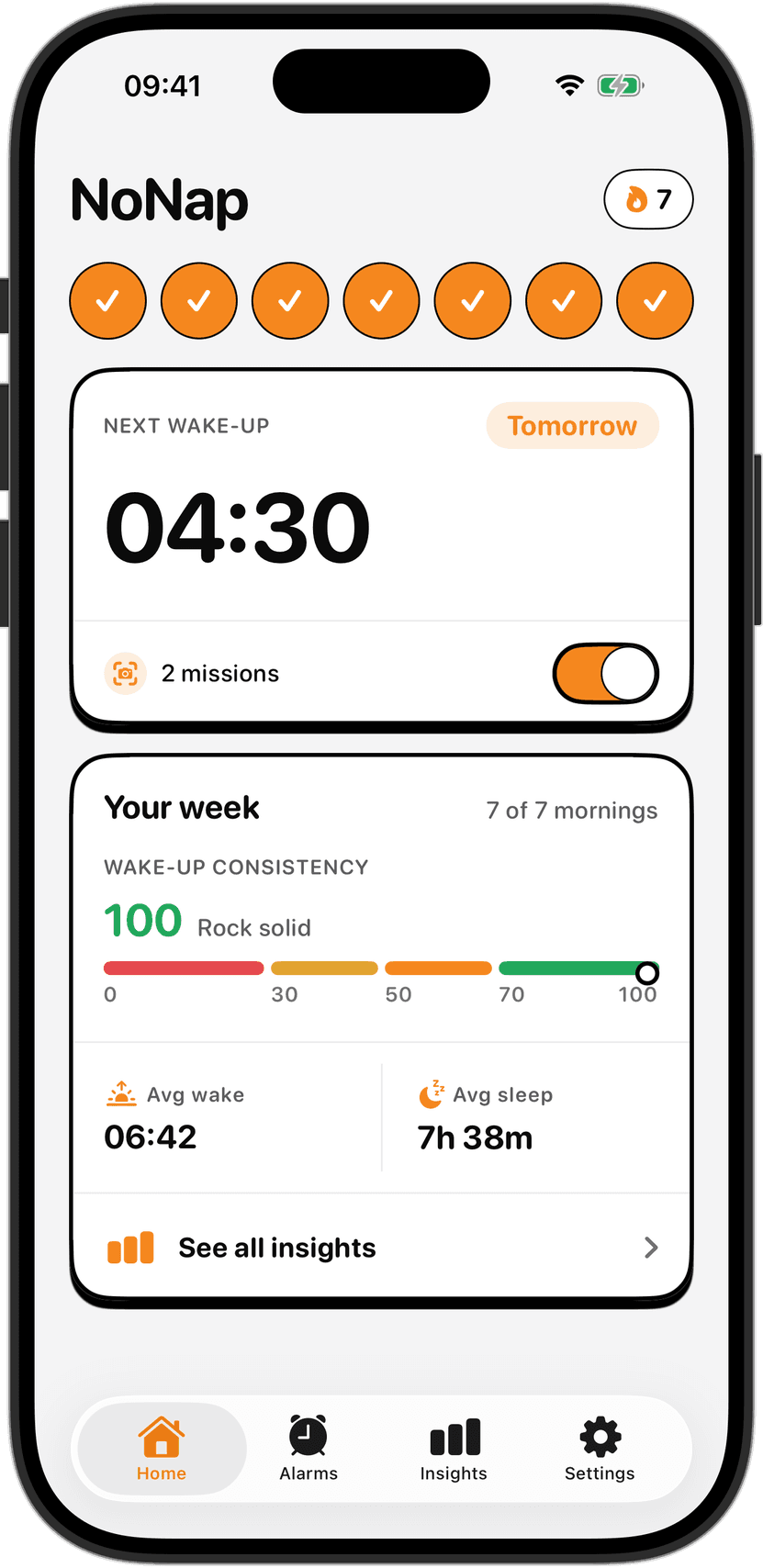
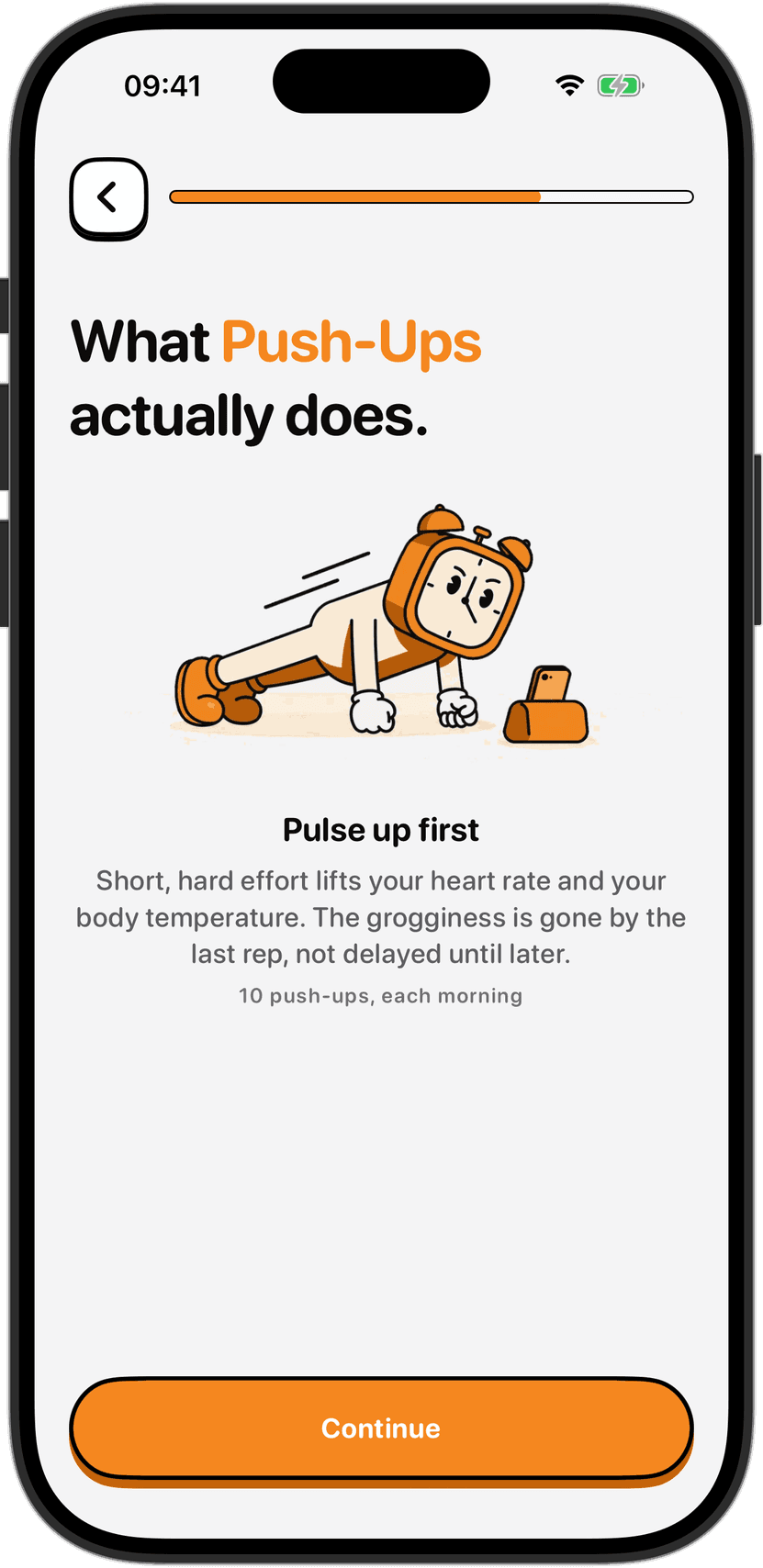
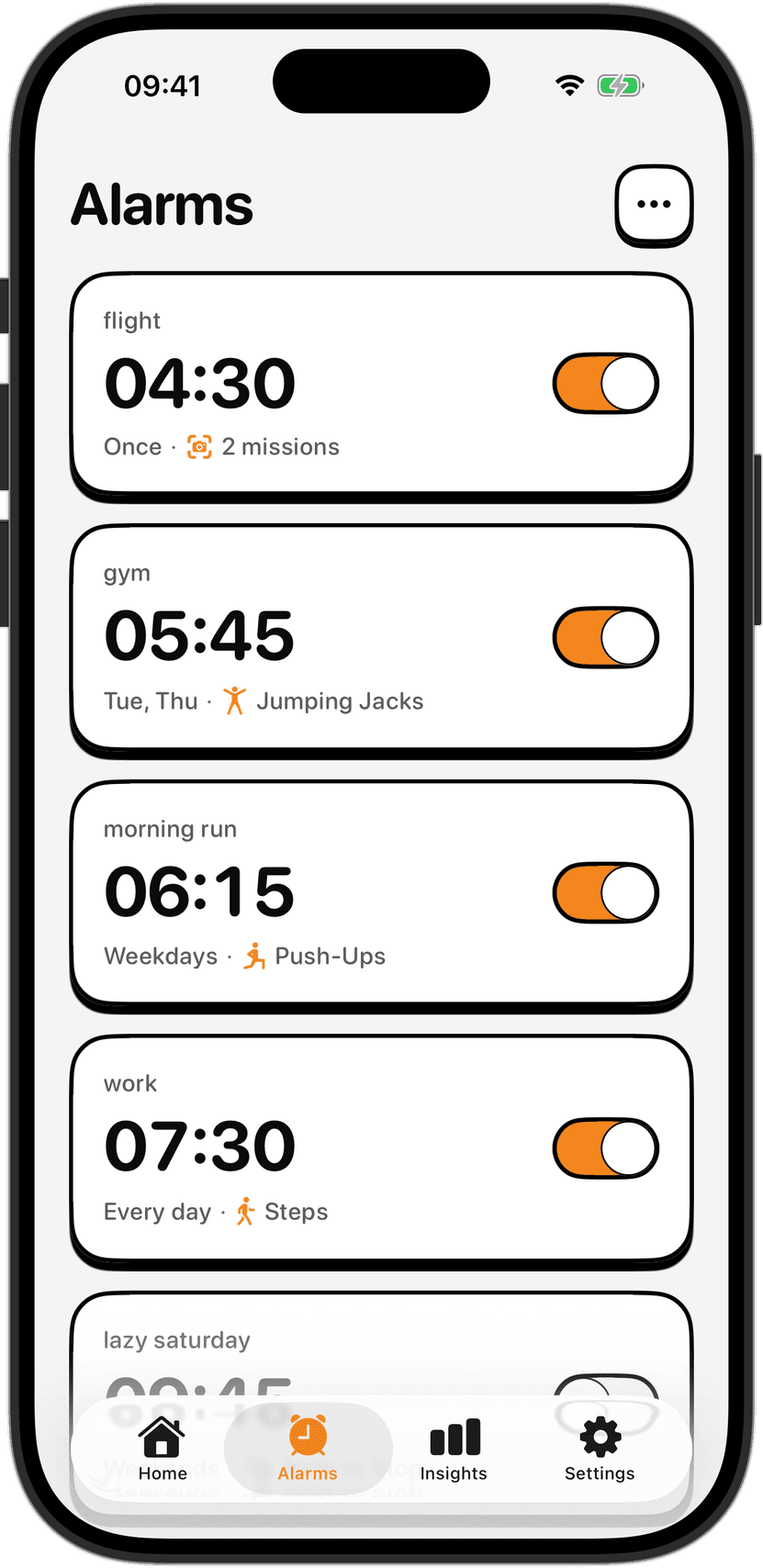
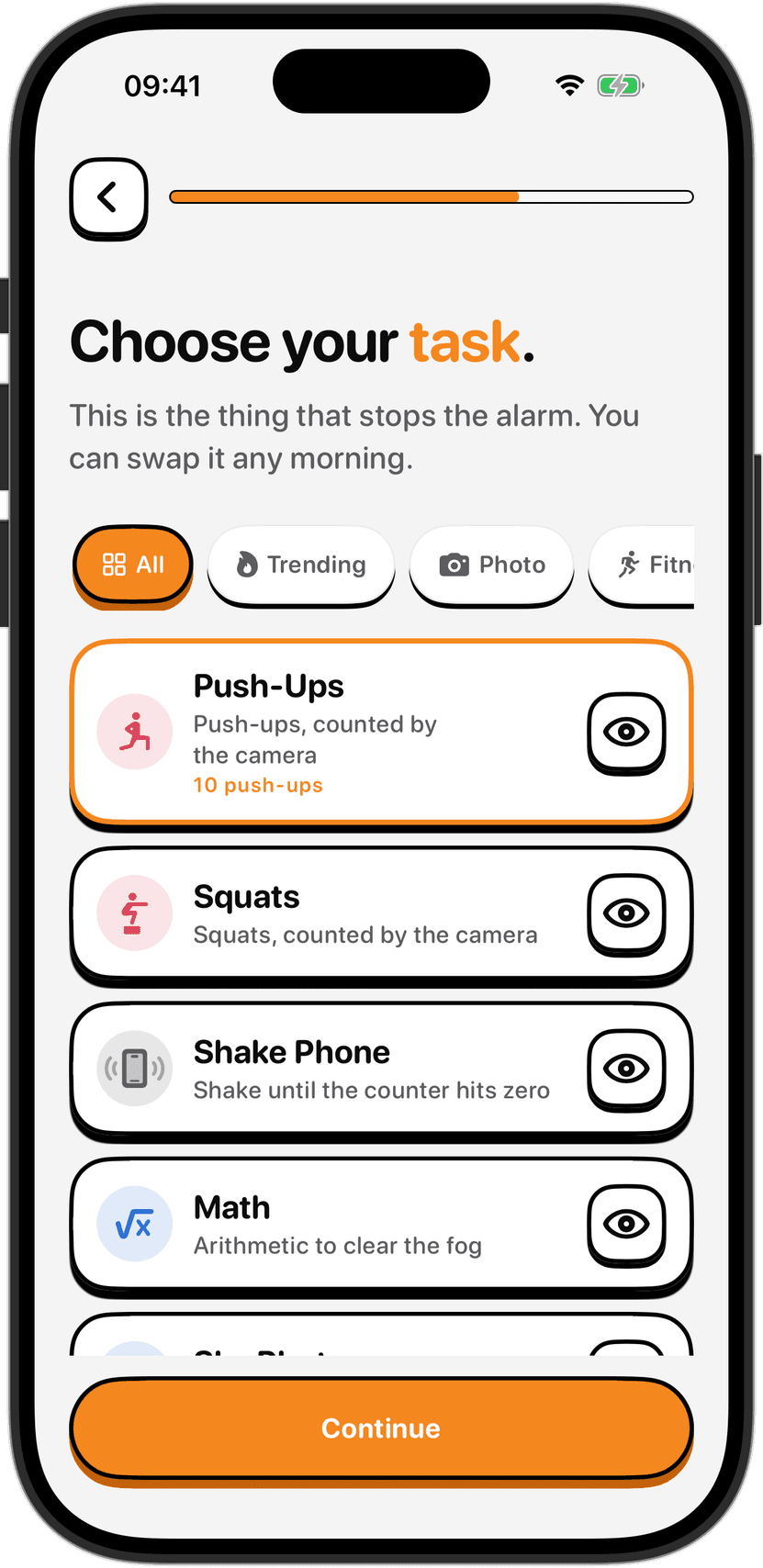
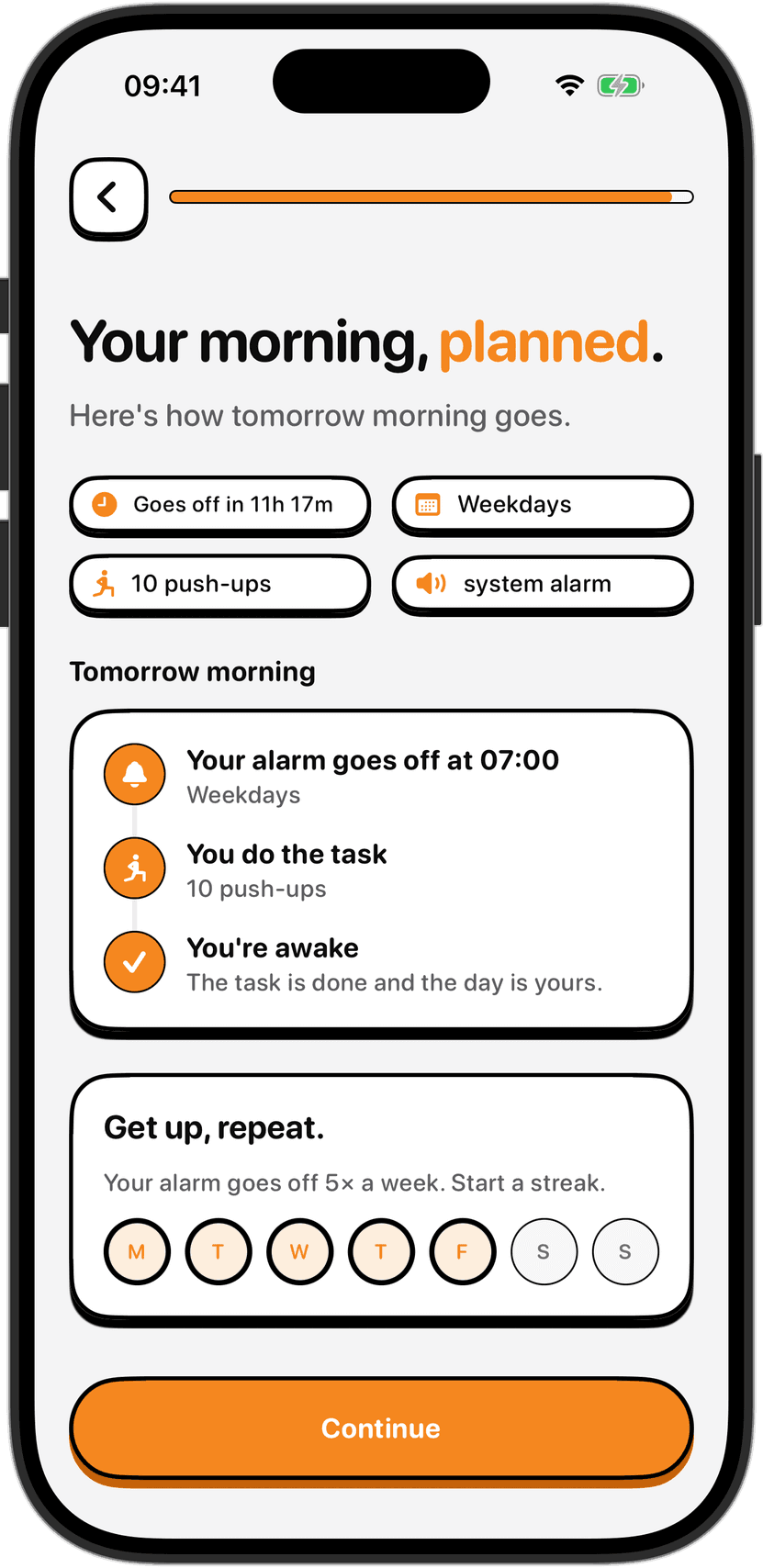
NoNap is built around one alarm with no snooze button, using Apple's system alarm on iPhone, so the ring and silent switch do not mute it and Focus modes do not either. It cannot fix a disrupted circadian rhythm, because that is a job for light, and sleep, and time. But it does keep a single consistent wake time steady, which is half the job of teaching your body clock what to expect. If exercise first thing in the morning is not safe for you because of an injury or a condition, pick Math or Shake Phone instead; the point is the consistency, not the specific task.
Sources
Barger, L. K., Flynn-Evans, E. E., Kubey, A., Walsh, L., Ronda, J. M., Wang, W., Wright, K. P., and Czeisler, C. A. (2014). Prevalence of sleep deficiency and use of hypnotic drugs in astronauts before, during, and after spaceflight: an observational study. Lancet Neurology, 13(9), 904-912. doi.org/10.1016/S1474-4422(14)70122-X
Giguère, R., Marois, A., Fortin-Guichard, D., Charest, J., Rocheleau, J., Thompson, K., Stolberg, M., St-Martin, P., Bergouignan, A., Niaussat, V., Paquette, J. S., Gagnon, M. P., Sasseville, M., and Rhéaume, C. (2025). Space exploration and lifestyle medicine: a narrative review of its implications for astronaut health and remote Earth-based environments. Frontiers in Physiology, 16, 1729596. doi.org/10.3389/fphys.2025.1729596
Image credits
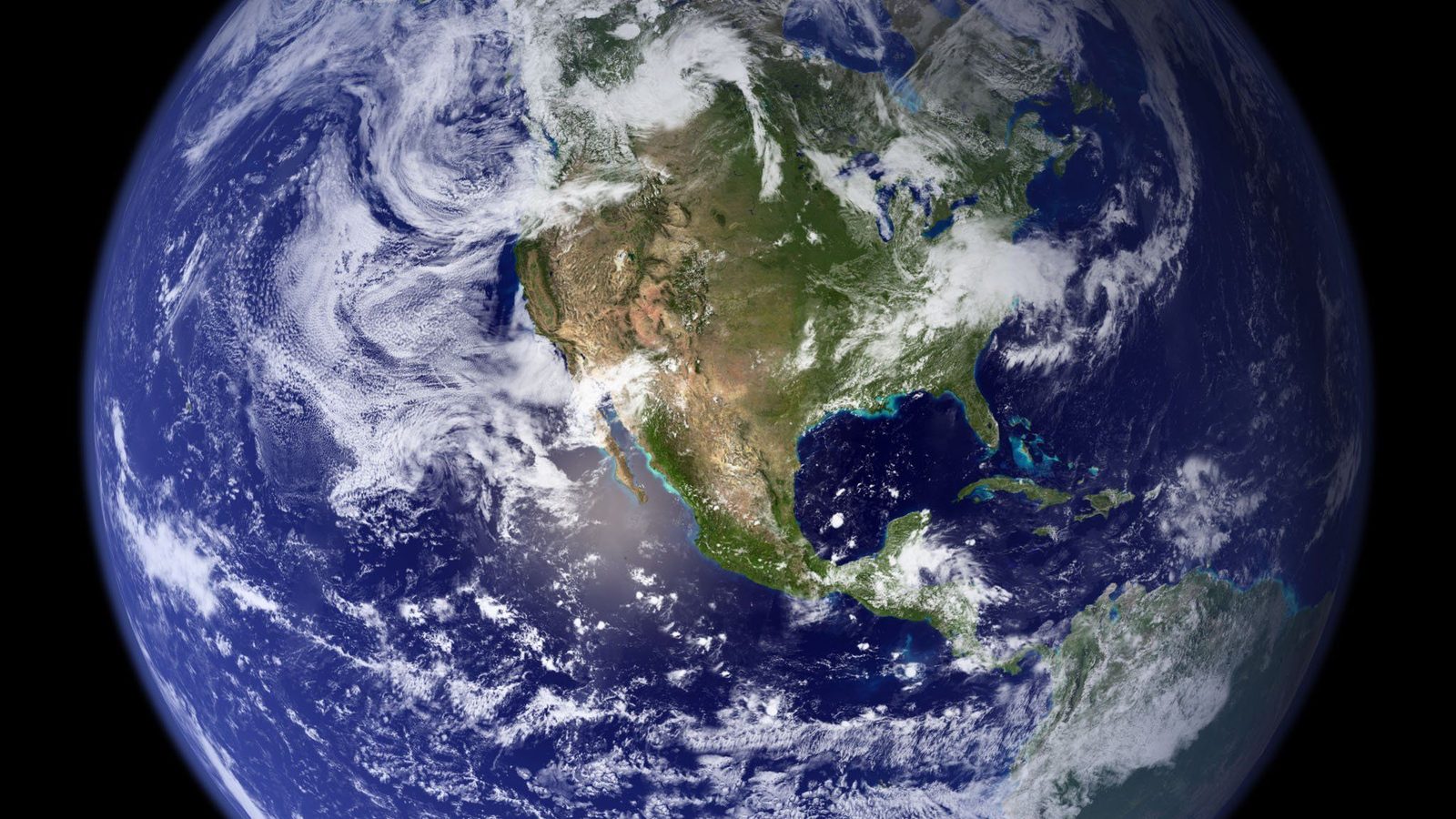
Cover photo from Pexels (pexels.com/photo/earth-blue-planet-globe-planet-87651/), used under the Pexels License, which permits commercial use without payment or attribution required.