Why you sometimes wake up right before your alarm
A 1999 hormone study, the body's circadian rhythm and a steady wake time explain the effect, and why one short night is usually enough to erase it.
Visana Studios
8 min read
Six fifty six in the morning, four minutes before the alarm, and you're already staring at the ceiling. No sound yet. Just awake, for no reason you can name. It happens often enough that people ask about it: some mysterious internal clock that seems to know the exact minute you're supposed to get up. Sleep researchers have actually tested this, and the honest answer is messier and more interesting than a single tidy mechanism. Part of it looks like real anticipation. Part of it is just the ordinary rhythm your body runs every night regardless of what you decided before bed. And most of it falls apart the moment you're running short on sleep.
What Jan Born found in a Lübeck sleep lab
In 1999, sleep researcher Jan Born and colleagues at the University of Lübeck brought 15 healthy adults into a sleep lab for three nights apiece and drew blood samples through the night. Everyone in the study normally woke up around 7:00 to 7:30 in the morning, so the researchers moved the target earlier or later, and in one condition, lied about it. Some subjects were told they'd be woken at 6 a.m. and then actually were. Others were told 9 a.m. and woken at 9, close to their habit. A third group was told to expect 9 but got woken at 6 anyway, with no warning.
Only the group that correctly expected the early 6 a.m. wake-up showed what the researchers were looking for: a clear rise in adrenocorticotropic hormone, ACTH, starting around 5 a.m., about an hour before the target. ACTH is what the pituitary gland releases to tell the adrenal glands to start making cortisol, the hormone most associated with alertness and stress. Neither the surprised group nor the 9 a.m. sleepers showed a comparable rise. Born, now at the University of Tübingen, told NPR in 2022 that the result "came out actually as hypothesized," and called it "a good adaptive preparatory response of the organism, because then you have enough energy to cope with getting up." The paper ran in Nature as a two page letter titled Timing the end of nocturnal sleep, and it's the piece of research behind almost everything written since about people beating their alarms.
What it does and doesn't prove
Fifteen people, split across three conditions. That's a small study, and the popular version of this story usually skips that part. It's also worth being precise about what actually moved: ACTH, not cortisol itself, and the two don't always track each other on the same few minutes. A far larger study in 2025, led by Samantha Klaas and published in Proceedings of the Royal Society B, sampled cortisol continuously from 201 healthy volunteers living their ordinary lives at home. It found no evidence that the rate of cortisol change increased simply because someone woke up. The authors read their own results as more supportive of anticipation and the body's built in rhythm than of waking itself triggering anything. Put plainly, a small 1999 study found one hormone rising in one group under lab conditions, and a much larger follow-up a generation later couldn't find waking itself producing a matching cortisol spike out in the real world. Anticipation, if it's real, is a narrower and more fragile effect than "your body always knows."
The rhythm that's already running before the alarm goes off
Anticipation is probably the smaller half of the story anyway. Cortisol runs on its own daily rhythm, independent of anything you decided the night before. Levels bottom out in the late evening and early part of the night, then climb steadily through the second half of sleep, reaching their peak around a person's habitual wake time, according to a 2021 review in Current Opinion in Endocrine and Metabolic Research. That climb is driven by the circadian clock, the roughly 24 hour internal timer set mainly by light and by the schedule you actually keep. If you usually get up at 6:45, your body has been raising alertness hormones and core temperature for a while already by the time an alarm at 7:00 would go off, no anticipation of that specific morning required. This is separate from the cortisol awakening response, a further burst in the first half hour after you actually open your eyes, which researchers are still arguing about.
Why a steady schedule seems to matter more than anything
A 2023 review in PLOS One pulled together the research on self-awakening, people deliberately trying to wake at a chosen time with no alarm, and found that across the studies it covered, about 17 percent of roughly 715 participants counted as reliable self-awakeners, usually meaning they woke within 30 minutes of the time they'd picked. The reviewers also noted something that fits with the circadian story above: success rates were higher when the target time sat close to a person's normal wake-up time, and worse when it didn't. A smaller Japanese study published in BMC Neuroscience in 2012 tracked blood flow in the brains of 15 men overnight. In the seven who woke successfully near their target, blood flow rose in the right prefrontal cortex starting about 30 minutes beforehand, alongside a shift into lighter sleep. In the eight who failed, nothing changed.
None of this describes a trick you can pick up on demand. It describes a system that performs best when it's barely being asked to do anything unusual: a familiar hour, on a body that already expects to be up around then. Fixed wake times are also the starting point most insomnia treatment is built around, for a related reason.
Why one bad night usually wipes it out
Ask anyone who's tried this on purpose and you'll hear some version of the same complaint: it works most mornings and then disappears completely after a late night, a few drinks, jet lag, or a stretch of short sleep. There isn't a study built around that exact question, but the explanation fits comfortably with well established sleep physiology. Sleep runs on two systems pulling in different directions, a circadian clock that marks roughly when you should be awake, and a separate pressure that builds the longer you've been awake and gets discharged by sleep itself. Run up enough of a debt on that second system and the body responds by sleeping harder in the hours that follow, not lighter. A 2004 study in the journal Sleep found that after a stretch of total sleep deprivation, the brief arousals that punctuate ordinary sleep, tiny surfacings that never fully wake a person but may be exactly what lets someone notice a target time is close, dropped sharply on the first night of recovery sleep before returning to normal. A body paying down sleep debt isn't primed to surface a few minutes early for anything. It's primed to stay under until something forces the issue, and on a short night that something is usually the alarm doing the job it exists to do.
Worth separating this from a different pattern. Opening your eyes a few minutes before a planned alarm isn't the same as waking at 3 a.m. and lying there unable to drop back off, which has its own explanation and, if it happens most nights and leaves you dragging all day, is worth raising with a doctor rather than troubleshooting alone.
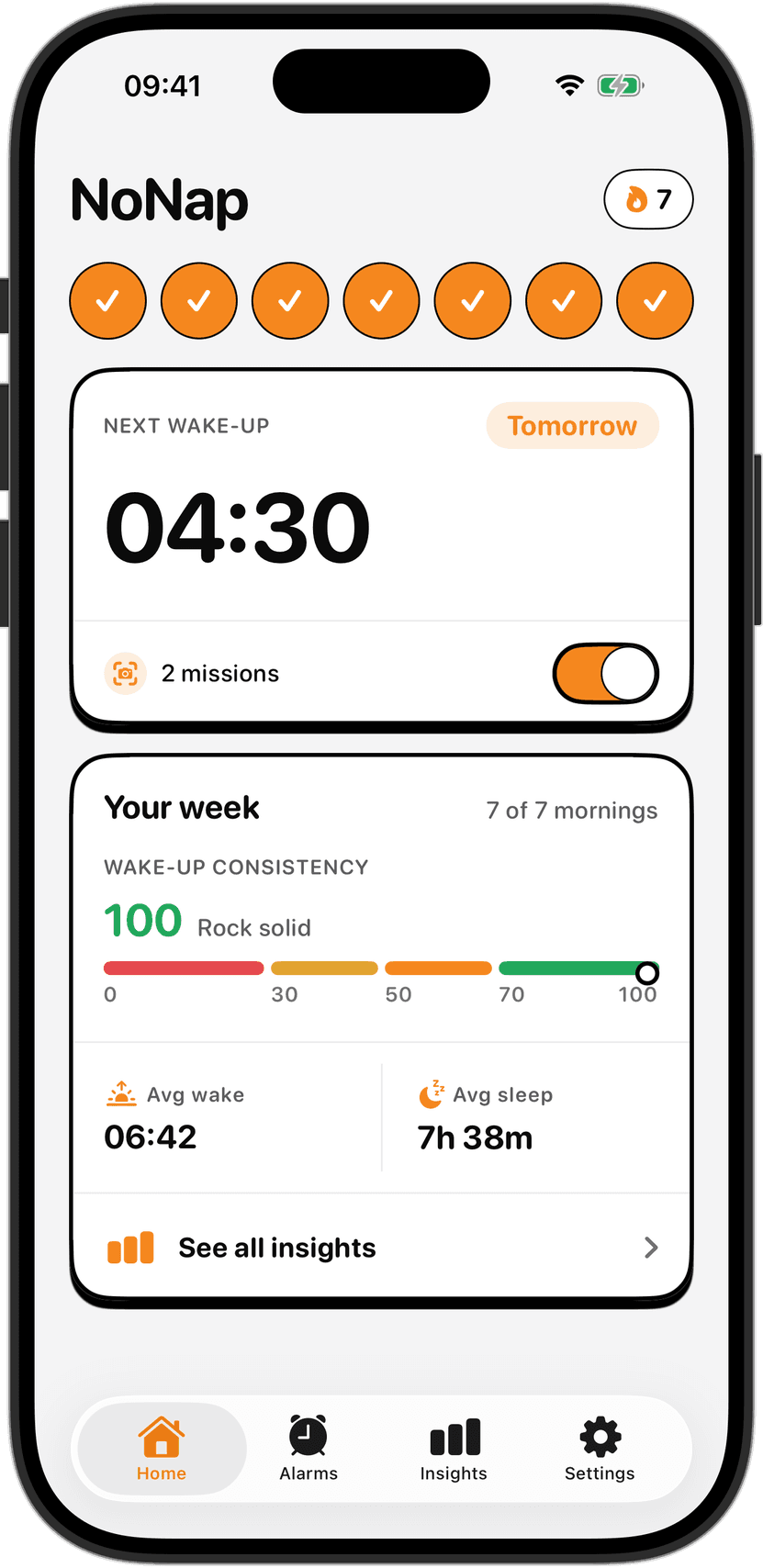
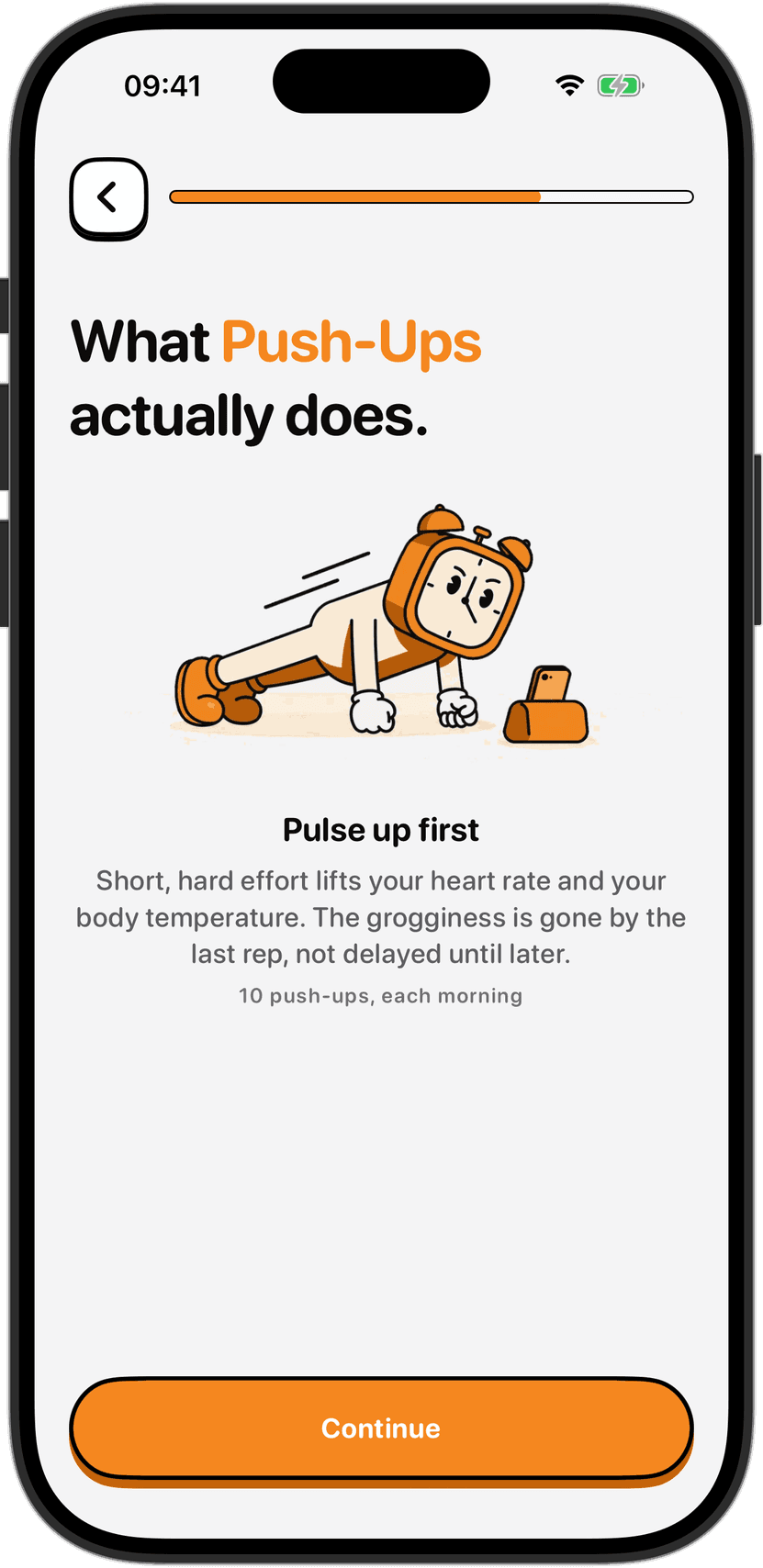
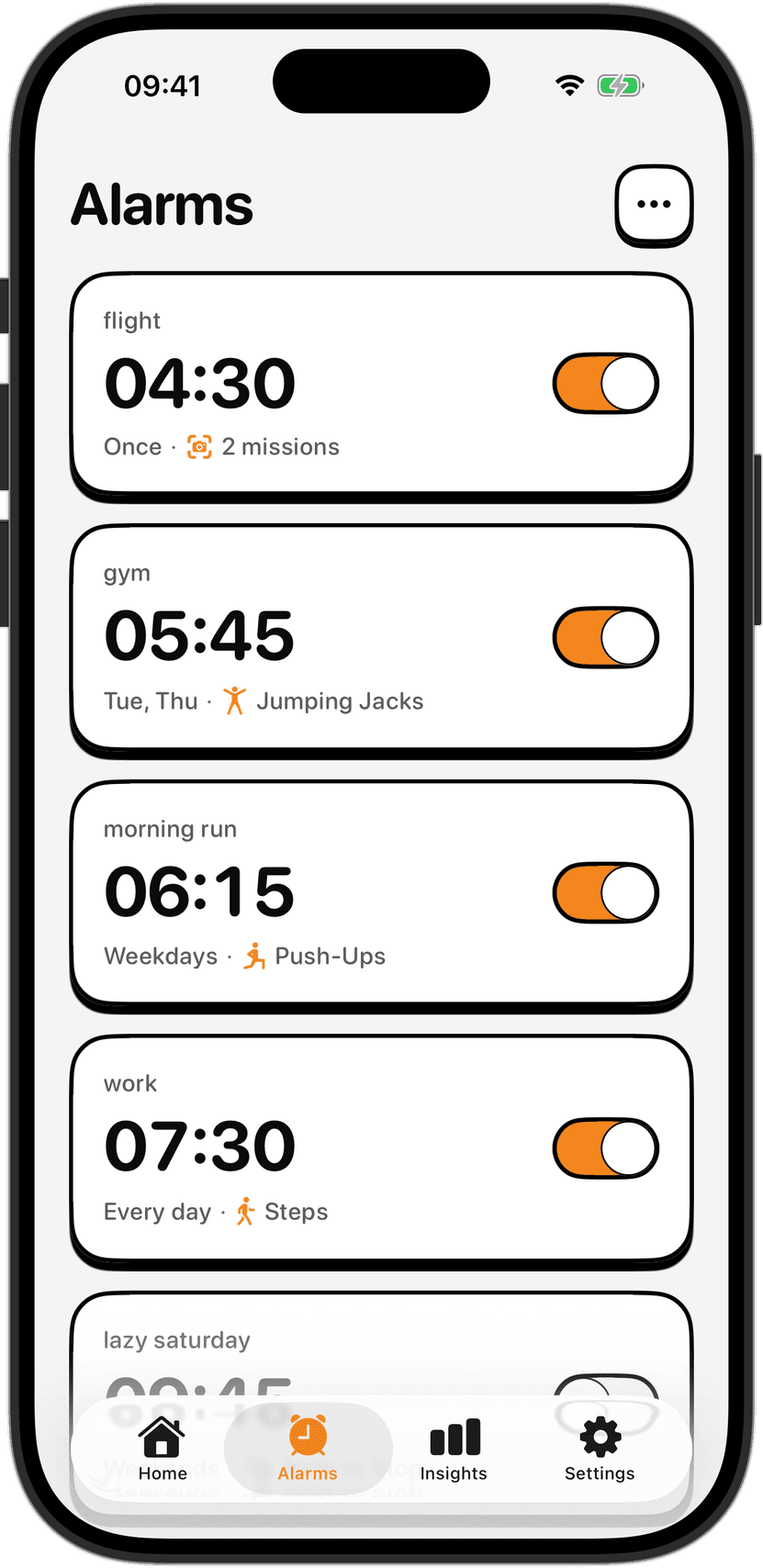
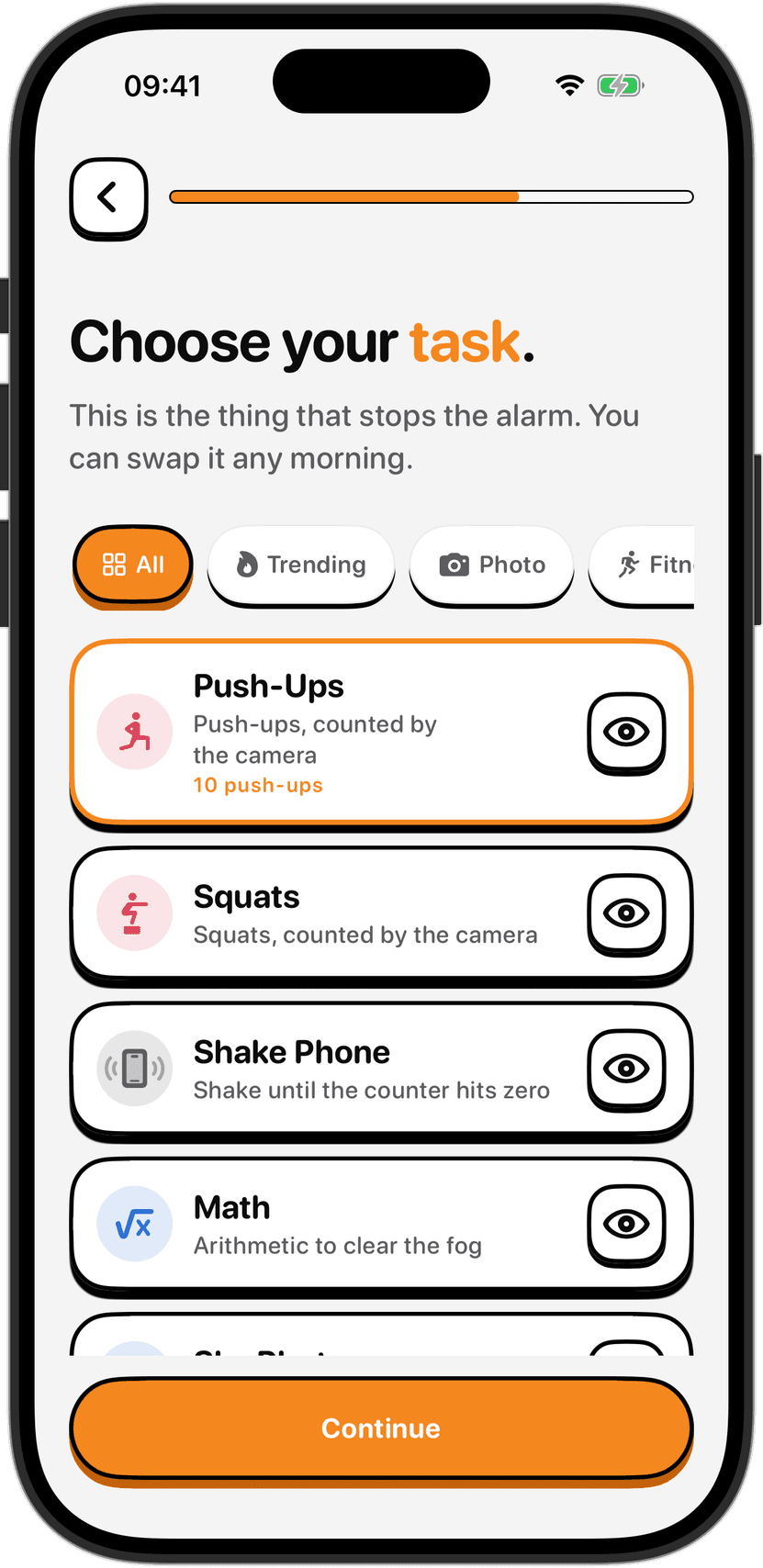
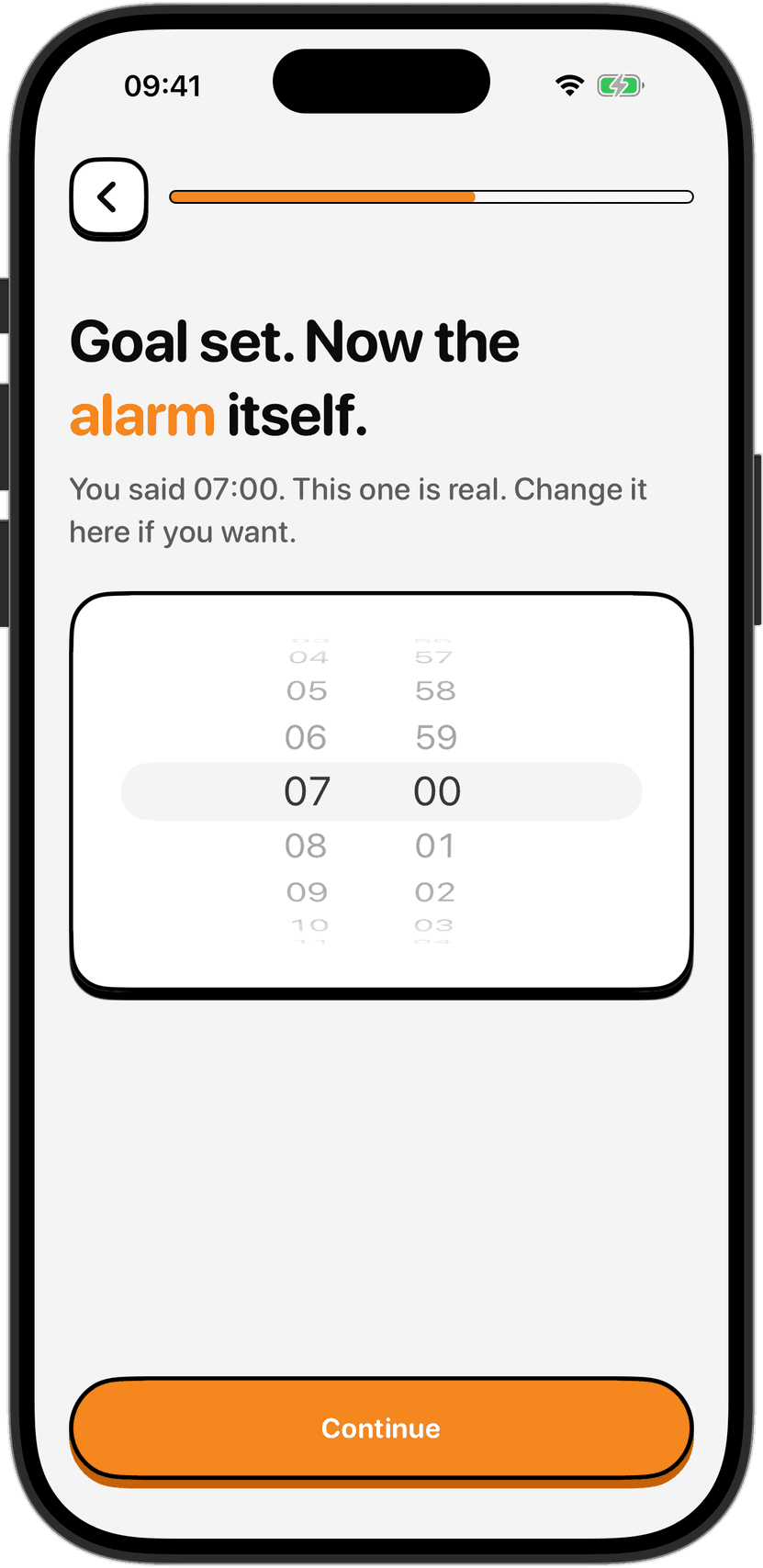
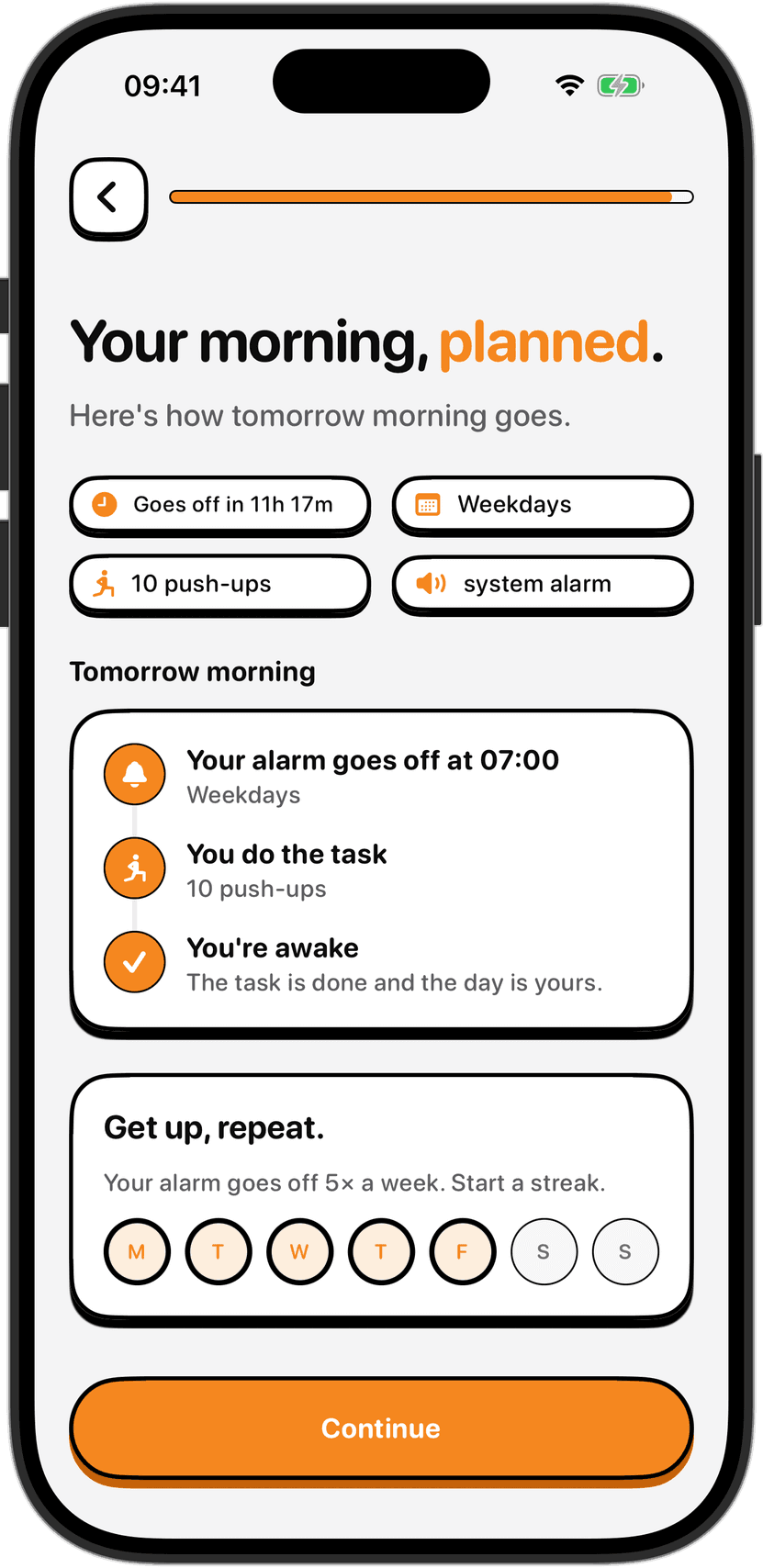
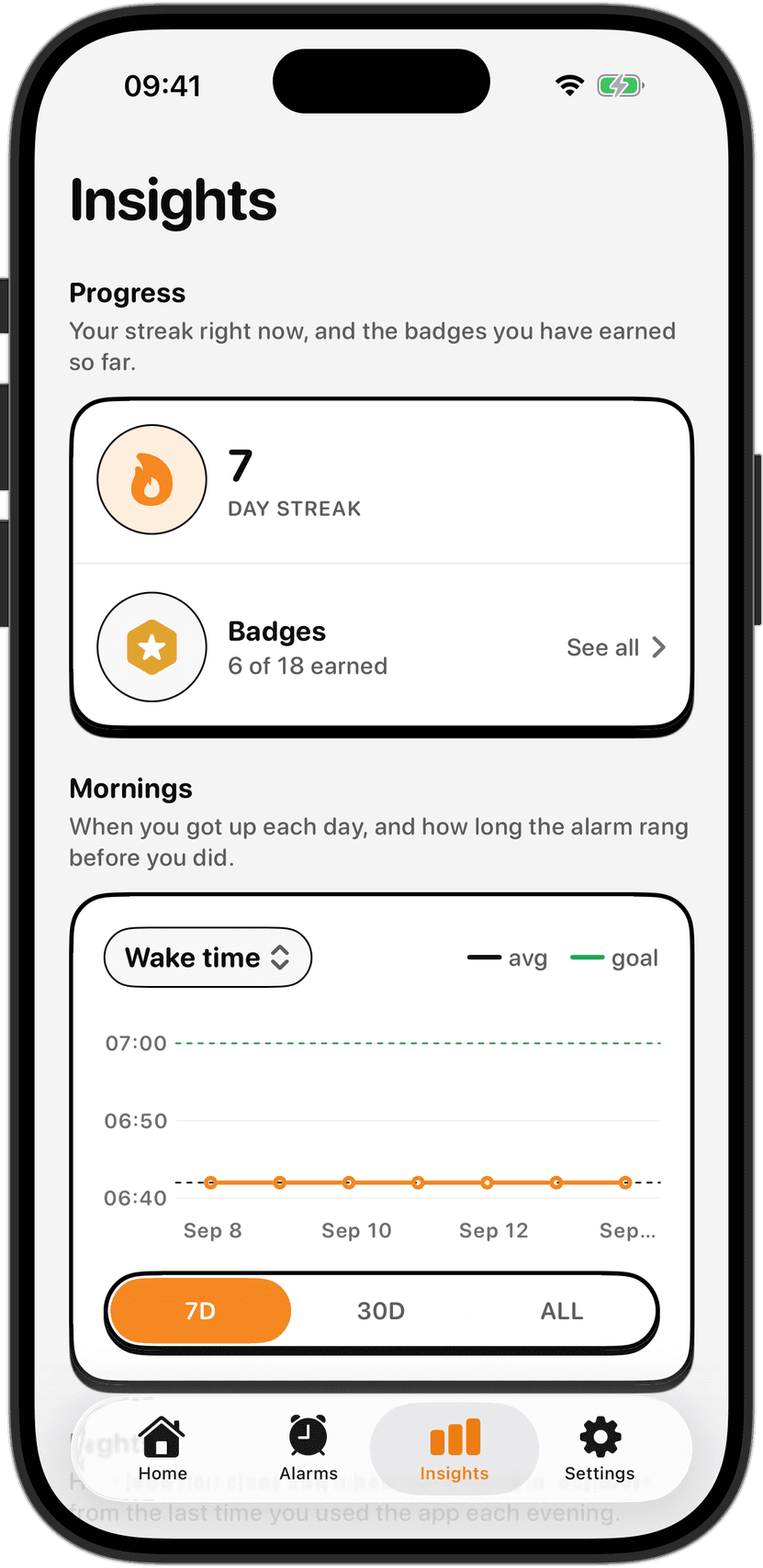
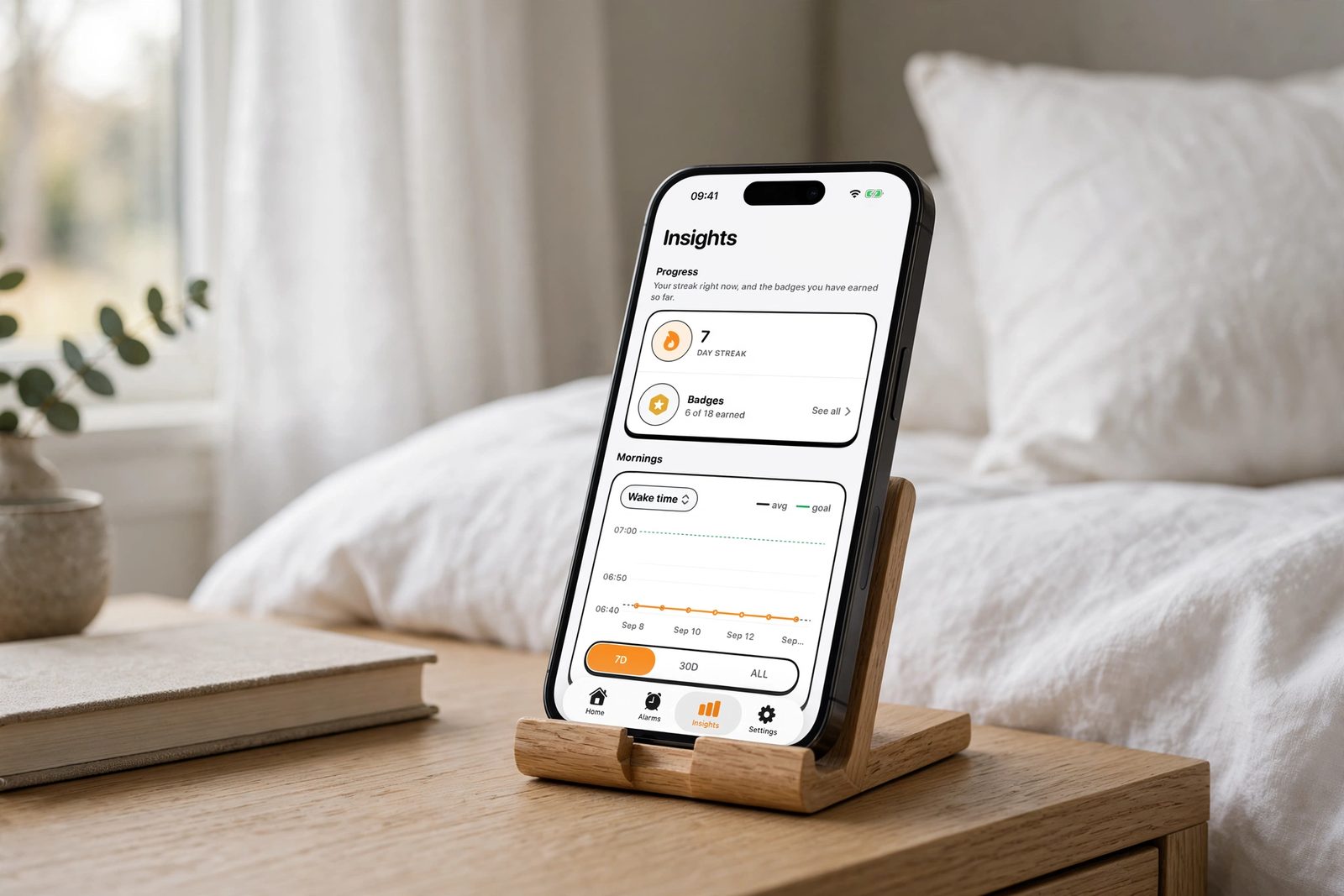
None of this is something to plan a morning around. On the nights sleep debt is running high, which covers more mornings than most people admit, the anticipatory system doesn't show up, and whatever's actually set to go off ends up doing all the work. That's the gap NoNap exists to cover, rather than betting on the body to time itself. It runs on Apple's system alarm, the same one behind the iPhone's own Clock app, so the ring or silent switch and Focus modes don't touch it, and it can't be dismissed from the lock screen. Stopping it means finishing a wake task chosen the night before, in about twenty seconds: push-ups or squats counted by the camera, shaking the phone, a math problem, a photo, or making the bed, with Shake Phone and Math there as the gentler options on a rougher morning. Anyone doing push-ups or squats while still half asleep should clear the space around them first and stop if anything feels wrong. The streaks and wake-time chart in the app exist mostly to answer the question this piece has been circling: whether your actual mornings are as consistent as you think, which, going by the research above, is most of what decides whether you'll ever beat the alarm on your own.
Sources
Born, J., Hansen, K., Marshall, L., Mölle, M., and Fehm, H. L. (1999). Timing the end of nocturnal sleep. Nature, 397, 29-30. nature.com/articles/16166
Klaas, S., Upton, T. J., Zavala, E., et al. (2025). Awakening not associated with an increased rate of cortisol secretion. Proceedings of the Royal Society B, 292(2038). doi.org/10.1098/rspb.2024.1844
O'Byrne, N. A., Yuen, F., Butt, W. Z., and Liu, P. Y. (2021). Sleep and Circadian Regulation of Cortisol: A Short Review. Current Opinion in Endocrine and Metabolic Research. pmc.ncbi.nlm.nih.gov/articles/PMC8813037/
Verga, L., D'Este, G., Cassani, S., Leitner, C., Kotz, S. A., Ferini-Strambi, L., and Galbiati, A. (2023). Sleeping with time in mind? A literature review and a proposal for a screening questionnaire on self-awakening. PLOS ONE. pmc.ncbi.nlm.nih.gov/articles/PMC10035927/
Aritake, S., Higuchi, S., Suzuki, M., Kuriyama, K., Enomoto, M., Soshi, T., Kitamura, S., Hida, A., and Mishima, K. (2012). Increased cerebral blood flow in the right frontal lobe area during sleep precedes self-awakening in humans. BMC Neuroscience. pmc.ncbi.nlm.nih.gov/articles/PMC3538054/
Sforza, E., Chapotot, F., Pigeau, R., Naitoh, P., and Buguet, A. (2004). Effects of Sleep Deprivation on Spontaneous Arousals in Humans. Sleep, 27(6), 1068-1075. academic.oup.com/sleep/article-abstract/27/6/1068/2696732
Stone, W. (2022). I usually wake up just ahead of my alarm. What's up with that? NPR, December 26, 2022. npr.org/sections/health-shots/2022/12/26/1139781557/i-usually-wake-up-just-ahead-of-my-alarm-whats-up-with-that
Image credits
Cover photo by Anton Sobotyak on Unsplash (unsplash.com/photos/the-sun-is-shining-through-the-curtains-on-a-bed-VPFi-s-xyXU), used under the Unsplash License, which permits commercial use without attribution.