Why you jerk awake as you fall asleep: hypnic jerks
Hypnic jerks are the sudden twitches that startle you as you drift off. What research says about their cause, what may raise the odds, and when to see a doctor.
Visana Studios
4 min read
You are nearly asleep when your leg kicks, or your whole body lurches as if you missed a step. Your heart is pounding and you are suddenly wide awake. That moment has a name: the hypnic jerk, also called a sleep start. The Sleep Foundation calls these twitches completely normal and generally harmless, which helps at 11 p.m. when one has just dragged you back from the edge of sleep.
What a hypnic jerk is
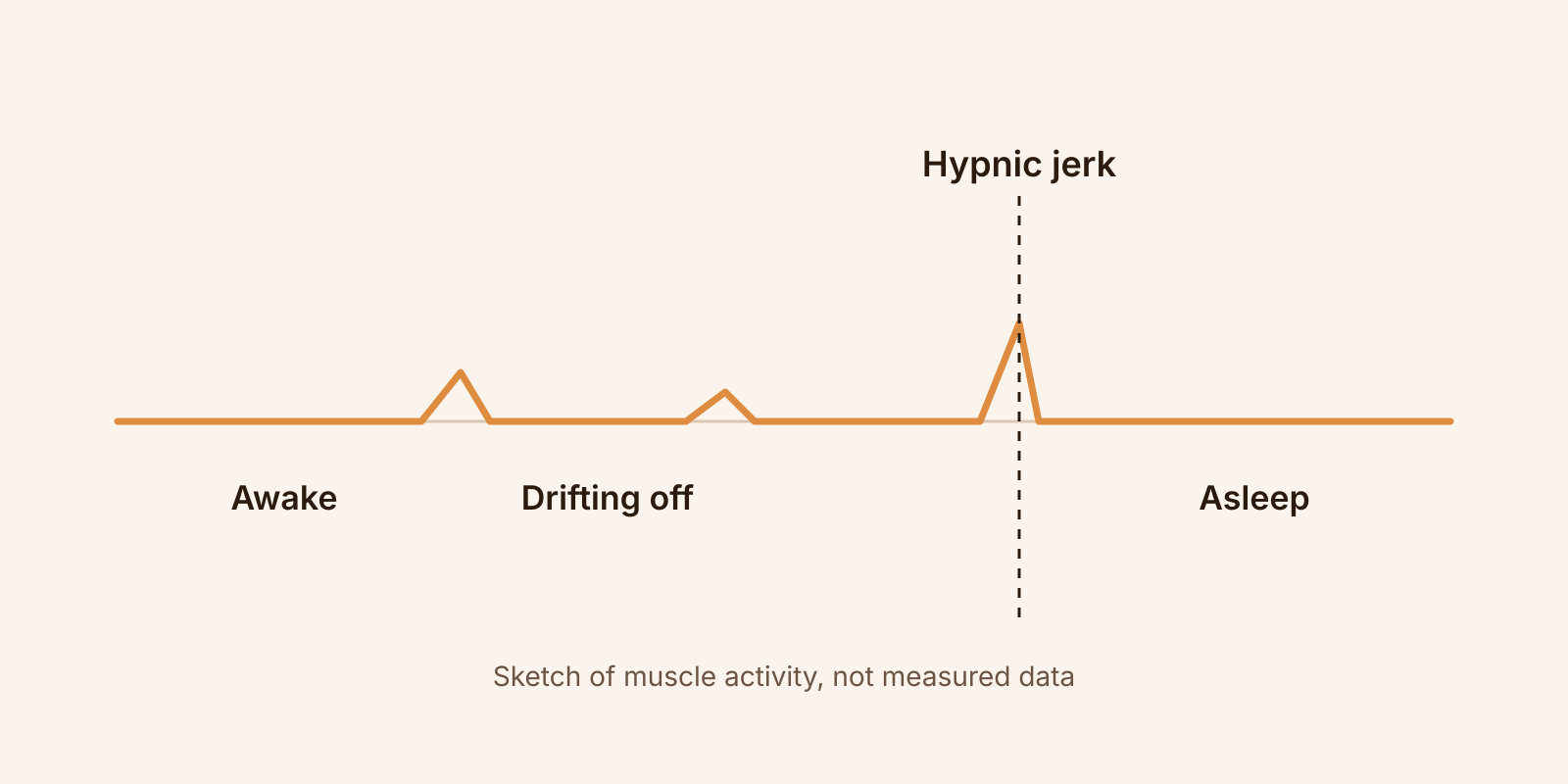
A hypnic jerk is a sudden, involuntary muscle twitch that happens as you fall asleep. It can involve a single limb or the whole body. In a 2014 report in the journal Sleep Medicine, Giovanna Calandra Buonaura and colleagues described hypnic jerks as physiological, non-periodic myoclonic jerks that mostly occur at sleep onset. Myoclonic means a brief, involuntary muscle contraction. Physiological means they belong to normal sleep rather than marking a fault. Non-periodic means they come as single events, not on a repeating rhythm.
The name points to the timing. "Hypnic" comes from the Greek for sleep, and the 2014 report places these jerks mostly in the minutes around sleep onset.
Why they happen
Nobody has pinned down the cause. The Sleep Foundation says researchers do not know for certain what triggers hypnic jerks, though several theories exist. The sources reviewed for this post treat the mechanism as an open question, so a neat, settled explanation goes beyond the evidence.
What is well documented is the timing and the character of the jerks. They happen mostly at sleep onset, they come as single events, and the 2014 authors describe them as a normal part of that transition rather than a disease.
What may raise the odds
The Sleep Foundation lists several factors that may make hypnic jerks more likely. Stimulants come first on that list. Caffeine and nicotine wake up the brain, which works against the slow drift into sleep. The caffeine cutoff post covers timing in more detail, and the same logic applies to a late espresso or an energy drink.
Vigorous exercise late in the evening can also contribute. A hard session that leaves you buzzing at bedtime may bring the jerks with it. Sleep deprivation is on the list too, and the page notes that a poor night of sleep may increase the risk, as can a longer run of insomnia. Everyday stress and diagnosed anxiety disorders can feed into that insomnia, so a bad week of worry may show up as more twitches.
The Sleep Foundation does not attach numbers to any of these. They are possible contributors, not measured effect sizes, and most people will have a mix of them on any given night.
When jerks become a problem
For most people an occasional jerk is only a startle. The Sleep Foundation advises that if you only experience hypnic jerks, you probably do not need to see a doctor.
The 2014 report describes a different situation. In some people the jerks become intense enough to interfere with falling asleep or staying asleep. One healthy 35-year-old man had long-standing sleep-onset insomnia caused by jerks in his trunk and limbs, along with a sensation the authors describe as a "petrified head." He was diagnosed with intensified hypnic jerks and treated with clonazepam, a prescription medicine, and both the jerks and the insomnia improved. That is a single case, so it shows what is possible rather than how common the problem is. The same report refers to an earlier video-polysomnographic study of 10 patients with intensified jerks and related conditions, which identified four motor patterns.
If your jerks are frequent, stop you from falling asleep, or worry you, speak to a doctor. The Sleep Foundation gives the same advice if you suspect the twitches are a sign of another issue. This article is educational and is not medical advice.
What you can change tonight
The triggers above point to a few adjustments that cost nothing. Move your last caffeinated drink earlier in the afternoon. Keep hard workouts to earlier in the day rather than the hour before bed. Protect your total sleep, since short nights are one of the listed risk factors. None of these is guaranteed to stop the jerks, and the sources do not measure how much each one helps. They are sensible changes that address the factors the research points to.
Sources
Buonaura GC, Alessandria M, Liguori R, Lugaresi E, Provini F. Hypnic jerks: neurophysiological characterization of a new motor pattern. Sleep Medicine. 2014;15(6):725-727. doi:10.1016/j.sleep.2014.01.024
Sleep Foundation. Hypnic jerks. Last updated July 25, 2025. https://www.sleepfoundation.org/sleep-disorders/hypnic-jerks
Image credits
The cover and the timeline diagram were made for this post. Neither is a photograph.