Does sleep make you more creative? What the studies show
Some lab studies link sleep to sudden insight, but the findings disagree. Here is what the REM and light-sleep research found, and what it leaves open.
Visana Studios
4 min read
A night's sleep can change how a problem looks in the morning. That idea runs through many stories about sudden discoveries. Lab studies have tested it, and the results are real but narrower than the popular version.
One night of sleep, twice the breakthroughs
In 2004, Ullrich Wagner, Jan Born and colleagues gave volunteers a task built around a hidden rule. People got faster with practice. Some also jumped ahead all at once when they saw the rule, and the authors called that sudden gain insight.
After the training, the volunteers either slept for 8 hours at night, stayed awake through the night, or stayed awake during the day. At retesting, more than twice as many people had gained insight after sleep as after wakefulness, whatever the time of day. Sleep did not help people who had not been trained first. Reaction times slowed during sleep, and the authors identified that slowing as a characteristic antecedent of sleep-related insight.
That is a clean result. It is also one study, and other work has not always found the same link.
REM sleep and the primed associations
Cai, Mednick and colleagues wanted to know whether REM sleep in particular was doing the work. The REM and NREM stages are the two broad kinds of sleep the study compared.
They tested 77 adults aged 18 to 35 across two experiments. In the morning, participants took a Remote Associates Test, a puzzle in which you find one word that links three others. Earlier that day, some analogy questions had primed words that later showed up in the afternoon version of the test.
In the afternoon, participants were randomly assigned to a nap of up to 90 minutes, with sleep recorded, or to quiet rest, which meant listening to instrumental music for 90 minutes. Then they took the test again. On the primed items, the REM group improved by almost 40 percent over its morning scores. The NREM and rest groups did not improve. On new items that had not been primed, no group beat its morning baseline, and the groups did not differ.
The REM groups had 10 people in the first experiment and 18 in the second. The NREM groups had only 6 in each. The main comparison came in with a p-value near 0.04, which is a thin margin when the groups are this small.
A narrow window at the edge of sleep
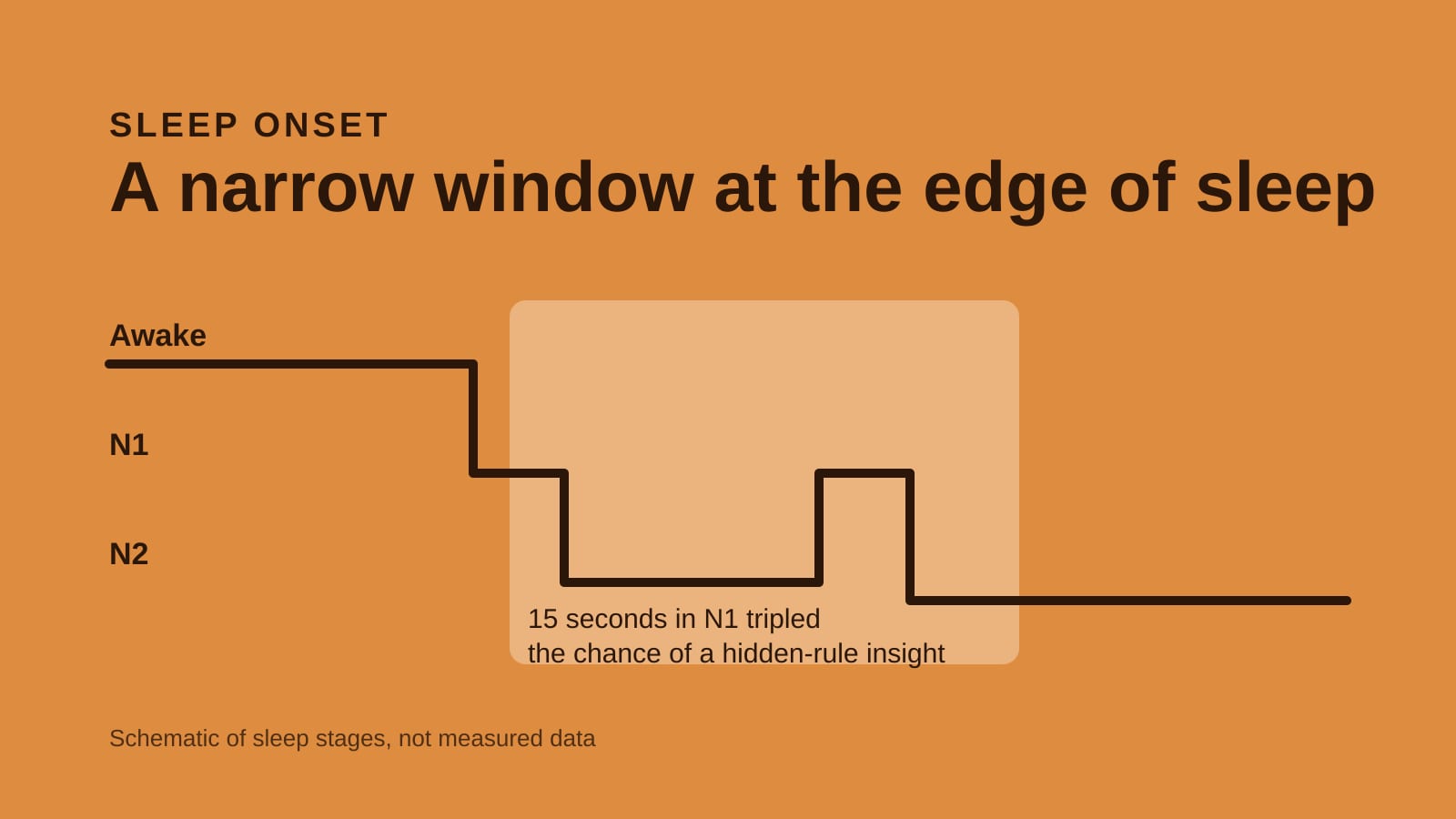
In 2021, Lacaux and colleagues gave 103 people math problems that hid a rule making each one solvable almost instantly. Then the participants rested for a period. Those who spent at least 15 seconds in N1, the twilight stage between waking and sleep, during that rest were about three times as likely to find the rule. The numbers were 83 percent against 30 percent for people who stayed awake. When people sank into deeper sleep, the advantage disappeared.
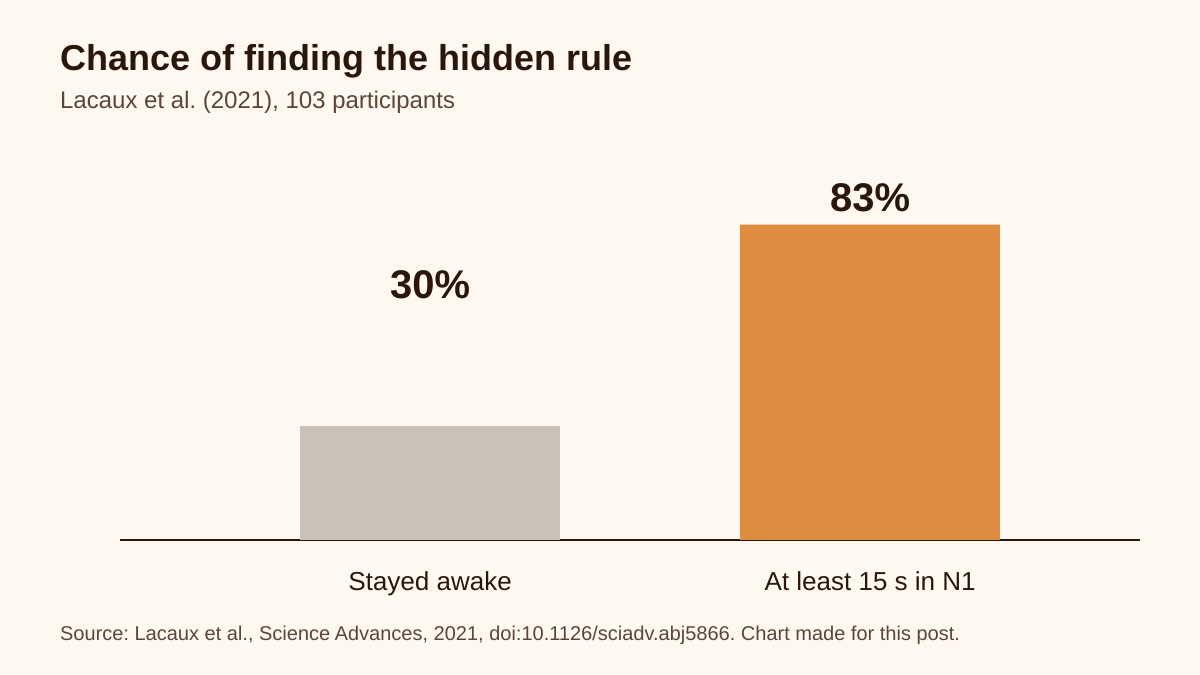
The authors called this a creative sweet spot at sleep onset. You need to fall asleep easily without falling too deep, and hitting that balance is the hard part.
When deeper sleep comes into it
In 2025, Löwe, Schuck and colleagues published a preregistered study in PLOS Biology. Preregistration means the hypotheses and analysis plan were written down before the data came in, which makes it harder to find a pattern after the fact. Ninety people did a perceptual insight task before and after a 20-minute daytime nap. The sleep EEG showed that N2 sleep, a deeper stage, increased the likelihood of insight after the nap. N1 did not.
That runs against the 2021 suggestion that N1 is the sweet spot. The two studies also used different tasks. Lacaux used math problems with a hidden rule, while Löwe used a perceptual task. The team also reported exploratory EEG analyses in which the slope of the brain's background activity predicted insight beyond sleep stage. The authors label those analyses exploratory, so treat them as a lead, not a result.
What this does and does not show
Taken together, the studies point to sleep affecting the moment a solution clicks, not to a general boost in creative output. Each experiment measured one kind of problem in one lab session. None followed people through a week of real work, and none tested writing, design or planning.
The studies also do not show that rest helps in general. Lacaux's effect was tied to the twilight stage. Cai's effect appeared only for REM on the primed items, and the quiet-rest group, which listened to music, did not improve. The practical takeaway is small. Sleep is a plausible help for the sudden click, and nothing here shows that more sleep makes you more inventive over the long run.
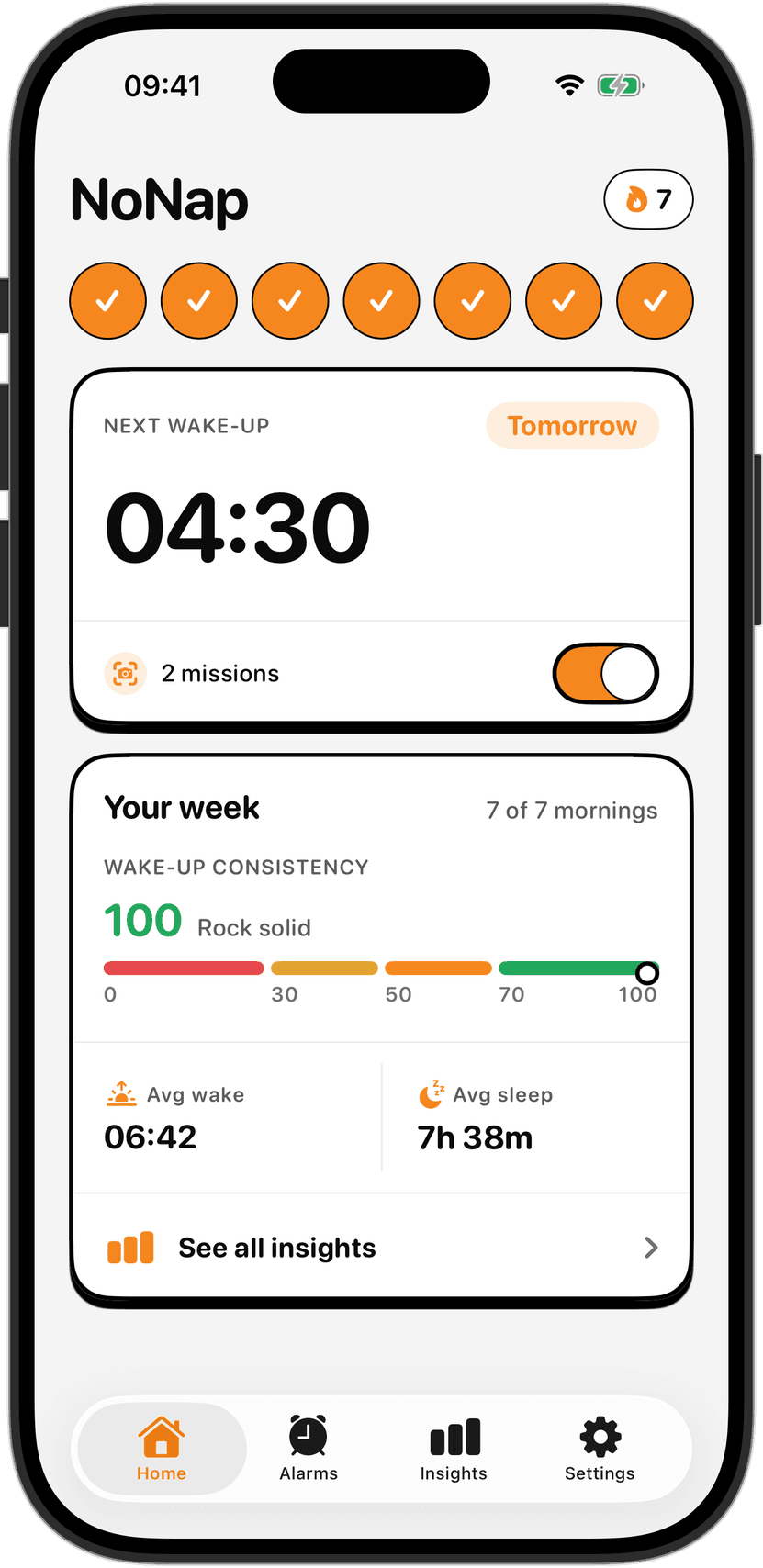
Ideas that arrive around waking are a separate question, and none of these studies measured the groggy minutes after an alarm. NoNap cannot be dismissed from the lock screen, so the first minutes of the morning go to the wake task you chose rather than to the lock screen. Whether that changes what you think of is untested. If you wake with a half-formed idea, a notebook by the bed will keep it better than memory will.
Sources
Wagner, U., Gais, S., Haider, H., Verleger, R., and Born, J. (2004). Sleep inspires insight. Nature, 427, 352-355. doi:10.1038/nature02223
Cai, D. J., Mednick, S. A., Harrison, E. M., Kanady, J. C., and Mednick, S. C. (2009). REM, not incubation, improves creativity by priming associative networks. Proceedings of the National Academy of Sciences, 106(25), 10130-10134. doi:10.1073/pnas.0900271106
Lacaux, C., Andrillon, T., Bastoul, C., Idir, Y., Fonteix-Galet, A., Arnulf, I., and Oudiette, D. (2021). Sleep onset is a creative sweet spot. Science Advances, eabj5866. doi:10.1126/sciadv.abj5866
Löwe, A. T., Petzka, M., Tzegka, M. M., and Schuck, N. W. (2025). N2 sleep promotes the occurrence of 'aha' moments in a perceptual insight task. PLOS Biology, e3003185. doi:10.1371/journal.pbio.3003185