Sleep stages: what REM and deep sleep actually do
Why sleep cycles through different stages, what each one does for your body and mind, and why waking during deep sleep feels like drowning.
Visana Studios
6 min read
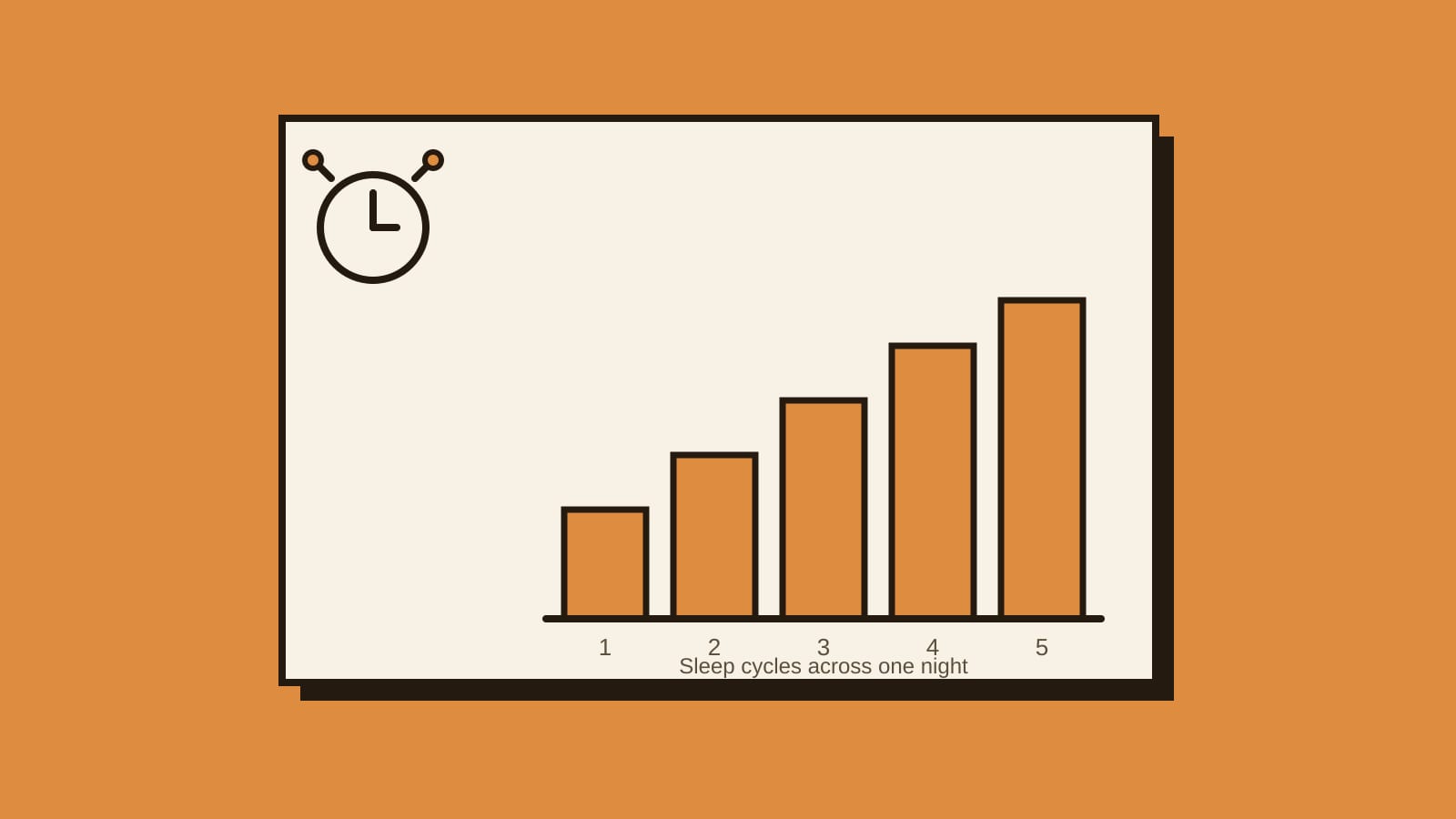
Sleep is not a uniform rest. A night of sleep cycles through five distinct stages, each one doing different jobs your awake hours left undone. The cycle takes roughly 90 minutes from start to finish, and your body runs through it four to six times a night. Knowing which stage does what helps explain why some nights leave you groggy despite hours of sleep, and why pulling an all-nighter has consequences that can't be fixed by a single good sleep the next day.
The NREM stages: three levels of deeper sleep
NREM stands for non-rapid eye movement, and it makes up about 75 percent of a night. It begins the moment you fall asleep, and it has three distinct stages marked by increasingly slow, deep brain wave patterns.
N1, the transition. This is the lightest stage, lasting only a few minutes when you first doze off. Your muscles relax, heart rate slows, and your brain waves shift from the alpha patterns of quiet wakefulness to something slower. This stage is short. Sleep studies find it takes up only about 5 percent of your night. You can still wake easily here, and if someone nudges you a few seconds after you drift off, you probably won't feel like you actually fell asleep at all. The boundary between wakefulness and sleep is blurry in N1. Your brain is transitioning. Eyes might move a bit. You are not yet fully asleep.
N2, light sleep with memory work. This stage lasts longer than N1 and makes up the largest chunk of your sleep, roughly 45 percent of the night. Your body temperature drops further. Brain activity shows distinctive patterns called sleep spindles: brief, powerful bursts of neural firing that researchers believe support memory consolidation. Studies have found that sleep spindles are particularly important for learning motor skills. Practicing a task then sleeping on it helps your brain file it away more durably than if you kept practicing without sleep. Declarative memory, the kind that holds facts and experiences, also consolidates during N2. Your body is locked in, but your brain is not idle. It is organizing and filing.
N3, deep sleep. The deepest stage makes up about 25 percent of your sleep time, and it is the most restorative. Your brain produces long, slow delta waves. Arousal becomes difficult. A loud sound or someone shaking your shoulder might not wake you. This is the stage where the body repairs and regrows tissues, builds bone and muscle, and strengthens the immune system. Growth hormone peaks during N3. This is when your body does maintenance. It is also when confusional arousals happen: the disoriented state where someone half-wakes and speaks incoherently or struggles against being touched, not fully conscious either way. Sleepwalking and night terrors occur in deep sleep. And this is the stage where sleep inertia, that immediate post-waking fog, is most severe. Dragging yourself out of N3 feels harder than waking from lighter stages. Your brain needs time to come back online. Someone roused from deep sleep in the first five minutes can be genuinely confused, clumsy and groggy.
REM sleep: dreams and brain maintenance
REM, rapid eye movement sleep, makes up about 20 to 25 percent of your night in healthy adults. It is fundamentally different from NREM. Your eyes move rapidly beneath closed eyelids. Your brain activity spikes to near-waking levels. Brain metabolism increases by up to 20 percent compared to wakefulness. Yet your skeletal muscles are paralyzed. The reason for this paralysis is thought to be a protective mechanism, preventing you from acting out your dreams. Without it, you would punch, kick and thrash through the night.
Dreaming happens primarily during REM, though brief dream-like experiences can occur in any stage. The purpose of REM sleep is not fully understood, but research points to memory consolidation of a different kind than NREM handles. While NREM consolidates facts and motor skills, REM appears to integrate memories into existing knowledge, link memories together, and help distinguish between similar experiences so they do not blur. REM also seems protective against memory distortion. After NREM-heavy sleep, your memory for facts is stronger. After REM-heavy sleep, your memories are more flexible, less prone to rigid detail and more integrated into the bigger picture.
REM gets longer as the night goes on. Your first REM period might last only 10 minutes. By your last sleep cycle, near morning, REM can stretch to an hour. This is why sleep needs time to work. The first sleep cycle delivers deep N3, the restoration. The later cycles deliver long REM, the memory integration. Cutting your night short by waking at six instead of eight means losing both the longest REM period and the N3 deep sleep that dominates the first cycle.
Why sleep architecture matters in the morning
The reason sleep stages matter for how you feel when your alarm goes off is simple. Waking from deep N3 feels qualitatively different from waking from light N1 or even from REM. Your brain needs time to exit deep sleep, not just to open your eyes but to regain full alertness. That gap between your alarm and your actual wakefulness is sleep inertia, and it is worst when you wake from the deepest stage. Some people manage to drag themselves up and keep moving. Others need 20 or 30 minutes to feel human again.
Sleep trackers and calculators that claim to wake you at a specific time in your cycle assume your sleep stage will be where they predict it to be. They often are not. Sleep cycles are individual. Some people's sleep cycles run long, others short. Your cycle length varies by night. Lighting, temperature, stress and sleep debt all shift when you enter which stage. The calculator might predict you will be in light sleep at six, but life rarely works that neatly.
What you can control is sleep duration. A full night gives you the cycles you need. A short night, especially one cut short in the early morning hours, means you are waking into whatever stage happens to be there. The CDC and the National Academies recommend seven to nine hours a night for most adults, partly because that time is usually enough to get four complete 90-minute cycles, each one with its own deep sleep and its own REM. One good night does not fix sleep debt. Your brain and body consolidate memory and repair tissue across nights. Missing sleep compounds. Sleeping ten hours the next night does not restore what was lost the night before, not fully, particularly for cognitive function, which research shows depends on consistent sleep architecture night after night.
NoNap is built for people who have already decided their wake time and want no negotiation about it once the alarm rings. But a wakeup is smoother when it lands outside deep sleep. A fixed wake time makes sleep more predictable, and predictable sleep shifts toward more regular cycles. That consistency matters more than the specific hour. Your body builds better sleep architecture when the wake time does not move.
Sources
NCBI Bookshelf. Physiology, Sleep Stages. https://www.ncbi.nlm.nih.gov/books/NBK526132/
NCBI Bookshelf. Physiology, REM Sleep. https://www.ncbi.nlm.nih.gov/books/NBK531454/
Nature Communications Biology. Both slow wave and rapid eye movement sleep contribute to emotional memory consolidation. https://www.nature.com/articles/s42003-025-07868-5
NCBI PMC. Sleep Microstructure and Memory Function. https://www.ncbi.nlm.nih.gov/pmc/articles/PMC3795358/
NCBI PMC. NREM2 and Sleep Spindles Are Instrumental to the Consolidation of Motor Sequence Memories. https://www.ncbi.nlm.nih.gov/pmc/articles/PMC4816304/
Cleveland Clinic. Sleep: What It Is, Why It's Important, Stages, REM & NREM. https://my.clevelandclinic.org/health/body/12148-sleep-basics