Why your body temperature rises before you wake up
Core body temperature hits its low in the middle of a typical night, then climbs toward morning. Here is what measurements show about that rhythm and waking.
Visana Studios
4 min read
Your core body temperature does not stay flat through the night. It drops through the first part of sleep, bottoms out, and then climbs toward morning. That climb is one of the clearest markers of where you sit in your daily body clock, and it varies more from person to person than most people expect.
Where the low point lands
The most detailed measurements come from a 2000 study by Erin Baehr, William Revelle and Charmane Eastman. They recorded core body temperature continuously for six days in 101 young men and 71 young women, using ambulatory monitoring during ordinary life. For each person and each day, they fitted a cosine curve to find the lowest point of the rhythm, called Tmin.
The average Tmin came at 03:50 for morning types, at 05:02 for people who were neither morning nor evening types, and at 06:01 for evening types. Across the group, the low fell about mid-way through an eight-hour sleep period. In people whose low came later, and who scored higher on eveningness, it sat closer to the time they woke. Men's lows came about half an hour later than women's.
Put simply, two people can sleep from 23:00 to 07:00 and spend that night on very different parts of their temperature cycle. The evening type's low arrives close to waking, so the body is still on the falling side for most of the night. The authors suggested this offset may explain why evening types feel more alert at bedtime and sleepier after they wake.
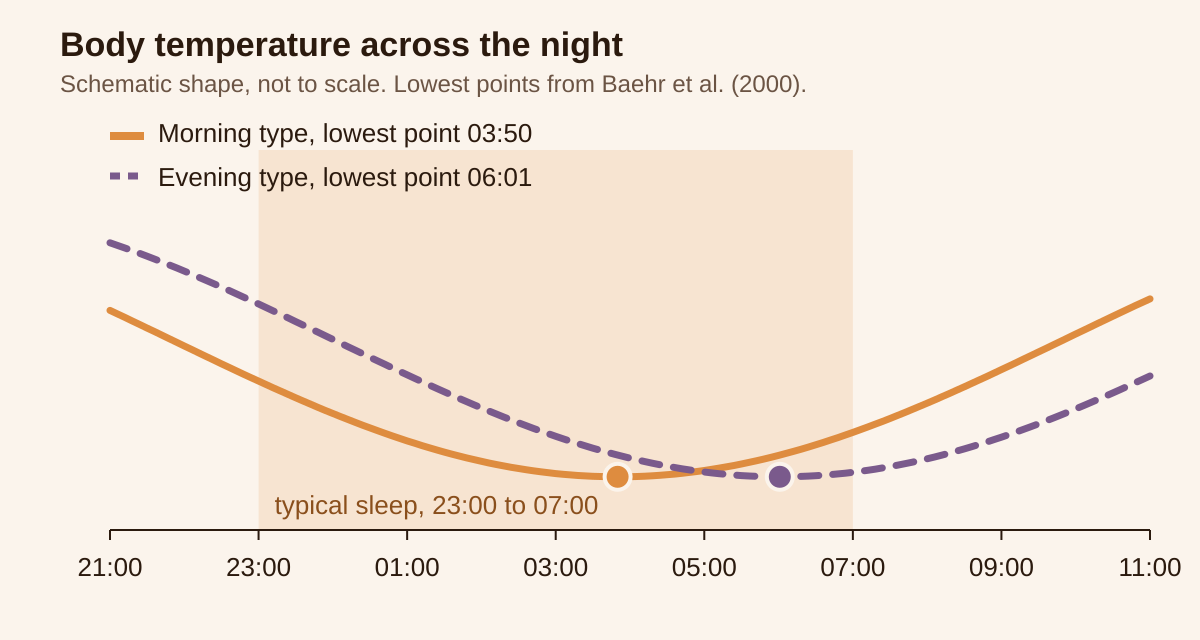
The shape is the same in both curves. Only the timing changes. A morning type's low lands earlier, so the final hours of a normal night are already on the rising side. An evening type's low arrives later, so the same alarm sits closer to the bottom of the curve.
What the rising side does to sleep
A 1999 study by Derk-Jan Dijk, Jeanne Duffy, Eymard Riel, Theresa Shanahan and Charles Czeisler used a laboratory method called forced desynchrony. Sleep was scheduled at many different points in the body clock, so the researchers could separate the clock's influence from the influence of how long someone had been awake. The study included 13 older adults and 11 young men.
Sleep propensity, meaning how easily sleep came, followed the circadian rhythms of body temperature and melatonin. Sleep latency was longest just before melatonin release began, and shortest near the temperature minimum. In older adults, sleep was lighter and less consolidated, with less slow-wave sleep. The authors attributed those differences to a weaker homeostatic drive for sleep, and to a weaker circadian push toward sleep in the early morning.
That last part matters for mornings. The temperature low is when the clock supports sleep most, and as the curve climbs, that support fades. The study is small and used older adults and young men, so it describes a pattern across groups, not a rule for any one person.
Why this matters for getting up
The temperature rhythm does not explain the whole feeling of morning heaviness. Sleep inertia, the grogginess that follows waking, depends on more than where you are in your cycle. The sleep inertia post covers the other factors, such as how deep the sleep was before the alarm. Still, the body clock sets the background against which those factors play out.
The practical lesson is about timing. If your temperature low lands late, an early alarm asks you to wake while your body is still well inside its own night. Keeping a steady wake time gives the body clock a fixed reference, and the morning light article explains how daylight shapes that clock, and the chronotype post looks at why some people fall naturally late.
Circadian phase is also measured in clinical work. Baehr and colleagues note that phase estimates help in designing treatment for jet lag and shift work, and in diagnosing circadian rhythm sleep disorders such as delayed sleep-phase syndrome. If your sleep timing stays far from what you need, even with steady habits, a doctor or sleep clinic can assess it properly. Nothing in this post is a diagnosis.
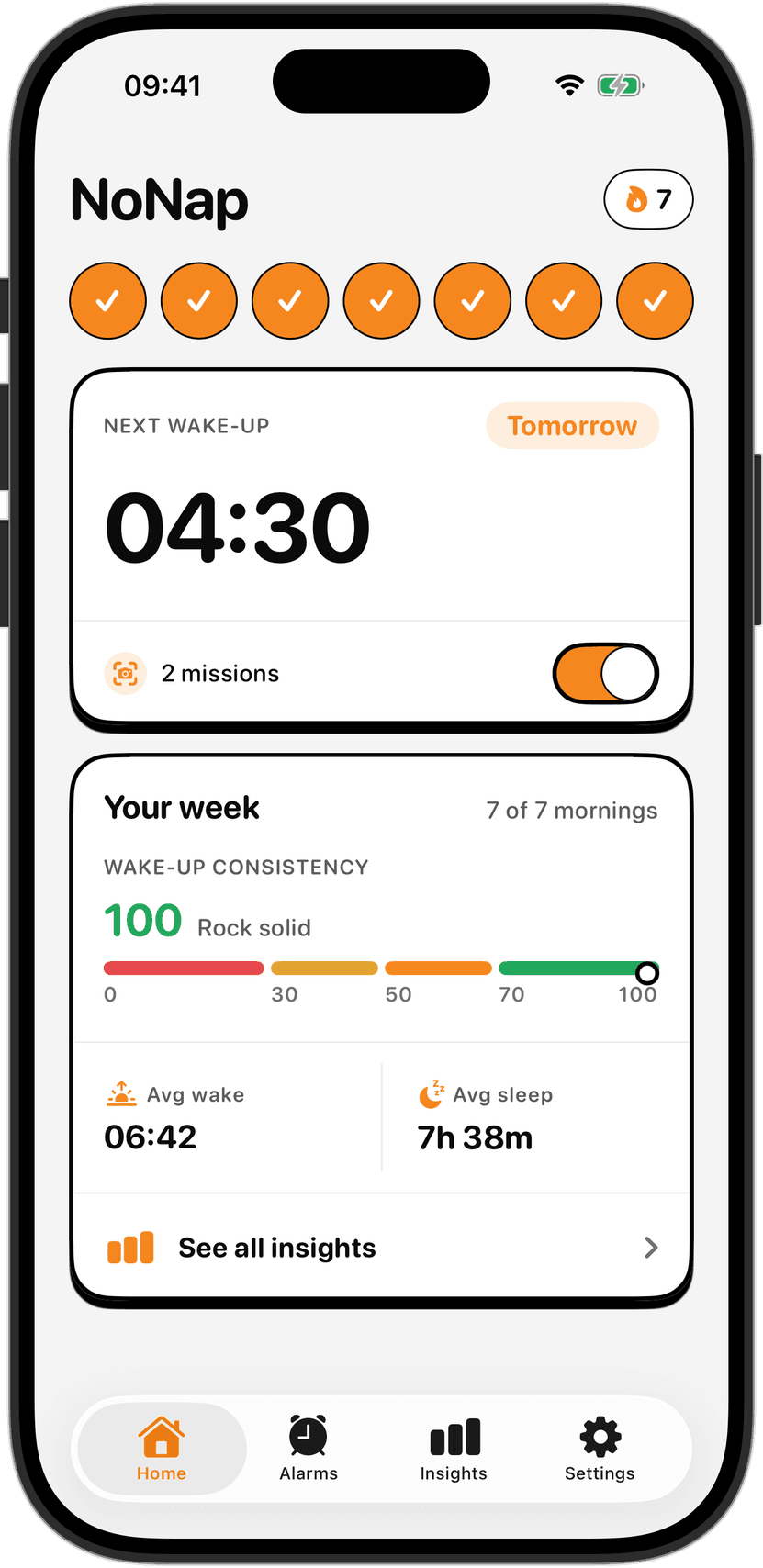
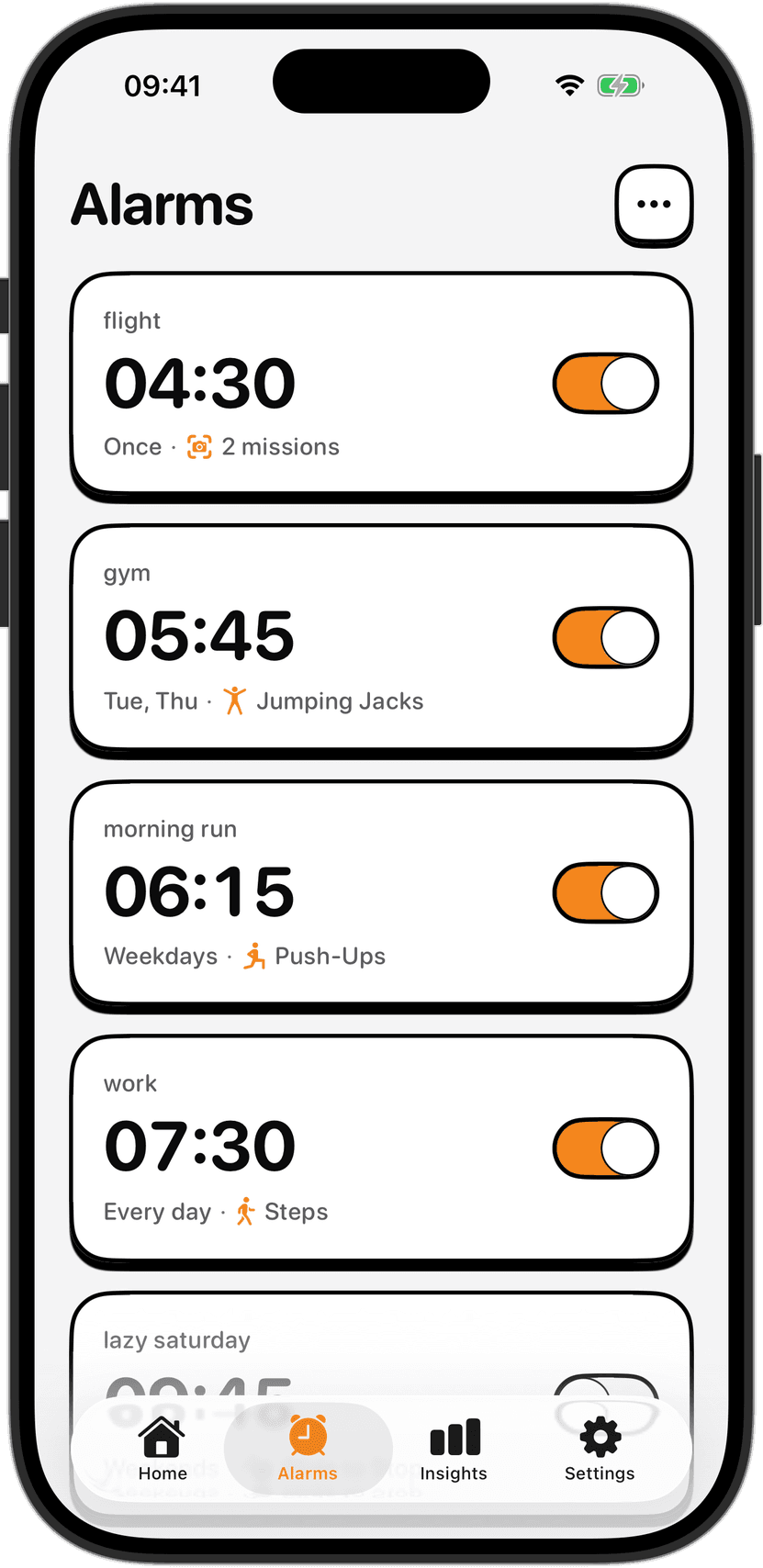
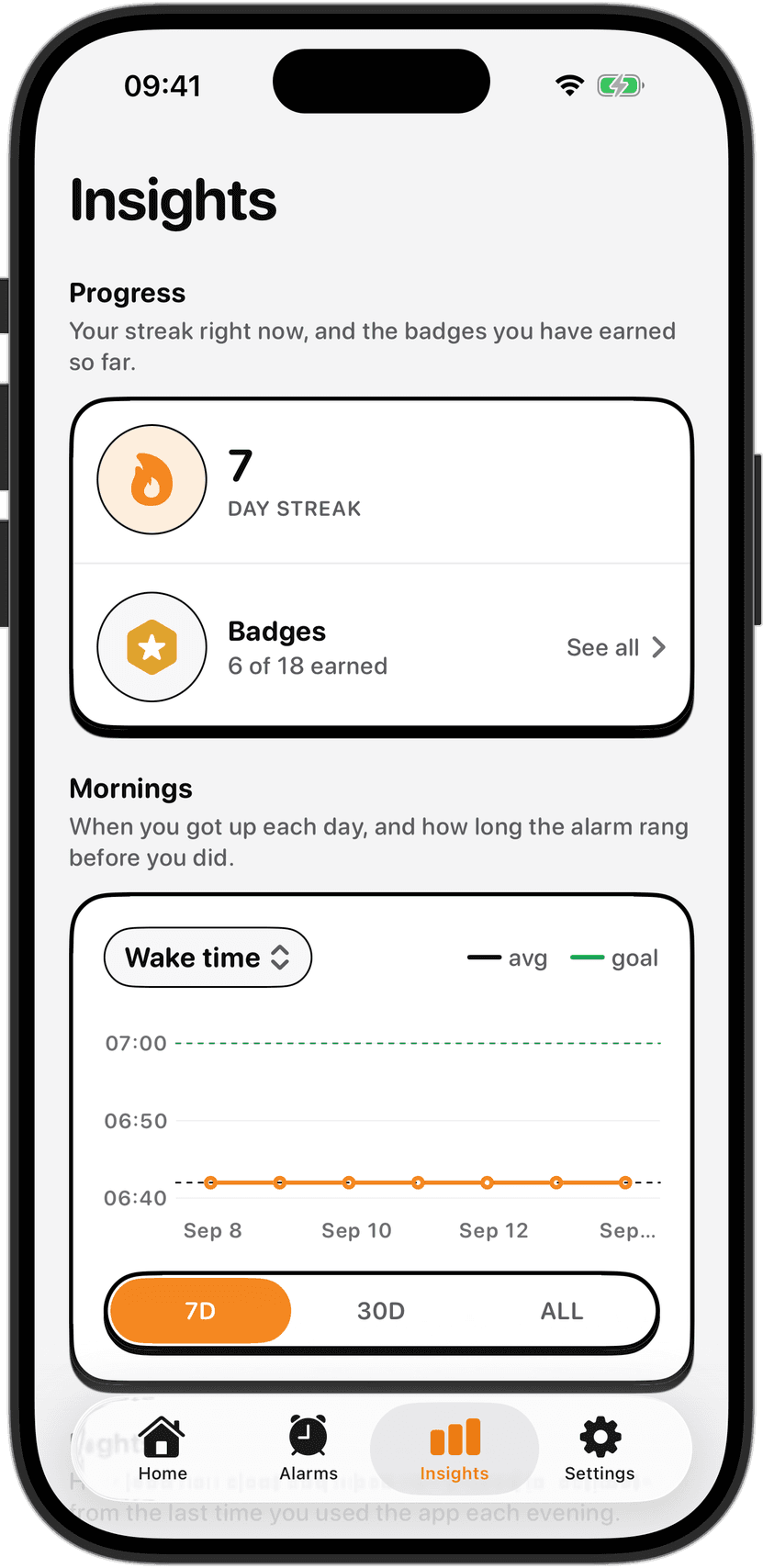
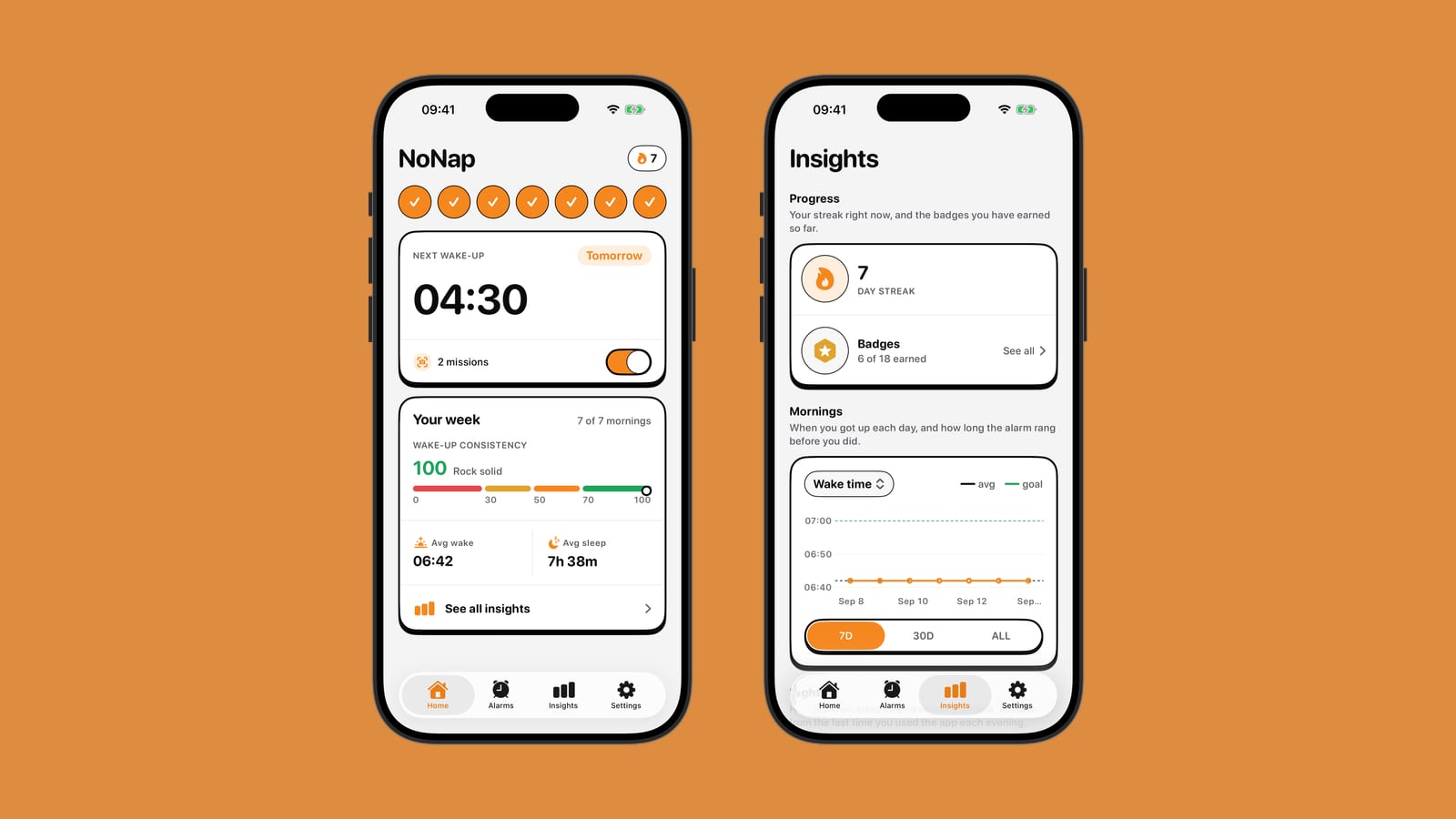
NoNap cannot measure your body temperature, and it does not track your sleep. What it does show is the gap between the wake time you set and the time you actually got up, through the streaks and wake-up charts on the insights screen. Over a few weeks, that record can show whether a 06:30 alarm is realistic for your body, or whether a slightly later time fits your rhythm better. Choose a wake task you can do safely on a bad morning, and pick a time you can keep.
Sources
Baehr, E. K., Revelle, W. and Eastman, C. I. (2000). Individual differences in the phase and amplitude of the human circadian temperature rhythm: with an emphasis on morningness-eveningness. Journal of Sleep Research, 9(2), 117 to 127. Read at https://www.personality-project.org/revelle/publications/baehr.revelle.eastman.pdf. The study reported the mean Tmin times for morning, neither and evening types, the sample of 101 men and 71 women, and the sex difference in Tmin timing.
Dijk, D.-J., Duffy, J. F., Riel, E., Shanahan, T. L. and Czeisler, C. A. (1999). Ageing and the circadian and homeostatic regulation of human sleep during forced desynchrony of rest, melatonin and temperature rhythms. The Journal of Physiology, 516(Pt 2), 611 to 627. doi:10.1111/j.1469-7793.1999.0611v.x. Read at https://pmc.ncbi.nlm.nih.gov/articles/PMC2269279. The study reported 13 older adults and 11 young men, sleep latency relative to the temperature minimum and melatonin rise, and the authors' explanation for poorer sleep in older adults.
Image credits
The cover shows two NoNap app screens, taken from the studio's own screenshots. The diagram of the temperature cycle was made for this post and is based on the minimum times reported by Baehr and colleagues.