Waking up from a nightmare: how common it is and what helps
Up to 85% of adults report a nightmare each year. What the research says about how often they happen, the link to trauma, and which treatments work.
Visana Studios
5 min read
Nightmares are more common than most people assume. In a review of adult studies, Hasler and Germain reported that up to 85 percent of adults describe at least one nightmare within a year. Monthly nightmares show up in 8 to 29 percent of adults, and weekly ones in 2 to 6 percent. The weekly figure matters for treatment, because the controlled trials of imagery rehearsal therapy enrolled people who had at least one nightmare a week.
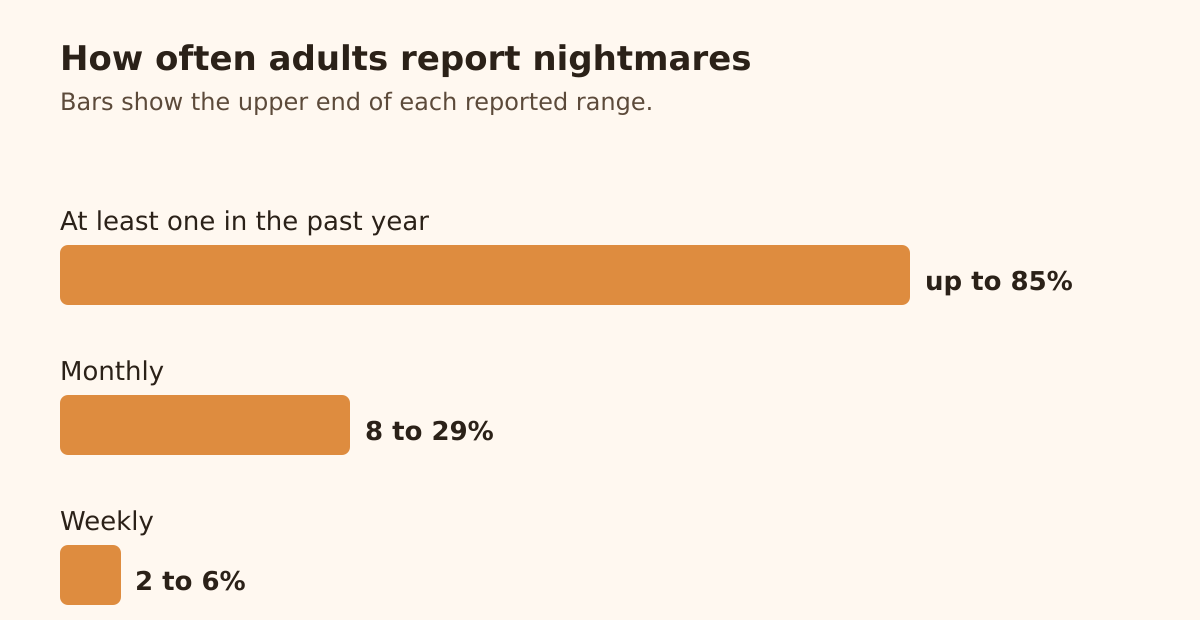
Those numbers come with a caveat. The authors note that retrospective questionnaires may underestimate how often nightmares happen compared with prospective logs, and they call prospective logs the gold standard.
Nightmare disorder and where the line sits
The American Academy of Sleep Medicine estimates that nightmare disorder affects about 4 percent of adults in the United States. That is a clinical label, not a description of a bad week. It applies when nightmares are frequent enough and distressing enough to cause real problems.
The definitions have changed over time. Older versions differed on whether the nightmare had to cause distress during the day, which made comparing studies harder. A nightmare that wakes you once and never comes back is a different situation from a dream that returns every few nights and leaves you dreading bedtime.
What seems to drive them
Hasler and Germain are candid about the limits of the evidence. Most of the studies they reviewed were cross-sectional, which means they took a snapshot of people at one point in time. That makes it hard to tell what causes what. They suggest that trauma, distress on waking and disturbed sleep may each feed into nightmares that start and then persist.
Stress belongs in that picture as well, but the review does not establish it as a direct cause. The safer reading is that nightmares sit inside a wider pattern of trauma, waking distress and disturbed sleep, and that the pattern is hard to untangle from snapshot data.
Distress may matter more than frequency
Several researchers argue that distress matters more than how often a nightmare happens. Hasler and Germain report that distress is only weakly related to frequency. It tracks more closely with anxiety and with sleep disturbance. Two people who have the same number of nightmares can have very different daytime lives if one of them dreads sleep and the other shrugs the dream off.
Measuring distress is harder than counting nights. The authors note that only one validated scale exists, the Nightmare Distress Scale, and that it may blur the line between distress and frequency. That is a reason to be cautious about any single number a sleep tracker or questionnaire gives you.
Nightmares and PTSD
Nightmares are a core feature of post-traumatic stress disorder. Hasler and Germain report that up to 90 percent of people with PTSD describe dreams that resemble the traumatic event. Those nightmares can continue for decades. A history of nightmares before a trauma predicted how severe PTSD became afterward, and nightmares that persisted after the event predicted later symptoms.
If nightmares started after a traumatic event, that is worth raising with a doctor or a therapist. Specific treatments exist for trauma-related nightmares, and the position paper discussed below covers them directly.
What treatment research shows
The treatment with the most evidence is imagery rehearsal therapy. You take a recurring nightmare, rewrite it into a version that is no longer distressing, and rehearse the new version while awake. The approach differs from exposure therapy because it does not require you to re-experience the frightening material. In controlled studies, people who had at least one nightmare a week reported fewer nightmares and better sleep. A large trial in sexual assault survivors also found lower PTSD symptoms compared with a wait-list group.
In 2018 the American Academy of Sleep Medicine published a position paper on treating nightmare disorder in adults. It recommends imagery rehearsal therapy for PTSD-related nightmares and for nightmare disorder, pointing to nine randomized controlled trials. The authors are clear that this is a position paper rather than a formal clinical guideline, because the evidence was limited. They did not use a grading system, and many of the studies reviewed predate the current diagnostic criteria for nightmare disorder.
The paper also discusses medication. It still calls prazosin the first choice for pharmacologic treatment in clinical practice, although it downgrades its own recommendation for it. Medication decisions belong with a doctor, who can weigh the options against your health history.
When to see someone
Occasional bad dreams after a stressful week are common and usually pass. It is worth talking to a doctor if nightmares happen most weeks, if they leave you afraid to fall asleep, if they make the bedroom feel like a place to avoid, or if they began after a trauma. A doctor can check for other causes of disturbed sleep and go through treatment options with you.
Where an alarm fits
An alarm cannot stop a nightmare, and it will not help you fall back asleep. Those are sleep problems, and the research above is where to look for help with them. What an alarm can do is keep a rough night from turning into a missed morning.
NoNap is an iPhone alarm. It is built around one alarm and one wake-up task you have to finish before it stops, and it cannot be dismissed from the lock screen. For a morning after a bad night, that structure can be useful. If nightmares are keeping you awake most nights, though, the first step is to talk to someone about the nightmares themselves.
Sources
Hasler BP, Germain A. Correlates and treatments of nightmares in adults. Sleep Medicine Clinics. 2009;4(4):507-517. doi:10.1016/j.jsmc.2009.07.012. Available at https://pmc.ncbi.nlm.nih.gov/articles/PMC2806673/. Source for the adult frequency figures (up to 85 percent yearly, 8 to 29 percent monthly, 2 to 6 percent weekly), the note that prospective logs are the gold standard, the PTSD figures (up to 90 percent), the distress findings, and the description of imagery rehearsal therapy.
Position Paper for the Treatment of Nightmare Disorder in Adults: An American Academy of Sleep Medicine Position Paper. Journal of Clinical Sleep Medicine. 2018;14(6):1041-1055. doi:10.5664/jcsm.7178. Available at https://pmc.ncbi.nlm.nih.gov/articles/PMC5991964/. Source for the 4 percent prevalence of nightmare disorder in US adults, the recommendation of imagery rehearsal therapy, the nine randomized controlled trials, the statement that the document is a position paper rather than a clinical guideline, the evidence limitations, and the comments on prazosin.
Image credits
The cover and the frequency chart were made for this post. The chart uses the figures from Hasler and Germain (2009) listed above.