How to wake up early when you are not a morning person
You don't have to be a morning person to wake up early. Here are the tactics that work for night owls who need to rise early.
Visana Studios
9 min read

The idea that only "morning people" can wake up early is a useful myth. It lets you off the hook. But it is not true. You don't have to be naturally wired to wake at 5 a.m., enjoy the quiet hours, or find mornings energizing. You just need to understand what makes mornings hard and build systems that work anyway.
Sleep inertia (that dense, cognitively sluggish state you wake into) is deepest in the first 10 to 15 minutes and is not a character defect. It is a neurobiology. Your brain is literally switching between sleep and wakefulness. During that transition, your prefrontal cortex, responsible for decision-making and impulse control, is the last to come online. This is why the snooze button exists and why you hit it. Your waking brain is not yet capable of choosing to stay up. What looks like laziness is a neurological fact. That insight changes what works. If willpower fails for the first 10 minutes, do not rely on willpower. Rely on systems.
The first 30 minutes are not optional
The morning is not won or lost at the alarm. It is won or lost in the first half hour after waking. During this window, sleep inertia fades, your core body temperature rises, light exposure resets your circadian rhythm, and your brain accumulates the adenosine that builds throughout the day. Everything that happens now cascades into your alertness for the rest of the morning.
The worst strategy is one that leaves you in bed thinking, or even moving slowly through a calm routine. Your brain is not yet ready for slow. It needs a jolt.
The alarm needs to work without negotiation
If you can snooze, you will snooze. Not because you are weak, but because your drowsy brain sees one option (stay) and takes it. An alarm that cannot be negotiated with is not harsh. It is merciful. It removes the one decision your sleeping brain is capable of making.
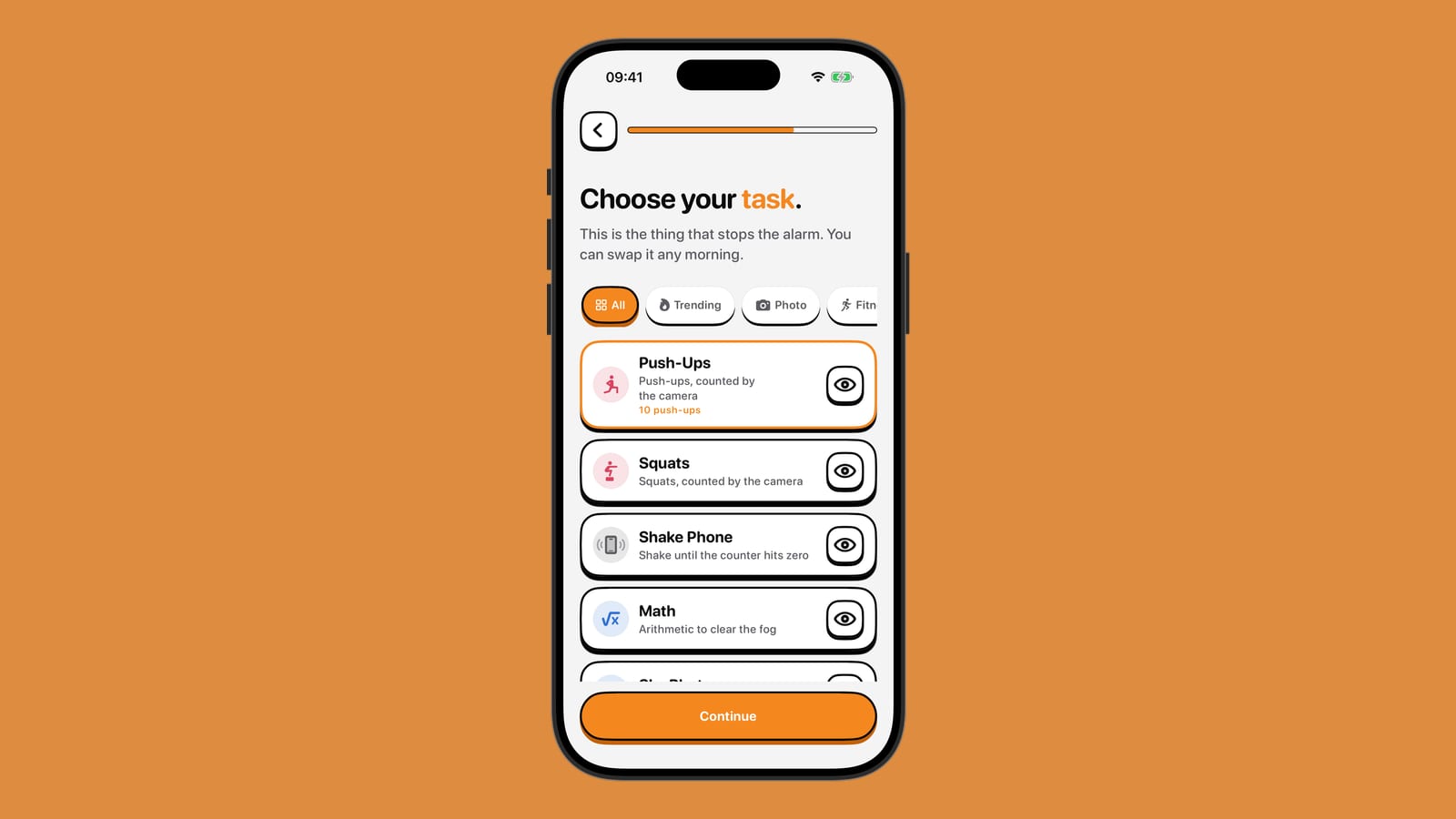
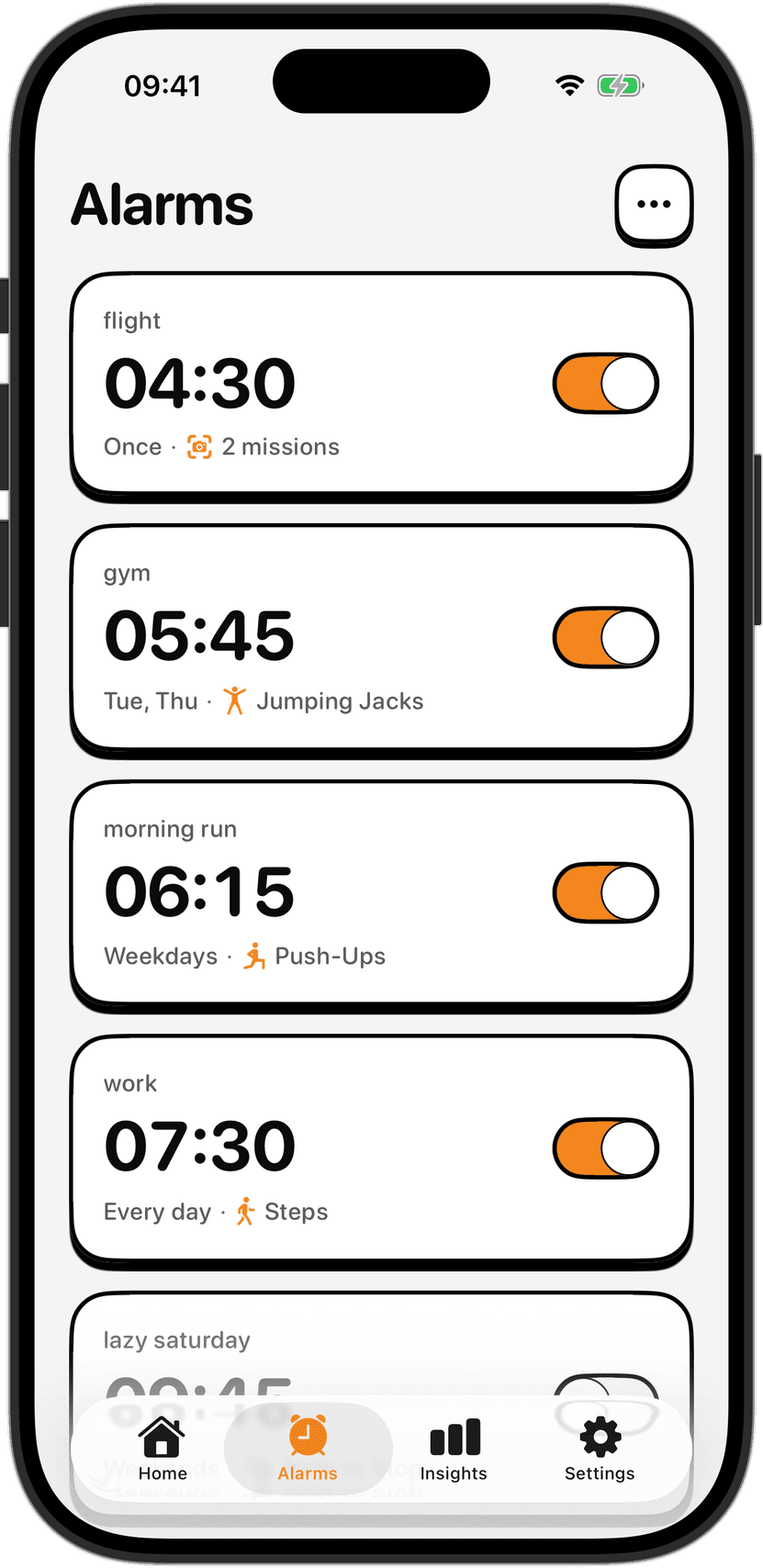
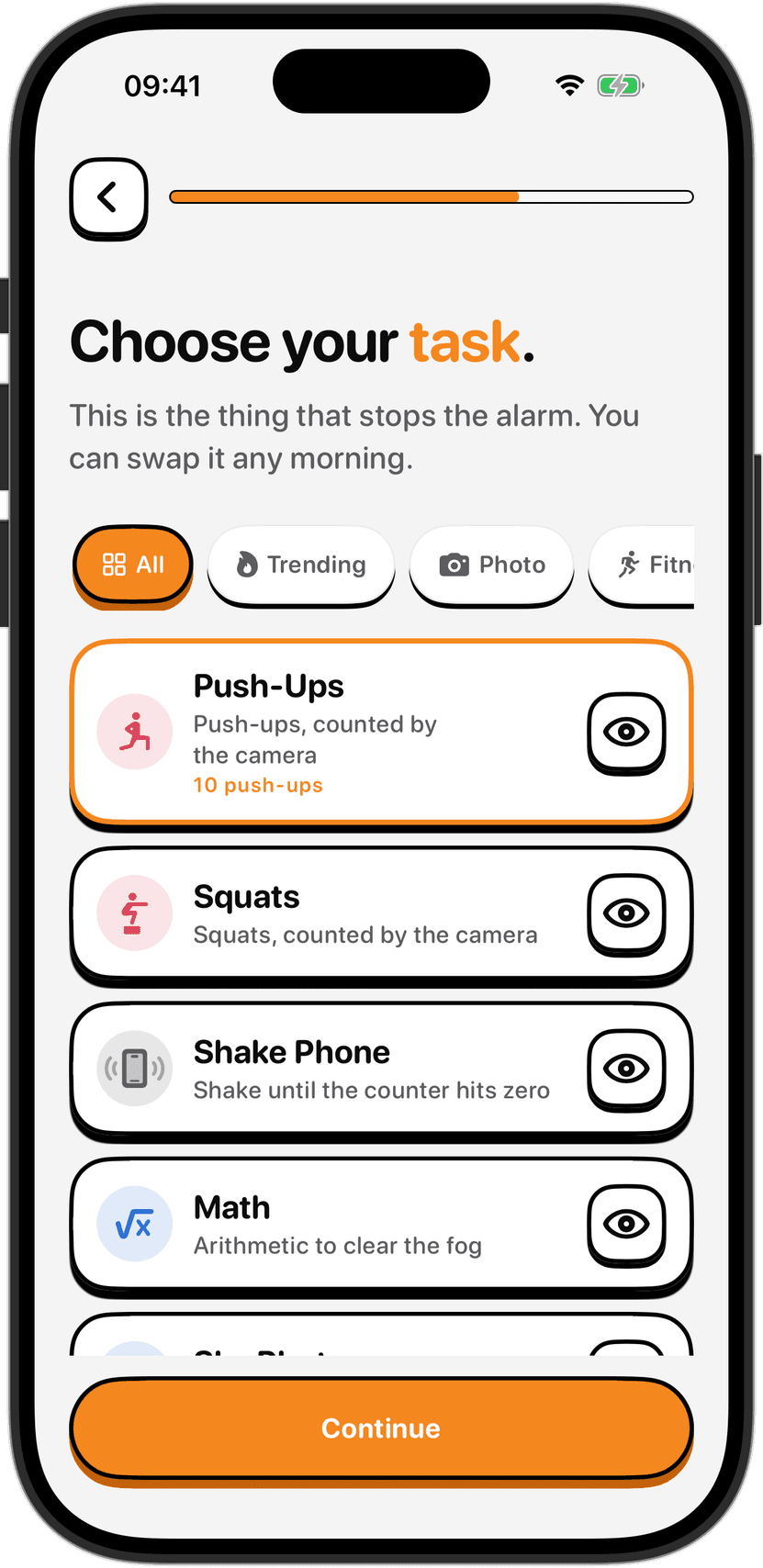
Place your alarm across the room, far enough that you have to leave the bed to silence it. Better yet, use an alarm app that requires you to do something after waking. A physical task, a math problem, a photo taken, anything that forces your still-sleeping brain to engage. No "OK Google" or swipe-to-silence. The alarm stays on until the task is done.
If you live with others and an alarm across the room is not possible, a vibrating alarm pad under the mattress or a vibrating watch ensures you wake without risking everyone else's sleep, and the physical sensation of vibration engages your nervous system at a different level than sound alone.
Light in the first 10 minutes rewires your clock
Your circadian rhythm (the 24-hour biological cycle that governs when you feel alert and when you feel sleepy) is set by light more than by anything else. Specifically, it is set by light exposure in the first hours after waking. This is not optional. Regardless of whether you are naturally a night owl or an early riser, morning light is the single strongest signal your body clock receives.
The mechanism works at the cellular level. Specialized cells in your eye called intrinsically photosensitive retinal ganglion cells, or ipRGCs, detect light and send signals to your brain's master clock, the suprachiasmatic nucleus. These cells are about 20 times more sensitive to blue wavelengths than the photoreceptors responsible for vision itself. Sunlight contains plenty of blue. Your bedroom lamp does not.
The tactic is simple: get outside or near a window in the first 10 to 15 minutes after waking. Even on an overcast day, outdoor light is 100 to 200 times brighter than typical indoor lighting and is sufficient to trigger the cascade. Five to 15 minutes is enough. If you cannot get outside, a light therapy lamp rated at 10,000 lux, used close to your face for 20 to 30 minutes, produces a measurable effect.
This is not comfort. This is neuroscience. Your night-owl circadian rhythm will not shift into permanent early-riser mode. But consistent morning light exposure will nudge your internal clock earlier by 30 minutes to 90 minutes, depending on your genetics and how consistently you do it. That shift is the difference between waking at your body's preferred time and waking one to three hours earlier than you would choose. It stays in place only as long as you keep doing it.
Cold water, then movement
Sleep inertia is partly thermal. Your core body temperature drops while you sleep and is lowest when you first wake. Until your temperature rises, your brain is not fully alert. Two things raise it fast: cold water and movement.
A cold shower is not necessary. Splashing cold water on your face, rinsing your hands, even holding a cold can or cold water bottle works. The shock triggers a cascade of wakefulness. Your heart rate increases, your breathing deepens, and your alertness spikes. This lasts 10 to 20 minutes, which is enough to carry you through the densest part of sleep inertia.
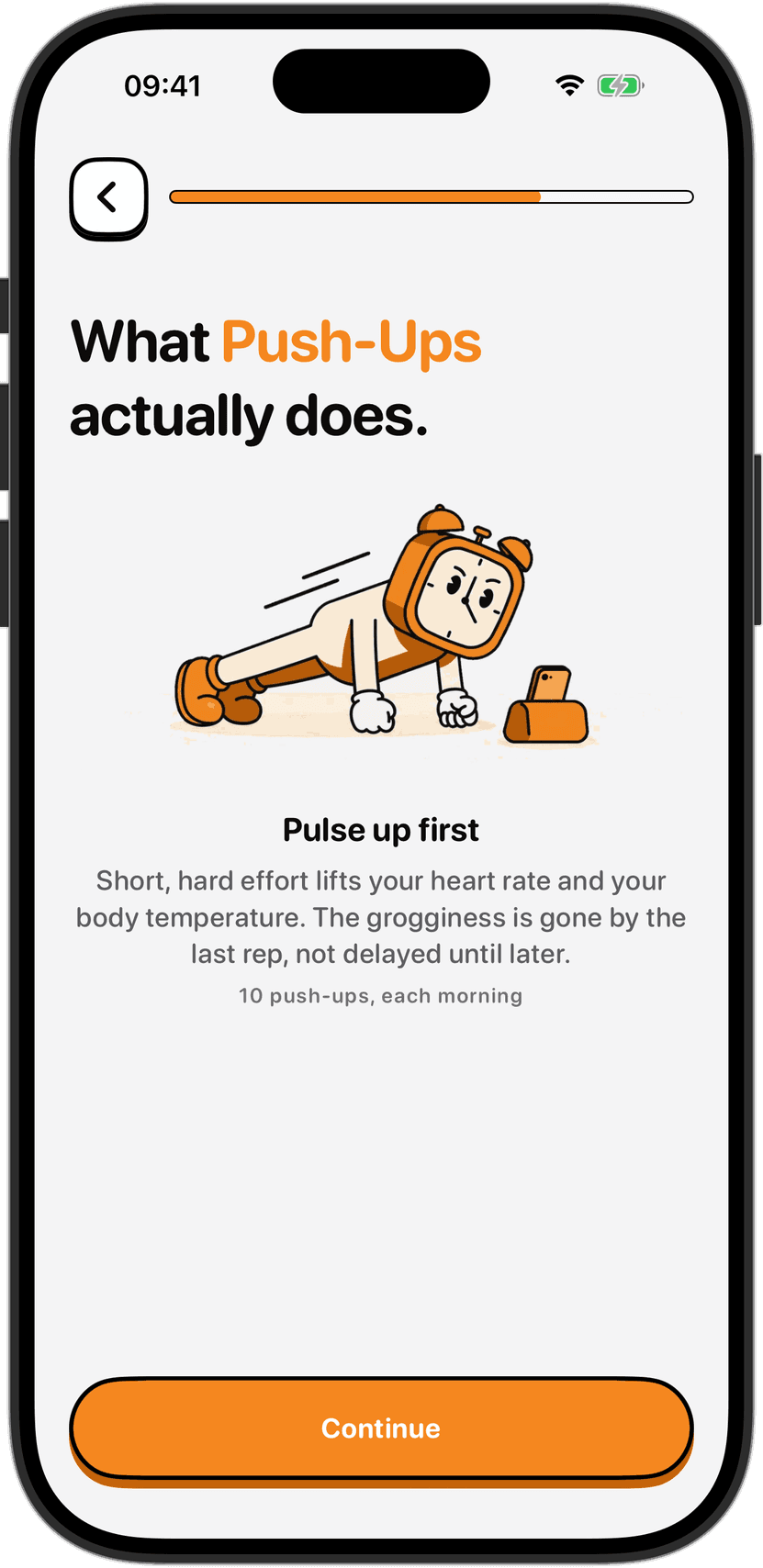
Movement does the same work. Any physical activity (walking, stretching, climbing stairs, doing push-ups, or dancing) raises your core body temperature and accelerates your transition to wakefulness. Exercise done in the first hour of waking has the added benefit of shifting your circadian rhythm earlier than evening exercise would, making tomorrow's wake-up easier.
If your mornings are rushed, five minutes of movement is better than zero. If you have the space and ability, 10 to 20 minutes of light aerobic activity or a brief strength routine produces more effect, but the difference is measured in minutes of increased alertness, not hours.
Skip breakfast, drink water
Your digestive system is designed to kick off when the sun rises and food is available. If you eat immediately after waking, your body directs blood flow and energy toward digestion. Meanwhile, your brain is trying to come online, and you just pulled resources away. Wait at least 30 minutes, better yet an hour, before eating.
Hydration is the opposite. You have not drunk anything for eight hours. Your blood volume has dropped slightly, which contributes to grogginess and the sensation of heaviness. Drinking a glass of water immediately after waking and another 15 minutes later rehydrates you and increases blood volume. This is measurable. Dehydration amplifies sleep inertia. Rehydration reduces it.
Caffeine makes sense (it blocks adenosine receptors and makes you feel alert) but the timing matters. If you drink coffee immediately upon waking, your peak caffeine effect comes about 45 minutes later, around the time you need to be engaged and focused. Perfect. But if you do not eat, the caffeine hits harder and lasts longer. Eat something 30 to 60 minutes after waking, once you are already alert and the worst of sleep inertia has passed.
Your bedroom temperature should not be comfortable
A comfortable bedroom (warm, cozy) is a wonderful place to sleep. It is a terrible place to wake. Your body initiates sleep by cooling down. If your bedroom is warm, sleep is fragmented, you spend more time in light sleep and less in deep sleep, and you wake groggier. Waking in a warm room keeps your core body temperature low, which prolongs sleep inertia.
The optimal bedroom temperature for sleep is 60 to 67 degrees Fahrenheit, with 65 to 68 degrees being the practical target for most people. But for the first morning minutes, even colder is better. If you can manage it, allow the temperature to drop further just before you wake, or open a window. The cold shock accelerates your waking in the same way a cold shower does, and the contrast reinforces the transition. Within an hour, as your core temperature rises and your body moves, warmth can return. But those first 30 minutes matter more than comfort.
Consistency over intensity
The single strongest lever for making mornings easier is doing the same wake time every day, even weekends. Your circadian rhythm anchors itself to consistent timing more powerfully than to any single intervention. If you wake at 6 a.m. on weekdays and 8 a.m. on weekends, you train your body to never fully adapt to early waking. The weekend sleep-in erases the week's progress.
This is not a life sentence. It is not a command to spring from bed at the same moment forever. It is a practical fact: your body adjusts to rhythm faster than it adjusts to heroic effort. If you keep the same wake time for 21 consecutive days, your body begins to anticipate waking around that time, and the morning becomes noticeably easier. If you keep it for 60 days, the change takes root. If you break it every weekend, that takes root never happens.
The alarm tool matters more than you think
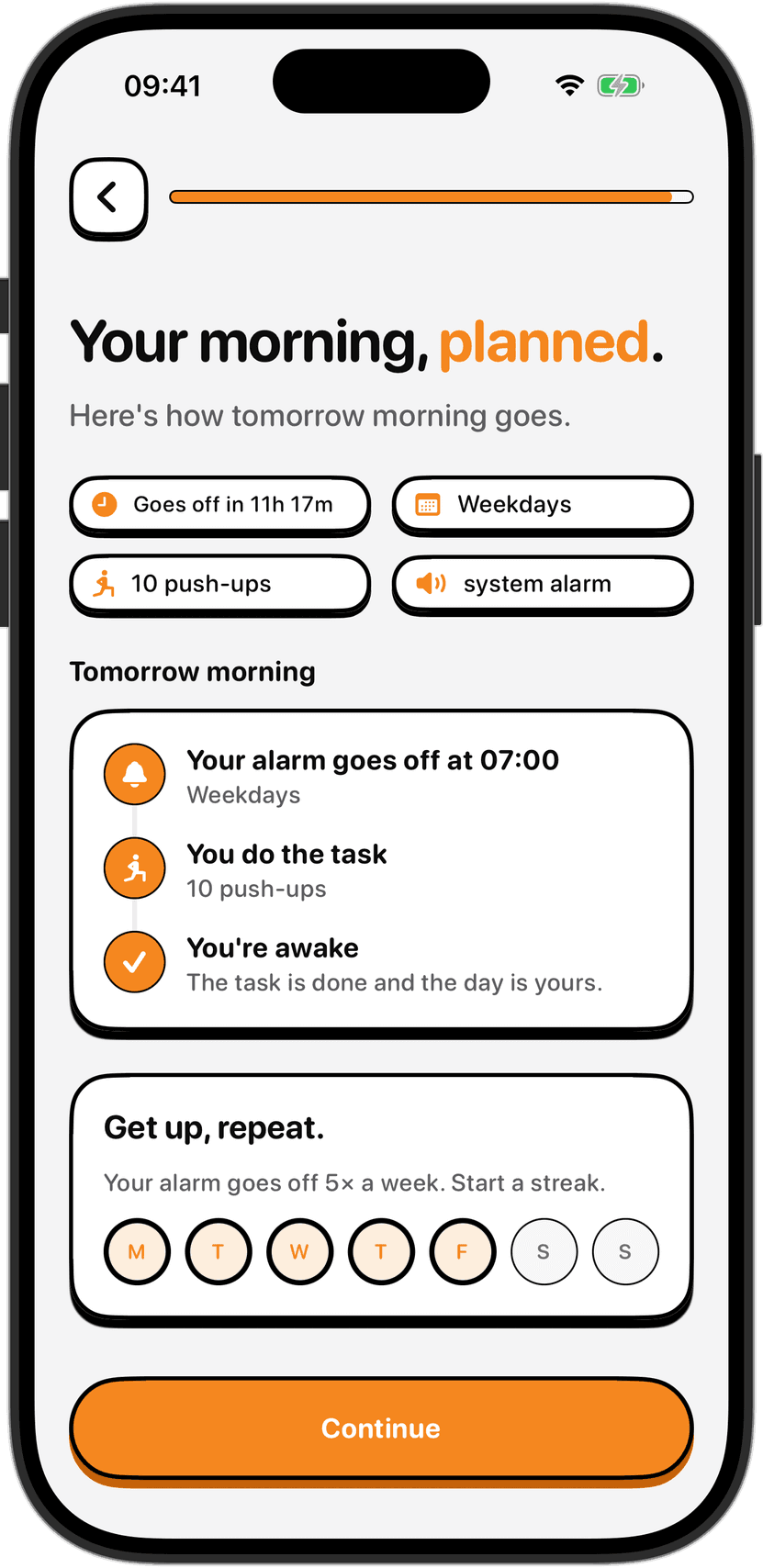
For all of this to work, your alarm needs to be reliable and non-negotiable. A phone alarm that can be snoozed or dismissed is working against you. An app that requires a task before it stops, or one that cannot be dismissed without getting out of bed, removes the central problem: the drowsy decision to stay in bed.
For many night owls, the difference between an ordinary alarm app and one designed for people who have a hard time waking is the difference between waking at 6:59 a.m. and actually getting up at 7:00 a.m. Small differences in the first moments compound. If you lose a snooze cycle every other morning, you lose an hour and a half of wake-time training per week. Over a month, that is a week of progress undone.
What not to rely on
Motivation and willpower are the first things to fail. Waking early is not easier on days when you feel more motivated. You do not suddenly become a morning person because you committed to it. Motivation is useful for deciding to wake early. It is useless for executing it at 6 a.m. on a Wednesday when you have slept poorly. Replace motivation with systems.
Do not expect your body to "adjust" to waking early if the only thing you change is the wake time. If you wake an hour earlier but the rest of your life stays the same (same bedtime, same afternoon caffeine, same evening light exposure, same weekend sleep-in), your body will fight the change for months. The adaptation comes from rebuilding your entire sleep schedule around the new wake time.
And do not expect one perfect morning strategy to work forever. What works this month may stop working in three months when your body has adapted to it. The alarm tone you find effective today will lose its impact if you use it for six months without change. Plan to rotate and adjust. Consistency in timing matters. Consistency in every other detail leads to habituation and diminishing returns.
The night-owl reality
You may never enjoy mornings. You may never leap from bed with energy and enthusiasm. That is not the goal. The goal is waking up at the time you committed to and being functional enough to do what needs doing. Those are achievable even if the joy of mornings stays out of reach.
Some of this works because of your biology. Some works because of systems and tools. The overlap is where success lives. You cannot change your genetics or force your chronotype to flip. You can change your alarm, your first 30 minutes, your bedroom temperature, your light exposure, and your consistency. That is enough.
Sources
Changhao, L., et al. (2025). Self-reported sleep inertia duration and its potential modifiers among 2,355 adults. Sleep & Hypnosis, 1(e). https://pmc.ncbi.nlm.nih.gov/articles/PMC12758700/
Dewan, S. T., Benloucif, S., Reid, K., Wang, W., Wolff, B., & Zee, P. C. (2011). Light-induced changes of circadian melatonin rhythm in humans. Sleep, 34(5), 593–599. https://academic.oup.com/sleep/article/34/5/593/2281471
Jones, S. E., Lane, J. M., Wood, A. R., van Hees, V. T., Tyrrell, J., Beaumont, R. N., ... & Weedon, M. N. (2019). Genome-wide association analyses in 128,266 individuals identifies new morningness and sleep duration loci. Nature Communications, 10(1), 5636. https://pmc.ncbi.nlm.nih.gov/articles/PMC6351539/
Okawa, M., et al. (2023). Efficacy of a combination therapy for difficulties waking up in adolescents with delayed sleep-wake phase disorder. Journal of Clinical Sleep Medicine, 19(8), 1525–1536. https://pmc.ncbi.nlm.nih.gov/articles/PMC9225467/
Ohashi, Y., et al. (2023). Effectiveness of blue-light therapy for patients with delayed sleep-wake phase disorder. Clocks & Sleep, 5(4), 615–626. https://pmc.ncbi.nlm.nih.gov/articles/PMC10594521/