A to-do list before bed: what the sleep study found
A 2018 sleep lab study found that writing tomorrow's tasks before bed may help people fall asleep. Here is what it tested, and where its limits are.
Visana Studios
5 min read
Writing down what you still have to do tomorrow might get you to sleep faster. That is the claim from a 2018 study by Michael Scullin and colleagues, published in the Journal of Experimental Psychology: General. It is a small experiment with a narrow group of volunteers, so the claim is more modest than the headlines around it. Here is what was tested, what it suggests, and where it stops.
How the study was set up
The researchers recruited 57 university students and brought them to a sleep lab at Baylor University on a weekday night. Bedtime was 10:30 p.m., and the students were kept away from technology and homework. Before lights out, each person spent five minutes writing.
Students were randomly split into two groups. One group listed the tasks they needed to do the next day or over the next few days. The other wrote about tasks they had already finished in the previous few days. Both groups wrote something, so the comparison is between two kinds of writing, not between writing and doing nothing.
Sleep was recorded overnight with polysomnography, which tracks brain activity and other signals during sleep. Sleep labs use it because it measures sleep directly, rather than relying on how sleepy someone feels in the morning. The reported result is that the to-do group fell asleep more quickly than the group that wrote about finished work.
Why an unfinished task can keep you awake
The authors start from a familiar problem. Their abstract describes bedtime worry, including worry about incomplete future tasks, as a significant contributor to difficulty falling asleep. Most people have lain in bed composing an email they have not written yet, so the idea will sound right to anyone who has done it.
A separate line of research supports the same general idea. In a 2011 paper in the Journal of Personality and Social Psychology, Erin Masicampo and Roy Baumeister reported that goals you have not finished stay active in the mind. Their experiments also found that making a specific plan for an unfinished goal removed those lingering effects. That work was about goal pursuit in general, not sleep, so it does not prove anything about bedtime. It does offer a plausible reason the list might help. A written list may work less by emptying your head and more by giving an open loop a concrete next step, so the mind has less reason to keep replaying it.
What the study does not show
The limits matter as much as the result. The volunteers were healthy young adults, and the lead author has said the team does not know whether the findings apply to people with insomnia. That group is the one most likely to be looking for a bedtime fix, so the study cannot answer their question.
The sample was small, and the setting was a sleep lab rather than a bedroom. The lead author suggested that a larger future study could test whether personality, anxiety and depression change how writing affects sleep. Until that work exists, a single night in a lab says little about how the habit works over weeks at home.
Trouble falling asleep for several weeks is worth raising with a doctor or sleep clinician. A notebook is unlikely to be the whole answer, and a clinician can check whether insomnia or another condition is involved.
Making the list work at home
The study tested a specific kind of writing, so it is a reasonable template even though it is not a proven routine. The forward-looking group was the one that did better, which points to the content. Write the next concrete step for each open item: the first task, the call you have to make, the thing that needs a decision. A vague note such as "sort out the lease" leaves the loop open. "Email the landlord about the boiler before 10 a.m." closes it a little.
Keep it to about five minutes, the length the study used, and stop when the list feels complete rather than exhaustive. Write it before you get into bed. Doing it in bed with a phone open is a different activity, and the study did not test it, so do not assume the same result.
Some people need a single line and others fill a page. Either works if the list ends with the next step rather than a general sense of dread.
Where a morning plan fits
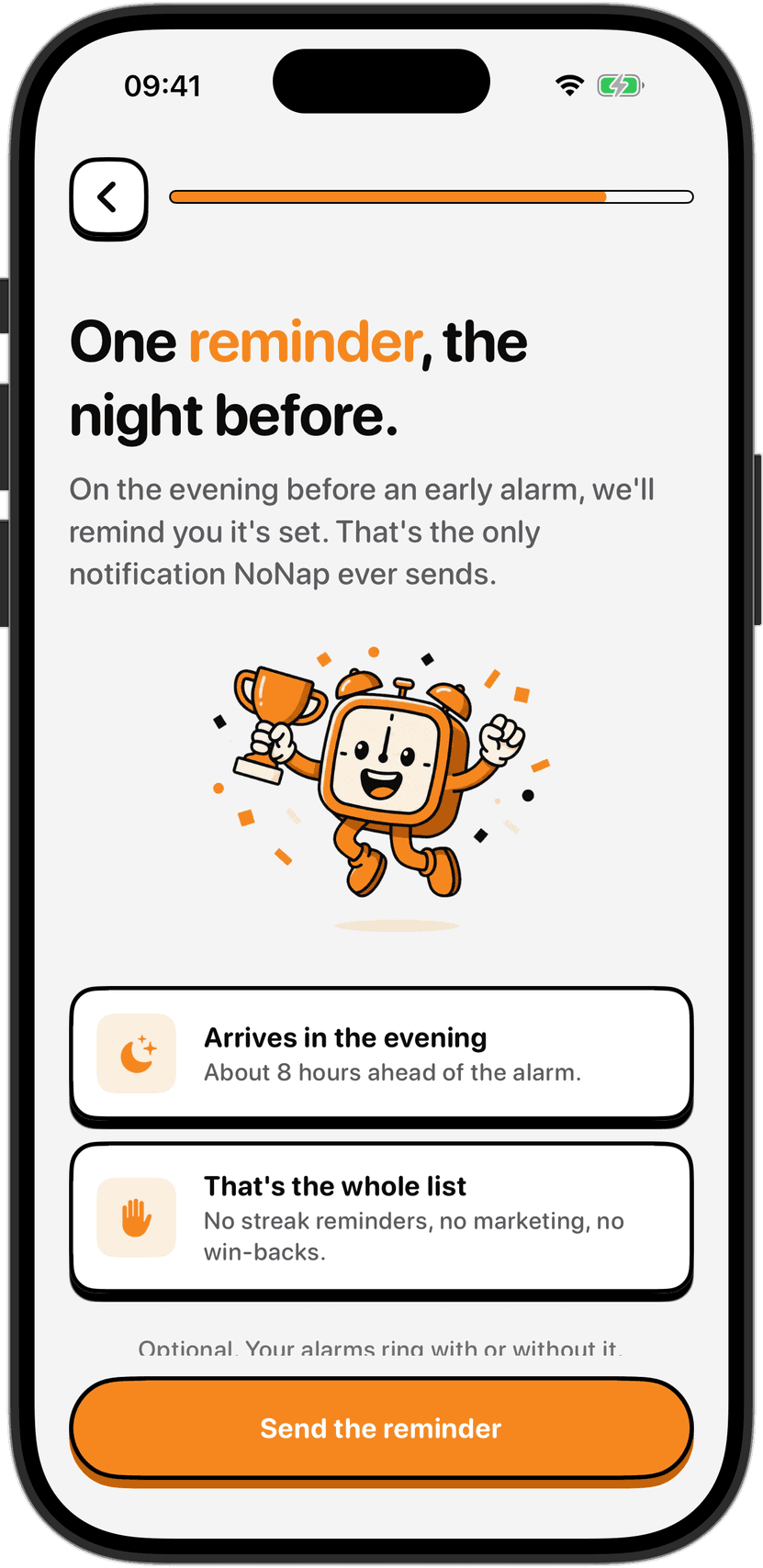
The list handles tomorrow's work. Tomorrow's wake-up is a separate decision, and it works best when it is made the night before rather than at 6 a.m. with the alarm already going. NoNap has a night-before reminder that nudges you to wind down while bedtime still affects the morning. You can read more about why tonight's bedtime decides tomorrow's wake-up, and the FAQ covers how the wake tasks work.
Sources
Scullin MK, Krueger ML, Ballard HK, Pruett N, Bliwise DL. The effects of bedtime writing on difficulty falling asleep: A polysomnographic study comparing to-do lists and completed activity lists. Journal of Experimental Psychology: General. 2018;147(1):139-146. doi:10.1037/xge0000374. PubMed 29058942, https://pubmed.ncbi.nlm.nih.gov/29058942/. The study design, sample of 57 university students, 10:30 p.m. bedtime, five-minute writing task and the abstract's statement on bedtime worry come from this paper's abstract and the coverage of it cited below.
Baylor University. Can writing your to-dos help you to doze? Baylor study suggests jotting down tasks can speed the trip to dreamland. 2018. https://news.web.baylor.edu/news/story/2018/can-writing-your-dos-help-you-doze-baylor-study-suggests-jotting-down-tasks-can. Source for the group design, the lab setting, the lead author's comments on insomnia and on future larger studies.
Masicampo EJ, Baumeister RF. Consider it done! Plan making can eliminate the cognitive effects of unfulfilled goals. Journal of Personality and Social Psychology. 2011;101(4):667-683. doi:10.1037/a0024192. https://pubmed.ncbi.nlm.nih.gov/21688924/. Source for the finding that unfinished goals stay active and that specific plans reduced those effects.
Image credits: both images are NoNap app screens, our own screenshots from the app's screenshot set. The cover was composed from two of them for this post.