The psychology of streaks: why a broken chain matters
Consumer research on why broken streaks drain motivation, the fresh start effect, all-or-nothing thinking, and how to keep going after you miss a day.
Visana Studios
7 min read

You wake up on day 47 of your new habit. You miss it. By day 48 you feel the streak is broken, and somehow that single broken link makes the whole chain feel worthless. The motivation that carried you through 46 days collapses under the weight of one skip.
That sensation is not just frustration. Research on how we track habits finds that broken streaks do something specific to our behavior: they reduce engagement in ways that go beyond the actual lapse. A streak is more than a count. You made a promise to yourself when you started it, and when it breaks, your brain treats the failure as harder than the numbers suggest.
Why intact streaks motivate and broken ones deflate
Consumer researchers Jackie Silverman and Alixandra Barasch studied how people respond to streaks by showing participants histories of behavior that were identical except in one way: how they were presented. Some saw a streak of completed days. Others saw the same actual behavior but with a gap that broke the visual chain.
The findings were stark. People who saw intact streaks increased their engagement in the behavior afterward, while those who saw broken streaks withdrew. The effect was not about objective performance. Actual behavior was the same in both groups. Everything came down to how the streak appeared on screen.
What made the break sting more was attribution. When people believed the break was their own fault, the hit to motivation was strongest. When they saw it as caused by circumstances outside their control, the damage shrank. And when people saw a way to quickly repair the streak, the damage nearly vanished.
The mechanism underneath is visual and psychological at once. A broken streak is not the absence of a day, but a physical gap in a line, and the brain reads gaps in lines as failure. The chain metaphor is exact: one broken link and the whole thing looks fractured, even though structurally, 46 completed days are still 46 completed days.
The fresh start problem and the reset trap
A related concept, called the fresh start effect, comes from research by Hengchen Dai, Katherine Milkman, and Jason Riis. They found that people are much more likely to start working on a goal when a temporal boundary appears: a new year, a new month, a birthday, even a Monday.
Temporal boundaries feel like clean breaks from the past. They are psychologically powerful precisely because they seem to signal that the old self, with its failures, is gone. A new calendar page means a new you. One study found that college students going to the gym increased their visits right after semester breaks and right after New Year's, even though nothing about the gym or their abilities changed.
But this creates a hidden cost when streaks break. If your mind treats Monday as a fresh start, it can also treat a missed day as a categorical failure: you either have the streak or you don't. You either are the person getting up on your scheduled time or you are not. There is no middle ground. This is all-or-nothing thinking, and once a streak breaks, it can feel like permission to abandon the whole effort.
One lapsed morning becomes all-or-nothing: the streak is over, so why get up tomorrow? The days ahead feel like starting from zero instead of continuing from 46.
Why one miss doesn't mean everything is lost
The size of the hit from a broken streak tells you something important: the streak itself was doing work. It was carrying motivation forward on days when the initial willpower had faded. It was a visible commitment that meant something to you. That is valuable information, not a reason to quit.
The reframing that actually changes behavior is simple but demanding: a streak is not the unit of success. A single day is. Waking up tomorrow is not about saving a number. It is about the one morning in front of you. Miss one day and you have twenty good days in a row already. That is not nothing. That is a pattern. Add today and it is twenty-one.
This is why repair is so important in Silverman and Barasch's research. The moment people saw a way to get the streak back, the psychological wound closed. The ability to fix it, to restore the chain, made the break feel less permanent. Some habit tracking apps do this intentionally: they let you mark a day as done even a day late, or they let you skip a day and keep the streak alive. Others show your best streak separately from your current one, so that one break does not erase what you already built.
Psychologically, what is happening is a shift in attribution. If the break was a one-time mistake that you can now fix, it feels like an accident. If it is permanent, it feels like a character flaw. The same break, different stories. The story changes the next day's behavior.
Building forward from a break
The lasting habit is not the one that never breaks. The lasting one is the one you restart after a break. Missing a day tells you where motivation thinned. It tells you the friction was higher than expected. The break does not prove it is hopeless.
Returning after a break is hard because of all-or-nothing thinking, the fresh start effect's shadow side. Your brain wants to declare it over and start completely fresh, which means you wait for another boundary: Monday, the first of the month, New Year. Waiting means days of not doing it. Waiting means the break gets longer.
The people who are successful at long-term habit change are usually not the ones who never miss. They are the ones who miss and then resume the next day, before the skip becomes a gap becomes a new normal. Going from 46 days to 1 day is discouraging. Going from 46 days to 47 is just continuing. Researchers studying sleep and habit formation have found that waking at a fixed time, even after a lapse, rebuilds the pattern faster than waiting for a perfect reset. A consistent wake-up time forms the foundation that habits build on, so returning to it the day after a break keeps the frame intact even if the streak counter resets.
One way to protect against all-or-nothing collapse is to separate the behavior from the streak. The behavior is what you actually do: get up at your scheduled time. The streak is just the way you count it. If your real goal is consistency over months and years, one missing day out of hundreds is a fraction. It does not undo the other days. It just is a day that happened.
Another is to plan for the break before it comes. If you know Saturdays are hard, or that you travel in September, or that the first month is brutal, plan to take those days off and treat them as scheduled rather than failures. Streaks that have built-in break days are broken streaks that do not feel broken. They are vacations, not lapses.
NoNap and the streaks that matter
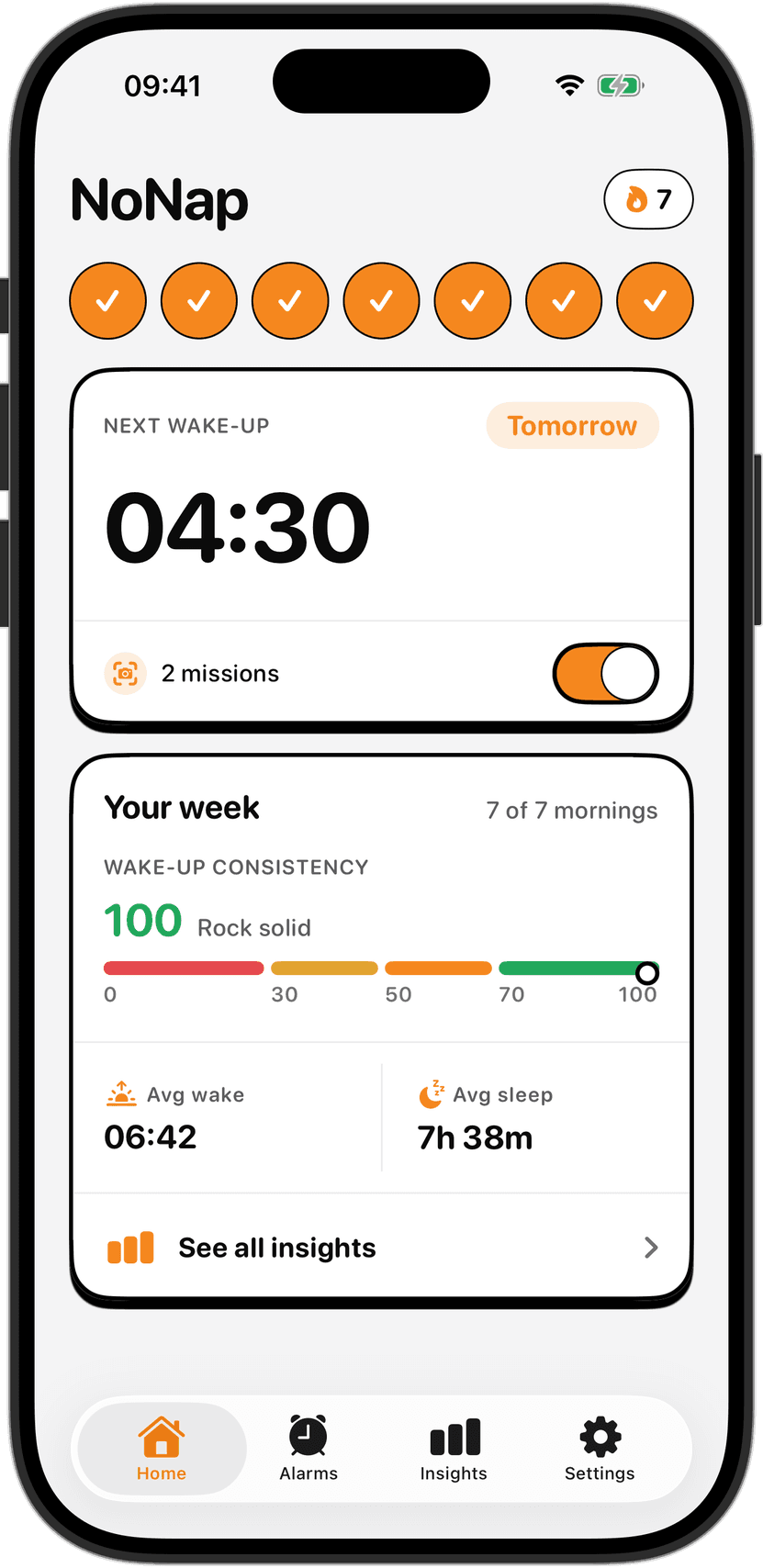
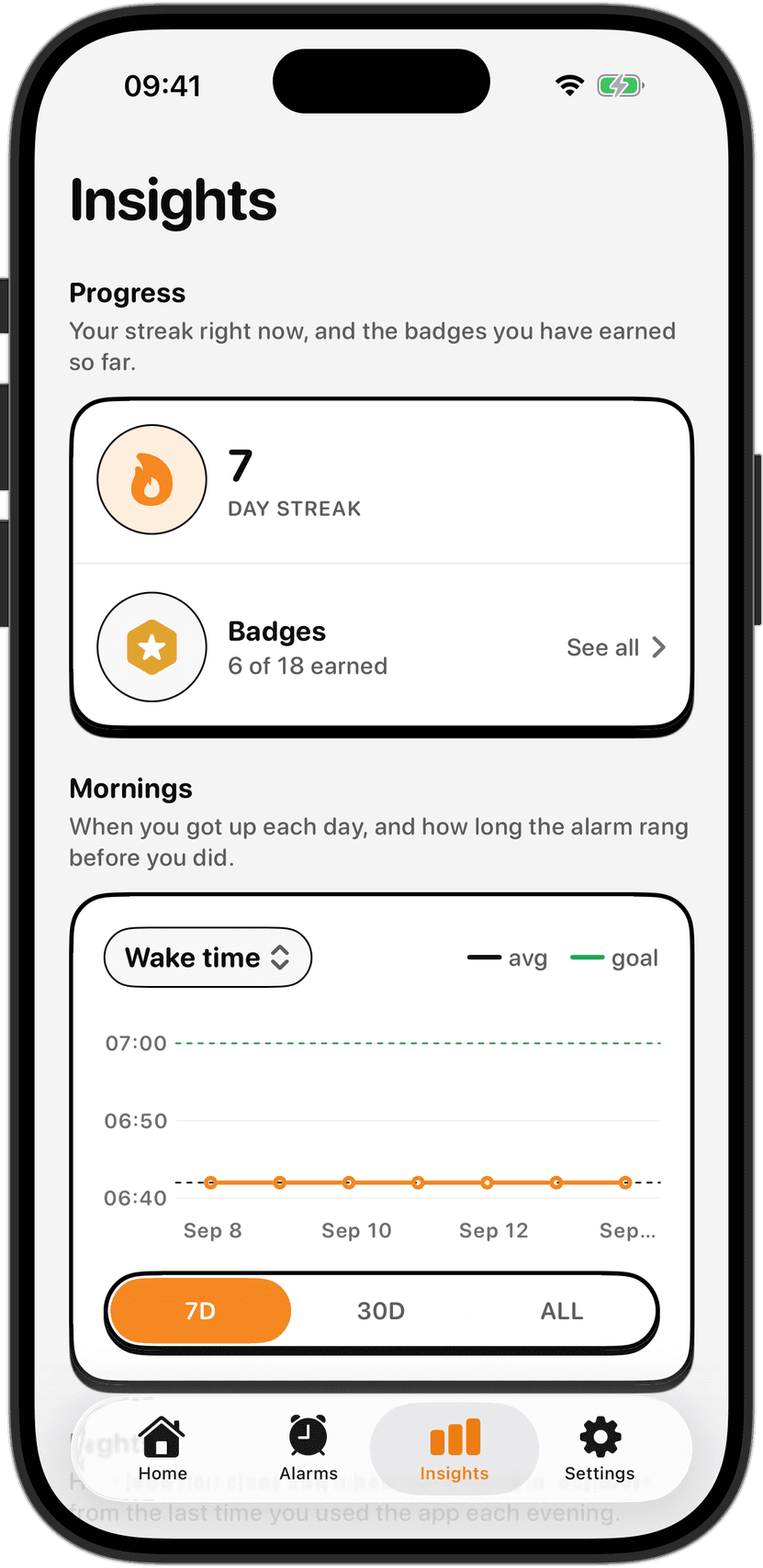
NoNap tracks your wake-up time and consistency with a streak counter and a chart. You see how many mornings in a row you have stopped the alarm by finishing the task. The feature is not there to shame you. It is there because the research is clear: seeing the streak works. It motivates tomorrow morning.
If you miss a morning, the streak resets to zero, and that is intentional. But a single miss should not erase what you already built. If you had forty mornings in a row of waking at your scheduled time, that is forty pieces of evidence that you can do it. One missed morning changes nothing about your ability. It changes only the current count.
The motivation in a streak is borrowed from the future. When you see six days in a row, your brain knows that breaking it on day seven would be wasteful. The streak is a commitment device. Use it as one. When you break one, start the next one the very next day. The break was one day, not permission to break the pattern itself.
Streaks work because we are the kind of animals who notice patterns and maintain them. One broken link and the chain looks fractured. The answer is not a perfect chain. It is knowing how to start the next one.
Sources
Silverman, J., and Barasch, A. (2022). On or off track: How (broken) streaks affect consumer decisions. Journal of Consumer Research, 49(6), 1095-1117. academic.oup.com/jcr/article/49/6/1095/6635904
Dai, H., Milkman, K. L., and Riis, J. (2014). The fresh start effect: Temporal landmarks motivate aspirational behavior. Management Science, 60(10), 2563-2582. pubsonline.informs.org/doi/10.1287/mnsc.2014.1901
Curry, S., and Marlatt, G. A. (1987). Abstinence violation effect: Validation of an attributional construct with smoking cessation. Journal of Consulting and Clinical Psychology, 55(2), 145-149. doi.apa.org/10.1037/0022-006X.55.2.145