Screens and blue light before bed: what the evidence actually shows
The research on blue light and sleep is more nuanced than 'screens keep you awake.' Here's what actually disrupts your sleep.
Visana Studios
5 min read
The advice is everywhere: turn off screens an hour before bed, or sleep will suffer. Blue light from phones and laptops suppresses melatonin, shifts your sleep schedule later, and keeps you awake. It's become so mainstream that blue light blocking glasses show up in pharmacies and sleep apps offer to dim your screen at sunset. The research, though, is messier than the warnings suggest.
What the research actually found about blue light
Melatonin suppression from light is real. Evening exposure to the 460 to 480 nanometer wavelengths that make up blue light can inhibit the pineal gland from producing melatonin, which would otherwise signal your body that it's time to sleep. A machine-learning analysis of 29 peer-reviewed studies identified the factors that drive this suppression: the brightness of the light measured in melanopic equivalent daylight illuminance, how long you're exposed, and the color temperature of the light itself. Blue enriches that signal, which is why your eye's intrinsically photosensitive retinal ganglion cells contain melanopsin, a protein attuned to blue light's 470 nanometer peak. The suprachiasmatic nucleus in your brain reads that signal and decides whether to hold back melatonin or release it.
But here's where the narrative breaks. A 2022 review of evening light studies found that most showed no connection between blue light and poor sleep. A 2024 study tracking 500 teenage boys found that those who texted, gamed, or talked on devices before bed fell asleep later and slept fewer hours than peers who didn't. Those same boys who watched television or movies reported no difference in sleep compared with peers who skipped screens entirely. The difference was not the light. It was what they were doing.
Why what you do matters more than what illuminates you
The mechanism is behavioral, not purely biochemical. Interactive activities stimulate your sympathetic nervous system and engage reward pathways in your brain that are difficult to disengage from. An hour of gaming or texting keeps your mind racing even after you lock the phone. An hour of passive watching does not. A 2026 study from Scientific Reports measured melatonin suppression across different light sources and found that cool white LED and fluorescent lamps induced more suppression than warm white alternatives or incandescent bulbs, but the suppression was only observed with exposure to fairly high brightness over time. Using an iPad at full brightness for two hours suppressed melatonin somewhat. One hour of use made no measurable difference.
This distinction matters because it explains why advice to simply avoid screens is both technically true and practically unhelpful. If you work a job that involves screens until 8 p.m. and you don't have a choice, suppressing your anxiety about it matters. If you choose to scroll for an hour before sleep, the choice is what disrupts sleep more than the wavelengths coming through.
Blue light blocking glasses and the evidence gap
The promise of blue light glasses is that you can keep using your devices and simply block the problematic wavelengths. A 2025 meta-analysis of randomized controlled trials found 49 participants across three well-designed studies. The glasses showed a non-significant reduction in sleep onset latency of about five minutes, a non-significant increase in total sleep time of about nine minutes, and no meaningful effect on sleep efficiency or wake after sleep onset. The researchers concluded that while blue light blocking glasses are low-cost and low-risk, current evidence does not support significant effects. They may work better for specific clinical populations with circadian misalignment rather than for general use.
The glasses also only block one piece of the problem. They don't quiet your reward system or slow your brain down. They don't stop the temporal demand of an unread email or a group chat. They just filter the wavelengths, leaving everything else intact.
What actually changes sleep when you use screens
The 2024 National Sleep Foundation consensus statement concluded something worth noting: both the content of screen use and the light impair sleep, but behavioral strategies addressing the content are at least as important as light-filtering technology. The consensus was drawn from research across multiple domains. Texting and gaming activate the sympathetic nervous system and engage attention systems that don't shut down just because you closed the app. The brightness matters, the duration matters, the time before bed matters. But your inability to stop reaching for the phone matters more.
This is not to say blue light plays no role. It does. Evening exposure to bright, blue-enriched light can delay melatonin production and shift your sleep schedule later. A shorter exposure, especially at lower brightness, may have no measurable effect. The dose-response relationship is real. But most people's sleep trouble from screens is not from a few minutes of text messages or a quick check of social media. It's from an hour of engagement that leaves them mentally activated long after the screen turns dark.
The practical implication
If you use screens for work until late evening and sleep is already difficult, warm white light or blue light filtering may help at the margins. If you choose to use screens recreationally before bed and sleep is suffering, the filtering won't solve much. The screen's effect on your sleep is mostly through your behavior and your wakefulness, not through the wavelengths alone. The single most useful move is usually not to turn the blue off, but to turn the device off earlier.
Sources
National Academy of Medicine. (2024). Consensus Study Report: Sleep Health and Public Health in the Era of Precision Health and Medicine. https://www.nap.edu/catalog/26977/sleep-health-and-public-health-in-the-era-of-precision-health-and-medicine
Czeisler, C. A., Gooley, J. J. (2007). Sleep and Circadian Rhythms in Humans. Cold Spring Harbor Perspectives in Biology, 19(8), a002675. https://pubmed.ncbi.nlm.nih.gov/17908042/
Giménez, M. C., van Camp, N., Riemersma-van der Lek, R. F., et al. (2022). Predicting melatonin suppression by light in humans. Journal of Pineal Research, 72(4), e12786. https://doi.org/10.1111/jpi.12786
Zeitzer, J. M., Dijk, D. J., Kronauer, R. E., Brown, E. N., Czeisler, C. A. (2000). Sensitivity of the human circadian pacemaker to nocturnal light: melatonin phase resetting and suppression. Journal of Physiology, 526(3), 695-702. https://pubmed.ncbi.nlm.nih.gov/10856829/
Chellappa, S. L., Steiner, R., Blattner, P., et al. (2022). Influence of evening light exposure on polysomnographically assessed night-time sleep. Sage Journals, 30(12), 1491-1512. https://doi.org/10.1177/14771535221078765
Frontiers in Neurology. (2025). Efficacy of blue-light blocking glasses on actigraphic sleep outcomes: a systematic review and meta-analysis of randomized controlled crossover trials. https://www.frontiersin.org/journals/neurology/articles/10.3389/fneur.2025.1699303/full
Advisory Board Daily Briefing. (2025). Beyond blue light: The real reason your phone keeps you up. https://www.advisory.com/daily-briefing/2025/08/26/blue-light-sleep
Nature. (2025). Afternoon to early evening bright light exposure reduces later melatonin production in adolescents. npj Biological Timing and Sleep. https://www.nature.com/articles/s44323-025-00040-6
Image credits
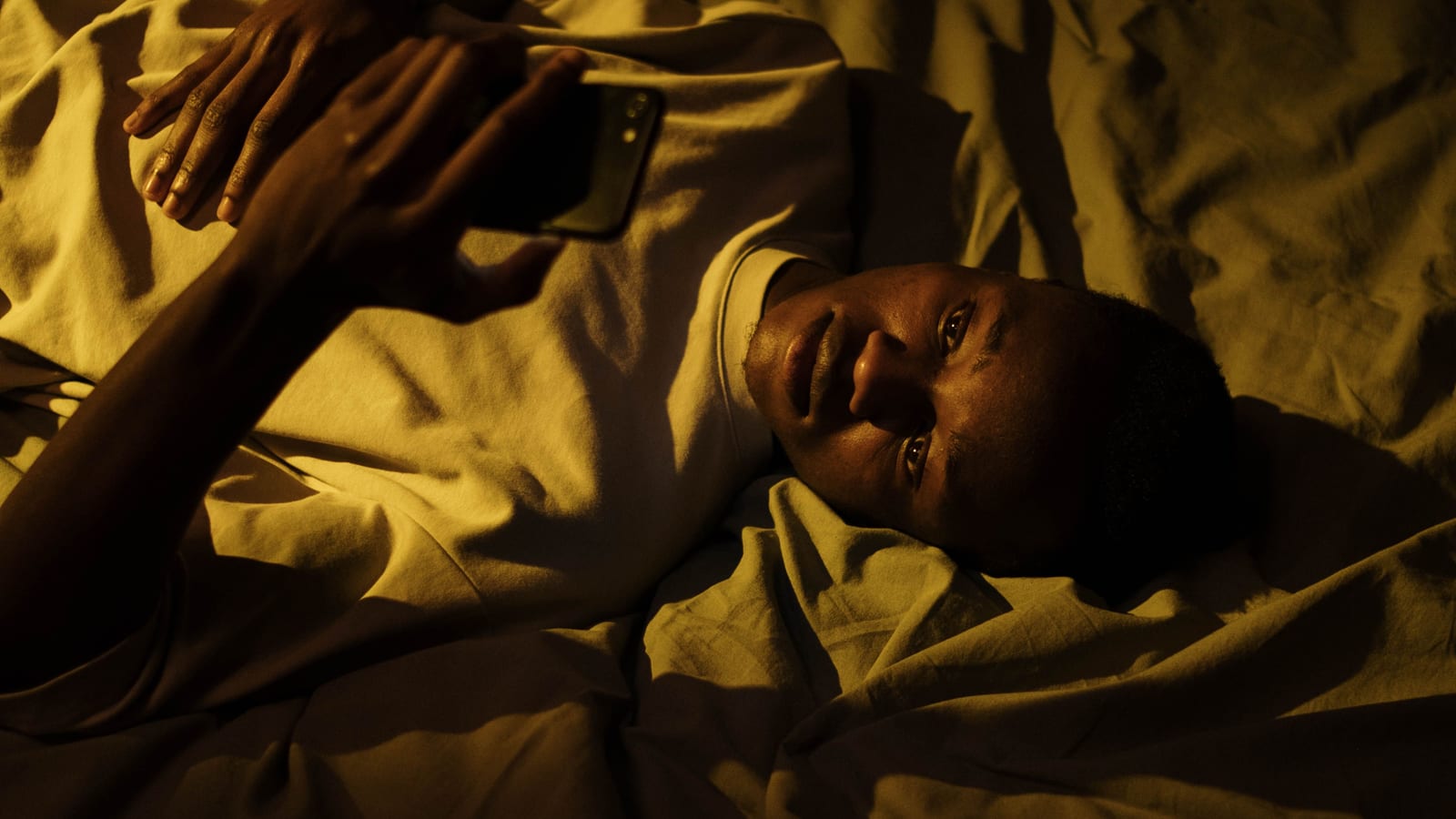
Cover image: A man lying in the dark room using a phone, by cottonbro studio. Free from Pexels under the Pexels License.