Revenge bedtime procrastination: staying up when you're already tired
What research shows about bedtime procrastination, its link to work stress, and evidence-based approaches to stay awake less late.
Visana Studios
5 min read
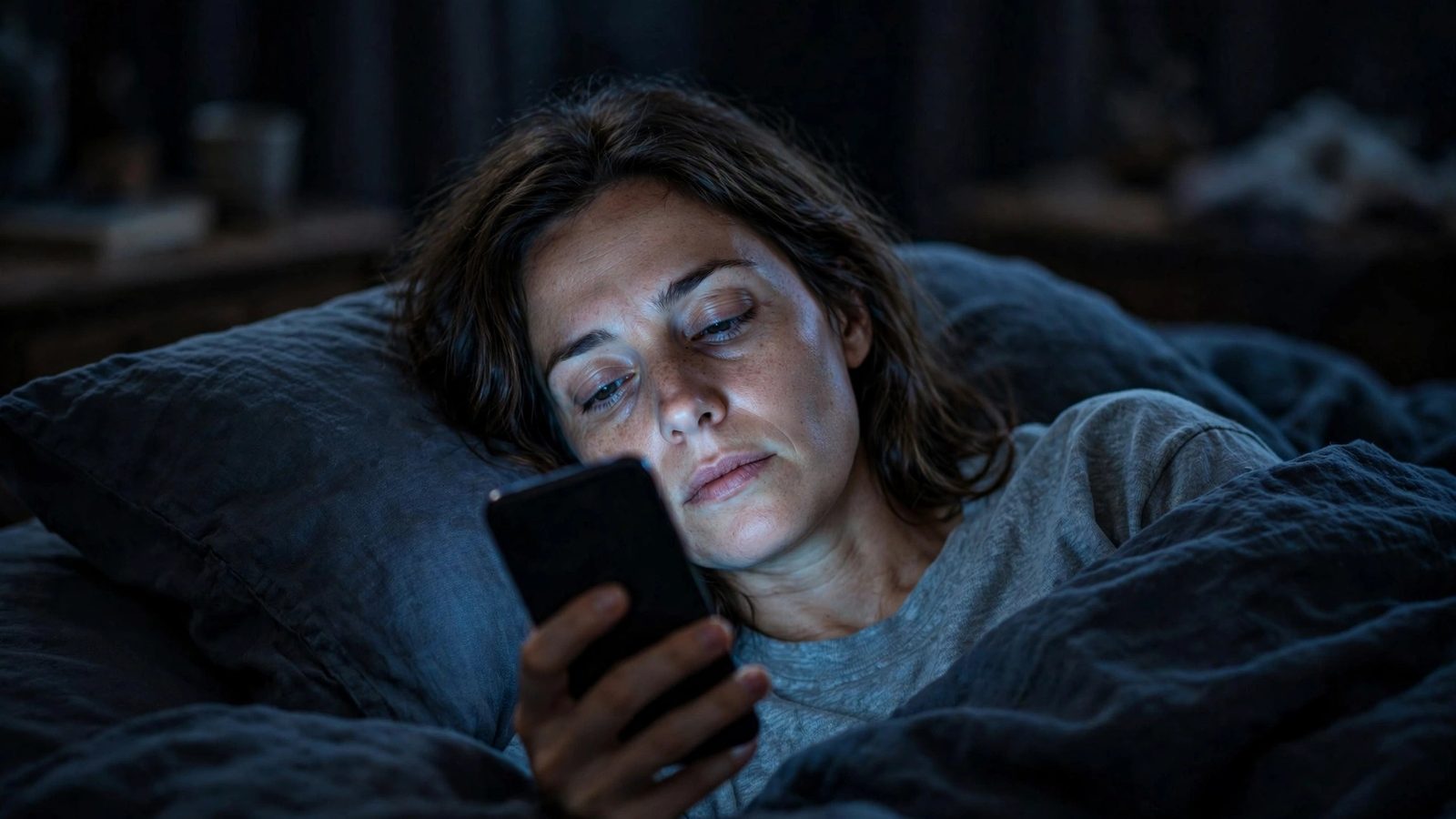
Work ends at 5 p.m., dinner finishes by 7, and by 11 p.m. you are still awake, scrolling. The alarm tomorrow is set for 6:30 a.m. You are genuinely tired. And yet another video begins, another article opens, another feed refreshes. Not because you forgot the time. Not because you do not care about sleep. The hours before bed were never yours to use, and now, finally alone, you are stealing them from your night instead of reclaiming them from your day.
This pattern has a name: bedtime procrastination. The term is newer than you might think. Kroese and colleagues coined it formally in 2014 to describe a specific kind of delay: going to bed later than you actually intend, without any external barrier forcing you to stay up. Nobody is keeping you at your desk. The boss is not texting. There is simply no reason to move toward the bedroom except the one you set for yourself hours ago, and now you cannot follow it.
The numbers on tired nights
In a 2014 study, Kroese and colleagues found that nearly 30 percent of participants slept six hours or fewer on weeknights. When asked how often they felt insufficiently rested, 84 percent said at least weekly. The pattern was clear: weak self-regulation predicted bedtime procrastination. People who scored lower on measures of self-control and conscientiousness were significantly more likely to delay sleep. More striking still, bedtime procrastination predicted insufficient sleep more strongly than general procrastination did. This was a distinct phenomenon with its own roots.
Why? A person deciding whether to sleep faces that choice at the end of a day when self-control is already depleted. Throughout your waking hours, decision-making draws on a limited pool of willpower. By evening, especially after a long or stressful day, that pool is nearly empty. The decision to go to bed, made when it should ideally be made, lands at precisely the moment when saying no is hardest.
What work and time off have to do with it
Bedtime procrastination rose to prominence in research just as free time was shrinking for many people. Working long hours, managing multiple roles, and carrying work stress into evening hours often leaves little unscheduled time after obligations end. When evening finally arrives and duty releases its grip, the impulse to reclaim a few hours is not frivolous. It is recovery time. Work stress research shows that psychological detachment is essential for restoration, and many people get none during their waking hours.
People with better access to genuine downtime show lower work-related rumination and better sleep. But what happens when the only free time available comes after the time you had planned to sleep. Then staying up does not feel like indulgence. This framing, the idea that you are reclaiming lost time, is what gave the phenomenon its name: revenge bedtime procrastination. You are exacting revenge on a day that left you no margin.
The pattern self-perpetuates. Staying up late to grab that time makes tomorrow harder, and the next evening's bedtime procrastination becomes even more likely. Over weeks and months, chronically insufficient sleep becomes the default.
Why the evening makes it worse
Darkness, distractions, and digital devices all converge in the evening. Smartphones and streaming services offer infinite content, each piece followed by a suggestion for the next. This was not true in 2014 when Kroese and colleagues first published their study. The sheer quantity of entertainment available on demand, the algorithmic encouragement to keep watching, and the speed at which you can flip from one thing to another have created an environment where bedtime procrastination is easier than ever.
Light from devices suppresses melatonin. The stimulation of content, the engagement of apps designed to hold your attention, and the blue light exposure all push your nervous system toward alertness precisely when it should be winding down. Bedtime feels further away. By 11 p.m., when self-control is already scarce, overriding the device's pull and moving to bed is a genuine challenge.
What actually works
Protecting free time during your waking hours is the most direct defense. If your day contains genuine downtime, time when no one is asking anything of you, the urgency to reclaim hours from your night diminishes. The urgency to stay awake as an act of rebellion dissolves when there is nothing to rebel against.
This is not always feasible. Many people cannot add time to their days or shrink their obligations. But where it is possible, the research on work recovery suggests it matters.
A second approach with evidence is the wind-down decision made early, before fatigue collapses judgment. Rather than choosing bedtime when exhausted and half-distracted, move the decision to an hour when you still have cognitive resources to follow through. Some of that commitment can be structural: removing devices that offer infinite distractions, placing your phone out of reach or in another room. Some comes from clarity, knowing in advance what the bedtime is and treating it like any other commitment you keep.
Consistency does the heavy lifting. A fixed sleep and wake schedule trains the body to feel tired at the expected hour and alert at the expected wake time. Research on cognitive-behavioral interventions for sleep, particularly sleep restriction therapy used in insomnia treatment, shows that consistency in timing produces measurable effects on sleep quality and ease of falling asleep. Willpower alone will not eliminate bedtime procrastination. Structure reduces how much you need.
Bringing the day to an end
The shift toward taking bedtime procrastination seriously, both in research and in everyday conversations about sleep, reflects a broader recognition that sleep is not a luxury to protect after everything else is done. It is a biological need, and the conditions that make it possible have to be built into your day, not squeezed into what remains. Evening free time matters. The ability to disengage from work matters. Devices that interrupt sleep matter.
For people struggling with the pattern, one small change is to pick a wind-down ritual and move it earlier, before exhaustion makes every decision a negotiation. Some find that a phone reminder twenty minutes before target bedtime, one explicitly naming sleep, creates a nudge toward movement. Others write down one small commitment for the next morning, something that matters enough to actually get out of bed when the alarm sounds. A single alarm with a wake task can serve that purpose, giving your morning a shape that makes the night before feel worth protecting.
The goal is not shame about reclaimed hours. It is to stop funding them by stealing from sleep.
Sources
Kroese, F. M., De Ridder, D. T., Evers, C., and Adriaanse, M. A. (2014). Bedtime procrastination: introducing a new area of procrastination. Frontiers in Psychology, 5, 611. doi:10.3389/fpsyg.2014.00611
de Jonge, J., Spoor, E., Sonnentag, S., Dormann, C., and van den Tooren, M. (2012). "Take a break?!" Off-job recovery, job demands, and job resources as predictors of health, active learning, and creativity. European Journal of Work and Organizational Psychology, 21(3), 321-348. doi:10.1080/1359432x.2011.576009