The Math task: solving a problem to wake up
Why solving math at 6am works better than you'd think, and when to use it instead of push-ups or a shake of your phone.
Visana Studios
5 min read

The instinct when designing a wake-up tool is always physical. Make the alarm loud. Make it leave your bed. Make it move. And those work for a lot of mornings. But not all of them. On days when your shoulder is sore, or you are recovering from surgery, or you just live in a studio where sprawling onto the floor means waking your partner, an alarm that makes you think instead of move becomes genuinely useful.
The Math task on NoNap asks you to solve a problem to dismiss the alarm. No camera, no motion sensor, no leaving your bed. Just a math problem on screen and your groggy brain working through it.
The obvious question is whether it works at all. Can you actually solve math at six in the morning?
Sleep inertia does not make you stupid
The first thing to clear up is a misunderstanding about sleep inertia, the grogginess right after waking. It is a real and measurable effect. Reaction time slows, accuracy drops, and you will not be at your sharpest for 20 to 30 minutes after you wake. But it doesn't erase your ability to think.
Studies on sleep inertia separate attention from working memory. In lab work, people immediately after waking show deficits in processing speed and reaction time, but reading comprehension and reasoning stay mostly intact. A 2019 review in the Journal of Sleep Research found that complex cognitive tasks like problem-solving are less affected by sleep inertia than simple reaction-time measures. The impairment is real but smaller than you would guess from how you feel.
This makes intuitive sense: you have not lost knowledge. You have not become less intelligent. You are running slower. A math problem you could solve in two minutes at noon might take four minutes at 6am, but you can still solve it.
Why this matters for an alarm
An alarm that makes you move gets you vertical and forces blood flow. That works. But for someone who cannot or will not do push-ups at 6am, a gentler friction point becomes appealing. A problem that takes thinking, real thinking rather than just recognising a tap on your phone as something to ignore, creates a different kind of engagement.
The Math task is set at a level you pick in advance: easy, medium or hard. Easy is straightforward arithmetic: addition, subtraction or simple multiplication. Medium adds in division and slightly larger numbers. Hard includes fractions or multi-step problems. The point is that you pick something you can solve half-awake but cannot answer by rote or lucky guessing.
If you have ever set an alarm you could silence in your sleep, you know the problem. Your brain can learn that waking means "pat the phone." It is not even conscious. But solving a math problem requires enough cognitive engagement that sleep-logic does not apply. You have to wake up enough to actually read the problem and work through it.
When to use Math over movement
If you have a physical limitation or injury, Math is obvious. But there are other situations where a thinking task fits better than a physical one.
Some people are in a space where noise or movement will disturb someone else. A roommate, a partner sleeping later, or even a baby in the same room. Math is silent and stationary. It asks you to move only your eyes and your mind.
Some people find they wake more easily to a problem than to an instruction. The specific question, "what is 7 times 8?" demands a mental response. It is harder to half-sleep through than "do ten push-ups," which feels like a negotiation your sleep-self thinks it can ignore.
Some mornings, physical exhaustion makes movement difficult. You might be recovering from illness, training very hard, or simply in the early days of a new job where you are more tired than usual. A day where your body needs rest and you still need to wake is exactly when a thinking task becomes the right choice.
The limits
The Math task is not universally easier. Some people are faster at waking their body than their mind. If you are strongest immediately after movement (if those first squats clarify your head in a way that nothing else does), then math will feel slower and more frustrating. You can change your wake task any morning, which is the actual design here: you are not locked into one approach.
And timing matters. A math problem takes a variable amount of time. Unlike "do 15 push-ups," which has a concrete duration, an easy problem might take 90 seconds and a hard one might take five minutes depending on how alert you are. If you have a tight schedule and a fixed time to wake, the unpredictability might be a drawback.
You also cannot use it while driving or operating anything, which is obvious but worth stating: the phone is in your hand, and you need to look at the screen.
How to set it up
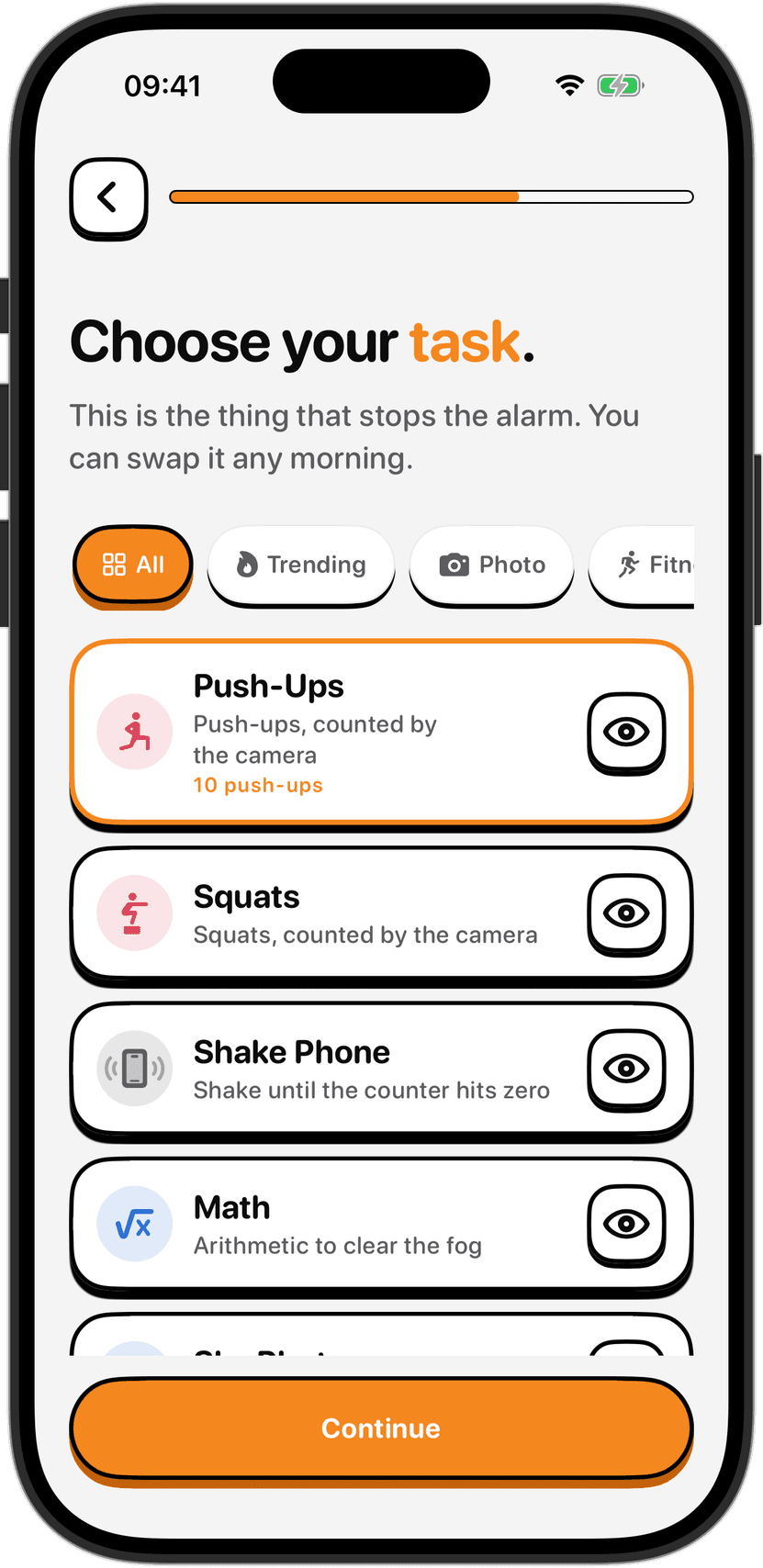
In NoNap, you choose the task when you set the alarm or change it any morning. For the Math task, you pick a difficulty level that matches your mornings. Start with Easy if this is new. The goal is to wake up, not to wrestle a calculus problem before coffee. You can move to Medium or Hard once you know what your 6am brain can handle.
The task is well-suited as a backup. You might wake to push-ups normally but set Math as your fallback on mornings when you are sore or sick. Or you might rotate: Math on Monday because you are still sleep-heavy after the weekend, and Squats on Wednesday when you have better energy.
NoNap is built on the idea that there is no one task that works for every person or every morning. The Math task is one tool in that toolbox. It is not the right choice for everyone, but it is essential for some people and useful as a change of pace for many others.
Sources
Tassi P, Muzet A. "Sleep inertia." Sleep Medicine Reviews. 2000;4(2):183-200. https://doi.org/10.1053/smrv.1999.0095
Trinder J, Kleiman J, Carrington M, et al. "Sleep and cardiovascular regulation." Pflügers Archiv - European Journal of Physiology. 2001;442(2):53-60. https://doi.org/10.1007/s004240100516
Tassi P, Rohmer O, Schöne B, et al. "Cognitive and motor performance during sleep inertia: the effect of 10 min of bright light exposure." Journal of Sleep Research. 2006;15(4):388-394. https://doi.org/10.1111/j.1369-7874.2006.00532.x
Ferrara M, Gennaro LD. "How much sleep do we need?" Sleep Medicine Reviews. 2001;5(2):155-179. https://doi.org/10.1053/smrv.2000.0145
Hilditch CJ, McHill AW, Hoehler FK, Czeisler CA, Kronauer RE. "Sleep inertia: Current insights." Nature and Science of Sleep. 2021;13:155-165. https://doi.org/10.2147/NSS.S284541