Does your brain hear sounds while you sleep?
Sleep does not switch hearing off. A 2022 study found sleeping brains respond more to unfamiliar voices, and that K-complexes decide how much gets processed.
Visana Studios
4 min read
Sleep does not switch your ears off. Sound keeps reaching the brain all night, and the sleeping brain keeps sorting it. Most of that sorting happens without you noticing. A siren can pull you out of sleep while the hum of a fridge passes straight through. A 2022 study by a team that includes Manuel Schabus gives one clear piece of the explanation, and the finding that stands out is that the voice matters more than the name.
How the sleeping brain sorts sound
Two brain signals matter here. Sleep spindles are thalamocortical oscillations of 11 to 15 Hz that last about 0.5 to 2 seconds. K-complexes are slow waves of roughly 1 Hz. Both are hallmarks of stage 2 NREM sleep, a light non-REM stage.
Spindles have repeatedly been shown to inhibit sensory processing during sleep. K-complexes behave differently. They appear either on their own or in response to a sensory stimulus, which makes them a measurable trace of a sound reaching the sleeping brain.
Ameen and colleagues recorded overnight brain activity in 17 healthy adults, 14 of them women with a median age of 22.6. Twenty people were recruited, but one dropped out and two were excluded because of EEG problems. Each sleeper heard three names during the night: their own and two unfamiliar ones. Every name was spoken either by a familiar voice or by an unfamiliar one, and each stimulus was played 690 times. The design separated who was speaking from what was being said.
Unfamiliar voices got through more
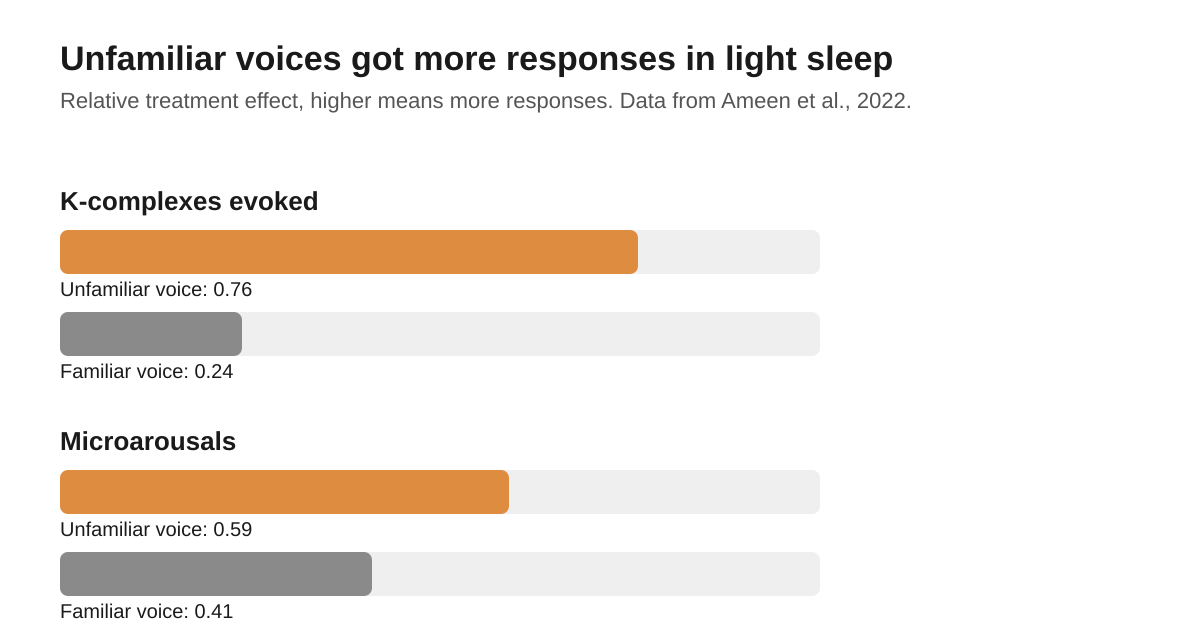
The clearest result concerned the voice. Unfamiliar voices evoked more K-complexes than familiar ones. The authors rank responses on a scale where a higher number means more responses, and unfamiliar voices scored 0.76 against 0.24 for familiar voices. Unfamiliar voices also triggered more microarousals, brief shifts toward wakefulness, at 0.59 against 0.41.
The microarousal result is weaker than the K-complex one. Across the whole stimulation window, the difference in microarousal density was not statistically significant (p = 0.31). It showed up only when the analysis focused on the moments a stimulus evoked a response, so it is a tendency that needs a larger study to confirm.
The response also changed over the night. Unfamiliar voices evoked fewer K-complexes in the second half of the night than in the first, while familiar voices produced the same number throughout. That fits the idea that the brain gets used to a new voice, although the study was not built to test that directly.
Responses were not simply bigger across the board. When a sound evoked a K-complex, unfamiliar voices produced larger, more synchronized brain responses. When no K-complex appeared, those differences vanished. In the authors' words, "these differences in brain responses disappear completely when no K-complexes are evoked by the auditory stimuli." The K-complex looks like the step that decides how much of a sound the sleeping brain processes.
Your own name was the surprise. You may have heard that your name can wake you, and the study set out to test it. It found no difference, because the name had no main effect on K-complexes. The authors note that this contradicts earlier work and offer only speculative explanations. One lab study with 17 people does not settle the question, but it makes the own-name claim look less solid than it sounds.
What this means for choosing an alarm
This study used voices, not alarm tones, so it cannot say which alarm sound works best. Two findings are still worth keeping in mind. Light sleep does not shut sound out, and a sound the brain has not heard before drew more processing than a familiar one. Whether a tone you hear every morning for months becomes easier to sleep through is a reasonable guess from this data, but the study did not test it with alarms.
If one sound stops working, switching to another is a simple test. The guide on choosing an alarm sound that wakes you goes through the trade-offs in more detail.
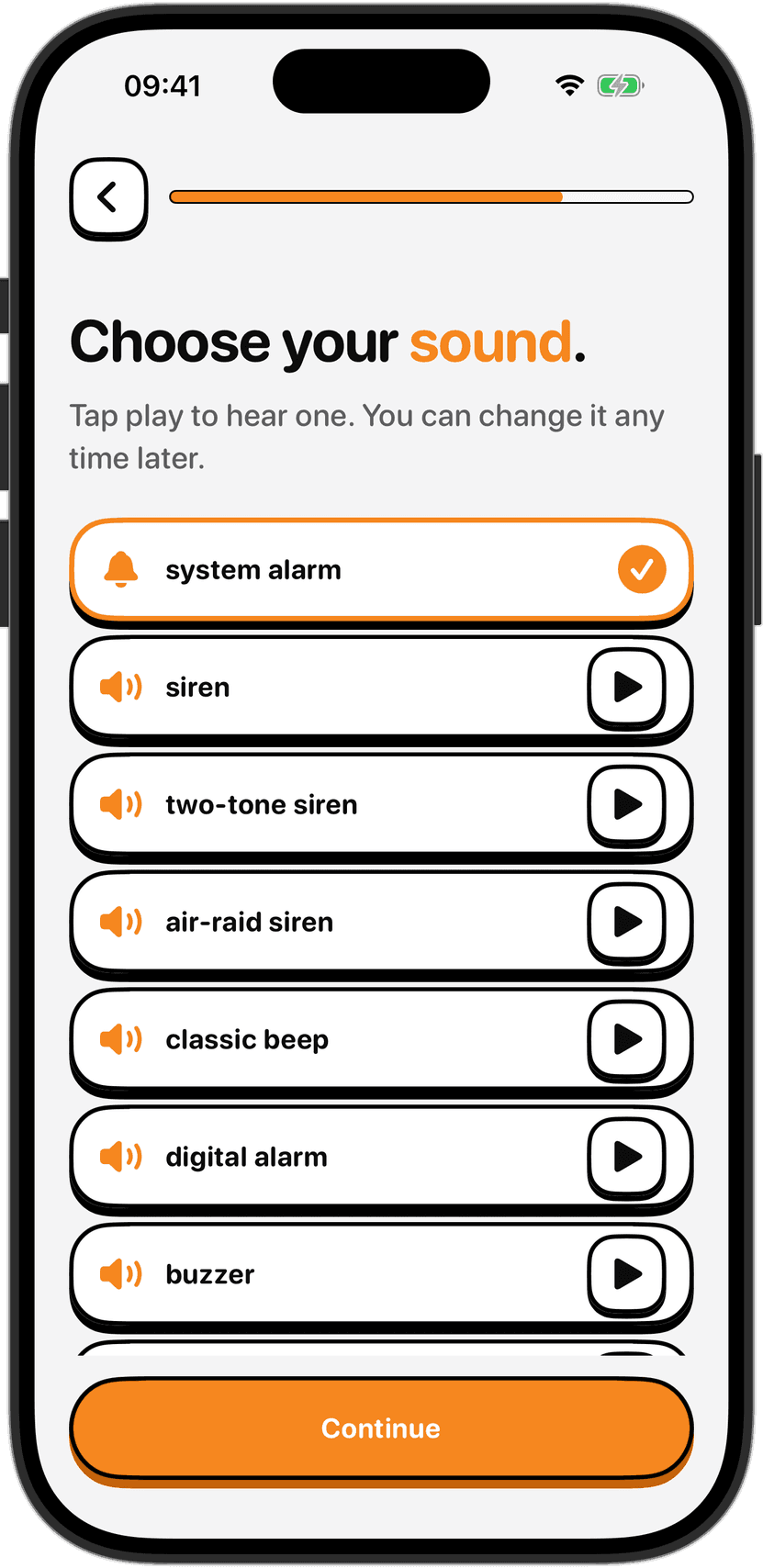
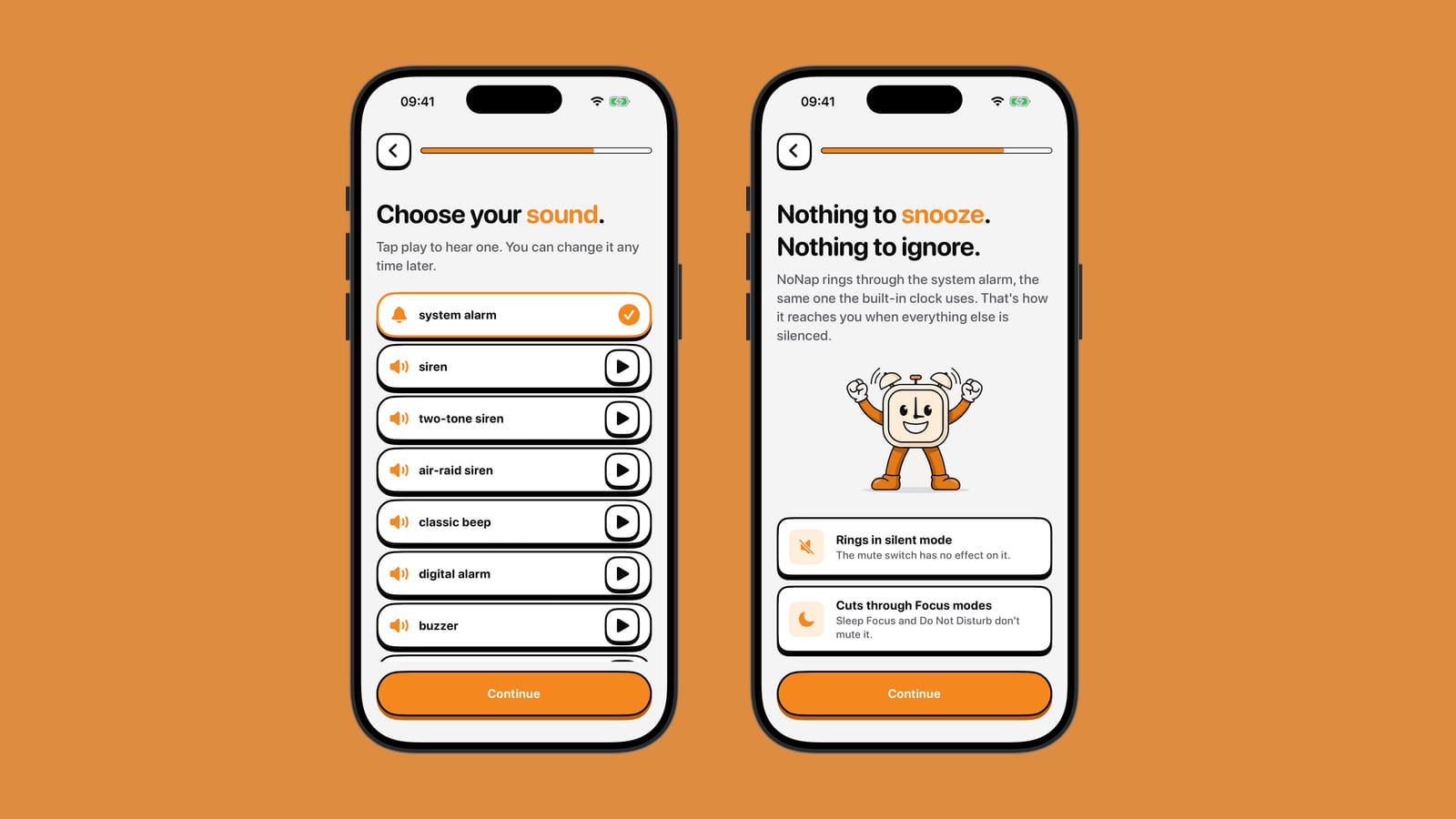
NoNap uses the system alarm, the same one the built-in clock app uses. The ringer switch does not touch it, and Sleep Focus and Do Not Disturb do not silence it. The sound list starts with the system alarm and includes sirens, a classic beep, a digital alarm and a buzzer. That settles whether a sound can reach you. Whether it wakes you depends on how deep you are sleeping and on the wake task you chose. The FAQ answers the common questions about silent mode and the lock screen.
Sources
Ameen MS, Heib DPJ, Blume C, Schabus M. The Brain Selectively Tunes to Unfamiliar Voices during Sleep. The Journal of Neuroscience. 2022;42(9):1791–1803. https://doi.org/10.1523/JNEUROSCI.2524-20.2021 The full text on PubMed Central is at https://pmc.ncbi.nlm.nih.gov/articles/PMC8896625/. This paper is the source for the study design, the results and the caveats, and for the background on sleep spindles and K-complexes.
Image credits: the cover uses two NoNap app screenshots, both our own. The diagram was made for this post from the values reported in the study.