Does sleep position matter? What the studies show
Back sleeping was linked to more wake-ups in a 2024 lab study and to snoring in reviews. What the evidence shows, where it stops, and when to see a doctor.
Visana Studios
4 min read
Lying on your back is linked to snoring in several studies. A 2024 lab study suggests it may also break up sleep in healthy adults, though the group was small and the findings come with caveats.
What the overnight recordings showed
Lionel Rayward and colleagues recorded 41 adults aged 54 to 75 on two at-home polysomnography nights, about two weeks apart. None had a diagnosed sleep disorder, and none had a recent spinal problem. Everyone slept on the same firm foam mattress, which keeps the mattress from being a variable.
On average, the group spent about 34 percent of their sleep on their backs, 62 percent on their sides and 4 percent face down. Back sleeping was the position with more disruption. The wake index, which counts wake periods per hour, averaged 4.8 on the back and 2.3 on the side. The arousal index, which counts arousals from sleep per hour, was 20.0 on the back against 9.7 on the side.
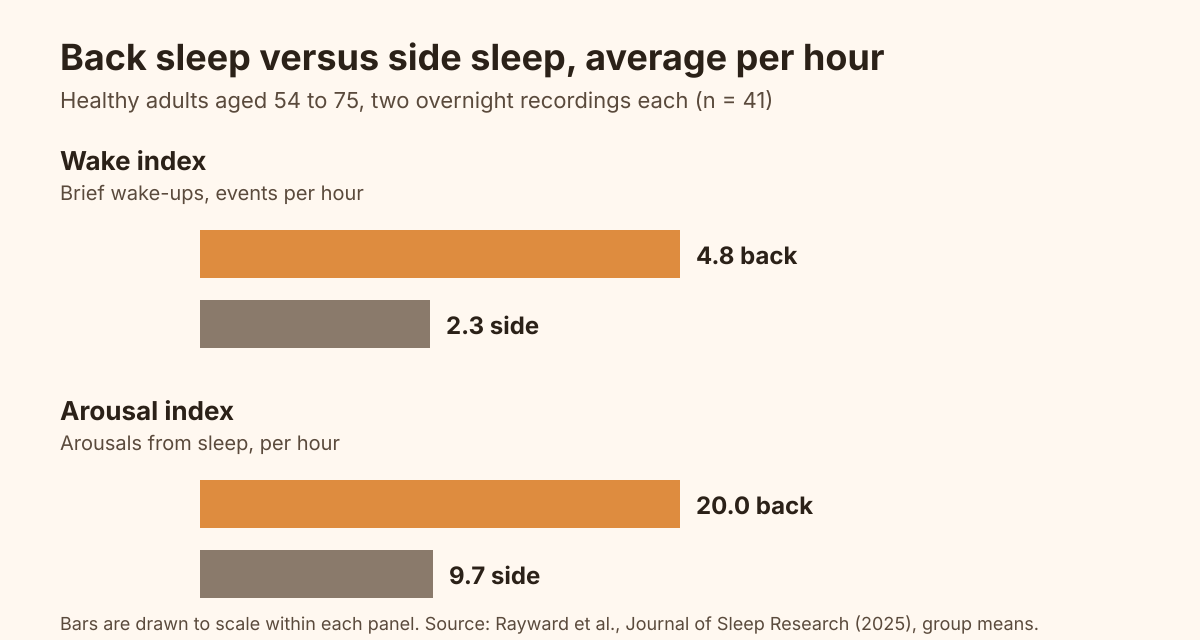
Relative increases like these sound dramatic. The absolute numbers are smaller than they look, and the spread between people was wide. The authors said the variation was large enough to argue against blanket advice that everyone should sleep on their side.
The study also found a pattern that suggests a feedback loop. People who woke more often on their backs spent a larger share of the night on their sides. That fits a simple story: some people lie on their side because the back position disturbs them. The data show an association, though, not proof of cause and effect.
The study has obvious limits. It used one mattress, the sensors and wires may have made people sleep differently than usual, and forty-one participants is a small sample. Two of the case reports were qualitative and involved only two people.
Snoring and sleep apnea
Most of the research on position concerns snoring and obstructive sleep apnea. Antonio Moffa and colleagues published a systematic review in 2024 covering nine studies and 235 patients. Their question was whether changing a person's position could reduce snoring.
The answer was: sometimes, and the evidence is mixed. Several studies found that a position change lowered the apnea-hypopnea index, which counts breathing pauses and shallow breaths per hour. One study of 15 people with position-dependent apnea who also snored reported a 45 percent drop when a device discouraged back sleeping. Another reported that supine time fell and the apnea index dropped with a pillow designed to keep people off their backs.
The review was careful about what it could not say. There was no pooled analysis, because the studies used different designs and follow-up periods, which ranged from a single night to six months. Some studies found no significant change in snoring. The authors also noted inconsistencies in how some results were reported between the text and the tables. In one cited study, 65.8 percent of non-apneic snorers were supine-dependent, meaning their snoring was tied to back sleeping. That is a useful pattern, but it does not establish a treatment.
Position-dependent sleep apnea is a real pattern. Some people's breathing events cluster when they lie on their backs and become much less frequent when they do not. Telling whether events follow position takes a sleep study that records position, and a guess at home cannot replace that.
When to see a doctor
The NHS advises seeing a GP if you have any of the main symptoms of sleep apnea. These include pauses in breathing during sleep, gasping, snorting or choking sounds at night, and feeling tired during the day all the time. If someone has watched you sleep, ask them to come to the appointment and describe what they saw.
The NHS also says that if sleep apnea with excessive sleepiness is confirmed, you should not drive until your tiredness is under control, and it points to the GOV.UK driving rules for detail. Sleepiness that makes a morning dangerous is worth taking seriously, whatever position you sleep in.
If you want to test side sleeping yourself, change one thing at a time and give it a few weeks. Pay attention to whether you wake less, whether a partner notices less snoring, and whether you feel more rested. Keep the notes, because a clear record is far more useful to a doctor than a memory of a bad week.
NoNap does not track sleep, so it cannot tell you what position you were in or how often you woke. The alarm only handles the moment you need to get up. For anything about what happens between bedtime and the alarm, a written log and a conversation with a doctor will do more than any app.
Sources
Rayward, L., Ho, S. W. K., Green, D. and Little, J. P. (2025). Sleep disruption and sleep position: Increased wake frequency in supine predicts lateral position preference. Journal of Sleep Research, 34(1), e14325. Published online 2024. https://doi.org/10.1111/jsr.14325. Source of the 41-person sample, the average time spent in each position, the wake and arousal indices, and the limitations the authors stated.
Moffa, A., Giorgi, L., Nardelli, D., Iafrati, F., Iannella, G., Magliulo, G., Baptista, P., Vicini, C. and Casale, M. (2024). The Potential Effect of Changing Patient Position on Snoring: A Systematic Review. Journal of Personalized Medicine, 14(7), 715. https://doi.org/10.3390/jpm14070715. Source of the nine studies and 235 patients, the apnea-index reductions reported by individual studies, the 65.8 percent figure, and the review's limitations.
NHS. Sleep apnoea. https://www.nhs.uk/conditions/sleep-apnoea/. Source of the symptoms that should prompt a GP visit and the advice on driving with confirmed sleep apnea and excessive sleepiness.
Image credits
The cover and the chart were made for this post. The chart plots the group means reported in Rayward et al. (2025).